
Strengthening the capacity of the waste sectors in Bhutan, Mongolia and Nepal by means of a circular economy concept aimed at reducing greenhouse gases (GHGs) and short-lived climate pollutants (SLCPs)
Bhutan, Mongolia and Nepal have great potential regarding the reduction of greenhouse gases and short-lived climate change pollutants (SLCPs) emissions generated by the waste sector. The project supported the partner countries at national and local levels by creating political, financial and technical framework conditions for the establishment of environmentally sound technologies. In this way, it contributed to technical and institutional capacity building, and to the implementation of national mitigation targets. For example, the project identified technologies to reduce greenhouse gas emissions and short-lived climate pollutants in the waste sector and prepared project proposals for the development of these technologies. This knowledge was also used to adapt the legal basis. Project reports, experiences and case studies from the project were published, creating incentives for the dissemination of the tested & tried approaches and measures.
- Countries
- Bhutan, Mongolia, Nepal
- IKI funding
- 1,651,770.62 €
- Duration
- 06/2017 till 12/2022
- Status
- completed
- Implementing organisation
- United Nations Environment Programme (UN Environment) - International Environmental Technology Centre (IETC)
- Political Partner
-
- Ministry of Environment - Nepal
- Ministry of Environment and Tourism – Mongolia
- National Environment Commission - Bhutan
- Implementing Partner
-
- Leadership for Environment & Development Nepal (LEAD) - Nepal
- The Asia Foundation – Mongolia
- World Wide Fund for Nature (WWF) - Bhutan
State of implementation/results
- Global:
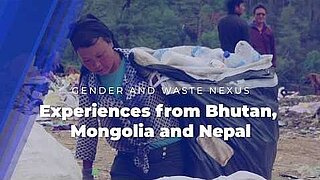
- The project published a series of five videos on the Gender and Waste Nexus launched on the 2020 International women’s day. These are based on gender mainstreaming workshops and interviews with women and men from Mongolia, Bhutan, and Nepal, and involve a wide range of stakeholders.
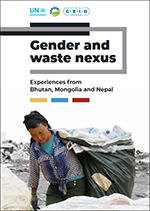
- The project launched the report titled Gender and Waste Nexus at the International Solid Waste Association (ISWA) Global congress in October 2019. The report is one of the first of its kind to analyse the relationship between gender and waste through detailed country analyses (www.unep.org/…).
- Bhutan:
- The project successfully conducted the training on green financing and waste management virtually for private sectors and key agencies. The virtual training also included the local media who were exposed to the concepts of waste, waste management as well as to the project and national waste flagship program.
- The project facilitated the development of a pilot project, which explores establishing end-to-end solutions for sustainable waste management and intends to provide an innovative partnership along the supply chain of organic waste to compost plants to market.
- The project is developing together with National Statistics Bureau (NSB) a detailed waste quantification study. A survey was conducted from November to December of 2019 and the results published in 2020.
- The project team in cooperation with Thimphu city has developed the District Waste Management Plan including an awareness and communication plan.
- Mongolia:
- The project developed in consultation with the Ministry of Environment and Tourism within a pilot project the design and blueprint of local prototypes of Environmental and Sound Technologies for small to medium scale food waste recycling. The blueprints are expected to be available to public by December 2022.
- Conference on composting has been co-organized with Mayor’s Office and ADB’s Community Food Waste Management and Recycling project in Ulaanbaatar. Recommendations to revise and improve national standards and requirements for composting from food waste were discussed and documented. The conference summary has been developed in Mongolian and disseminated to public.
- Nepal:
- A comprehensive analysis report using the Solid Waste Emissions Estimation Tool (SWEET) was completed for five municipalities. The data contributed to the formulation of a 15-year national and city-level implementation plan and allows estimating the greenhouse gas and short-lived climate pollutants (SLCP) reduction with improved waste management practices.
- The project supported the Government of Nepal to develop National Integrated Waste Management Strategy and Action Plan and Birendranagar Municipality to develop a strategy and action plan on integrated waste management and to implement a demonstration project.
Latest Update:
10/2026
Further links
- Brochure "Waste and Climate Change Project"
- Factsheet "Global Recycling Day"
- As an extract from the “Gender and Waste Nexus Report” you can read some Women voices from Bhutan
- Photo gallery: Gender and waste management in Thimphu, Bhutan
- Photo gallery: Gender and waste management in Ulaanbaatar, Mongolia
- Photo gallery: Gender and waste management in Kathmandu, Nepal
Project relations
Legend:
The link has been copied to the clipboard
![[Translate to English:] Cover: Ulaanbaatar Household waste composition study report](/legacy/_processed_/7/d/csm_200220_Ulaanbaatar_household_waste_6912160c99.jpg)