

IKI funding area: preserving and restoring natural carbon sinks
Combatting the causes of global warming and the destruction of natural ecosystems (as of April 2024)

Natural carbon sinks are ecosystems that store large quantities of carbon and therefore offer enormous potential for climate change mitigation. These include forests, savannahs and steppes, but also soils and peatlands as well as natural green spaces in cities and in the countryside.
As a result of unsustainable agriculture, animal husbandry and forestry, land-use changes, deforestation, the drainage of peatlands and the overuse of ecosystems, this stored carbon is released into the atmosphere as CO2, where it contributes to global climate change.
The REDD+ approach for forest conservation
According to figures from the UN’s Intergovernmental Panel on Climate Change (IPCC), greenhouse gas emissions from agriculture, forestry and land uses are responsible for as much as 22 percent of total anthropogenic emissions worldwide. Roughly half of these emissions arise from land use, land use change and forestry – especially as a result of deforestation.
The international community has therefore developed an approach known as ‘REDD+’, which offers financial incentives to preserve forests in developing and emerging countries. This approach aims to reduce emissions from deforestation and the degradation of forests over the long term.
The UN Decade on Ecosystem Restoration
The United Nations emphasises the importance of restoring degraded forests and other landscapes as making a key contribution to climate change mitigation and biodiversity conservation, and has officially designated the period 2021 to 2030 as the ‘UN Decade on Ecosystem Restoration’. The objective is to contribute to furthering the goals of the three UN conventions on climate change, biodiversity and desertification, as well as the Sustainable Development Goals (SDGs).
Sustainable use of ecosystems
Sustainable development also includes the moderate usage of ecosystems that make significant contributions to the livelihoods of local population groups. A secure source of income coupled with protection for ecosystems is also playing an increasingly important role for the long-term preservation of these ecosystems.
Priority fields of action for the IKI
In particular, the International Climate Initiative (IKI) aims to contribute to the implementation of the nationally determined contributions (NDCs) of partner countries. One central aim of this project work is to utilise synergies between the protection of ecosystems and biodiversity conservation, and between climate change mitigation and adaptation to the impacts of climate change.
The 2030 International Climate Initiative Strategy defines four priority fields of action for activities in the funding area of natural carbon sinks:
1. Strengthening nature-based climate action
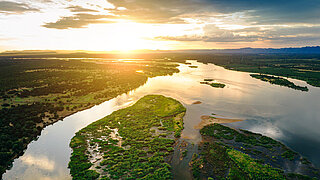
The stronger integration of adaptation and biodiversity conservation in IKI projects aims to retain ecosystem services that improve the resilience of ecosystems and the performance of carbon sinks.
2. Ending deforestation and land use changes
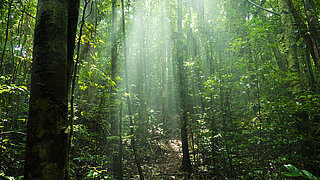
In this priority field of action, the IKI funds the implementation of REDD+ measures, for example, as well as the establishment of deforestation-free supply chains, improvements to forest monitoring, and social and ecological safeguards.
[Read more about the REDD+ framework...]
[Read more about emission mitigation and carbon storage ...]
3. Forest landscape restoration
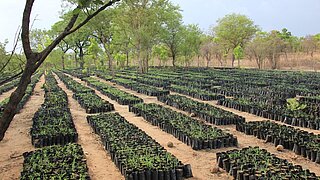
The IKI supports initiatives such as the Bonn Challenge and the UN Decade on Ecosystem Restoration. The Bonn Challenge pursues a landscape approach that combines climate change mitigation with biodiversity conservation, helps to ensure sustainable development and reports on progress made in the restoration of forests. The UN Decade uses the hashtag #GenerationRestoration to indicate attempts to reverse the trend of destroying nature.
4. Protecting peatlands

The IKI supports the conservation and restoration of peatlands and the greater consideration of these ecosystems within infrastructure projects and planning work for developing rural landscapes.
At a glance
From 2008 to the end of 2023, a total of over 152 projects with a total funding volume of 710.3 million euros were approved in this funding area.
Selected projects
- Strengthening coastal biodiversity conservation and management through protection and rehabilitation incentives for coastal carbon sinks in Pacific Island countries
- The Global Peatlands Initiative: Assessing, Measuring and Preserving Peat Carbon
- The Paris Agreement in action: upscaling forest and landscape restoration to achieve nationally determined contributions
- Taking Deforestation out of Banks Portfolios in Emerging Markets
Further information
About the IKI
Cross-cutting topics of the IKI
Supporting international negotiation processes
Funding the socio-ecological transformation

Developing sustainable urban and peri-urban areas

Publications
-
 11/ 2023 | IKI values
Germany's International Climate Initiative: Strategy 2023 to 2030
English (PDF, 675 KB)
-


![[Translate to English:] Sechs Beteilgte des Projektes RECAP4NDC stehen am Rande eines Feldes in Alwar, Rajasthan, und lassen sich von Landwirten die Landnutzung beschreiben.](/fileadmin/_processed_/7/7/csm_20260526_22_III_123_RECAP4NDC_15a550bf5f.jpeg)

The link has been copied to the clipboard