
Indo-German Support project for Climate Action in India
The Indian government is targeting an unconditional reduction in the emissions intensity of its GDP by 45 per cent by 2030 compared to 2005 levels, according to its updated Nationally Determined Contribution (NDC). The project supports the Ministry of Environment, Forest and Climate Change (MoEFCC) with the coordination and implementation of Indian climate and biodiversity policies. The project aims to strengthen capacities of selected decision makers at the national and state level to develop innovative approaches for implementation of India’s NDCs and climate policy. The project develops models for public-private sector collaboration implementing demonstration projects in selected states to establish a climate co-benefit roadmap. Aligned to priorities of the MoEFCC, project activities focus on two selected areas: circular economy and biodiversity. The project implements the interface function for IKI projects in India to foster synergies.
- Countries
- India
- IKI funding
- 10,000,000.00 €
- Duration
- 04/2021 till 09/2026
- Status
- completed
- Implementing organisation
- Deutsche Gesellschaft für Internationale Zusammenarbeit (GIZ) GmbH
- Political Partner
-
- Ministry of Environment, Forest and Climate Change (MoEFCC) - India
- Implementing Partner
-
- The Energy and Resources Institute (TERI) - India
State of implementation/results
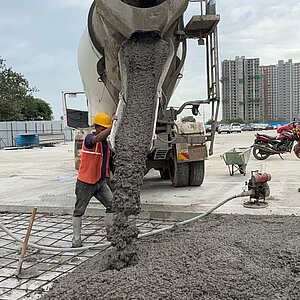
- Commercialising Low-Carbon Cement (LC3): In collaboration with IIT Delhi, the project achieved a major milestone by successfully commercialising Limestone-Calcined-Clay-Cement (LC3) in India for the first time, laying the groundwork for industry-wide decarbonisation. This was achieved by supporting technical engagements with regulators such as pollution control board, cement production company JK cement, building and construction company Lodha group.
- Decarbonising the Steel Sector: Completed a comprehensive techno-commercial feasibility study of low carbon technologies in one of the oldest and largest publicly owned steel production unit of Steel Authority of India Limited (SAIL) supported by the project identified technically feasible and investable low carbon solutions for steel production.
- Mainstreaming Climate Co-benefits in Government Policy: A tool to quantify climate Co-benefits of forestry and single use plastics policies are in place. The governments of Maharashtra and Tamil Nadu adopted these tools, with Maharashtra government integrating these into its State Climate Action Cell’s (SCAC) web-based tool. The Co-benefits of Wetlands (CoWET) digital tool developed by the project and launched at Ramsar COP15, assesses disaster risk reduction co-benefits. The tool is hosted on the Wetlands of India Portal and can be downloaded as an application on Microsoft Store & App Store.
- Advancing Peatland and Climate Intelligence: India’s first peatland inventory and assessment to map carbon storage potential and identify priority restoration sites is completed. The report can be found at Peatlands of India - An Overview and Future Roadmap.
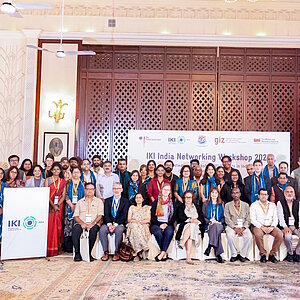
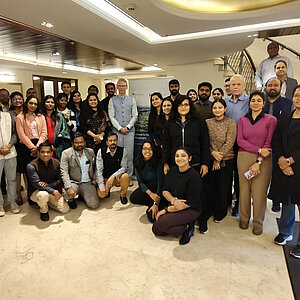
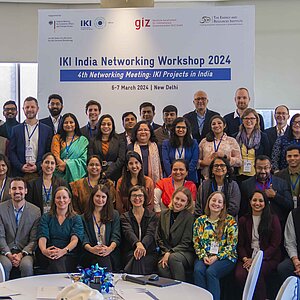
- Strengthening Indo-German Climate & Biodiversity Co-operation: The project facilitated 43 dialogues between Indian and German political partners, IKI India community and youth deepening co-operation on climate and biodiversity. Additionally, 31 knowledge products, developed by the project supported bilateral policy alignment. Thematic sub-platforms created by the project fostered collaboration, new synergies and stronger community engagement on climate and biodiversity.
- Empowering Public Sector Enterprises (PSEs) for Industry Transition: PSE participation in the Leadership Group for Industry Transition (LeadIT), of which Germany is a member country, is promoted through conducting regional knowledge exchange workshops in partnership with Standing Conference of Public Enterprises (SCOPE). LEADIT members and project collaborators - JK Cement and SAIL- also contributed to these workshops.
- Capacity Building on Climate Action: The project developed an online certificate training for enhancing PSEs capacity on climate policy and climate finance. A total of 192 officials from PSEs successfully completed the training. A study tour of 8 Indian PSEs and 2 premier climate think tanks to Germany was conducted to facilitate exchange with German think tanks, industries and policy makers.
Latest Update:
10/2026
Further links
Project relations
Legend:
The link has been copied to the clipboard