
Cementing the Future: Scaling Low-Carbon Cement in India
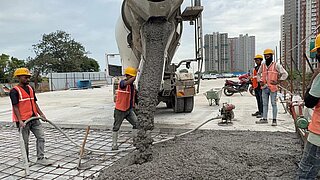
How the IKI powered the commercialisation and research of low-carbon LC3 cement.
Cement is a crucial material in India’s growth story, but it also contributes an estimated five to seven per cent of India’s CO₂ emissions. Cement is one of the most carbon-intensive commodities, driven largely by energy-intensive kilns and the production of clinker, which is used as a binder in cement. As the world’s second-largest cement producer, India’s transition to low-carbon alternatives therefore is vital to achieving national climate and sustainability goals.
Limestone Calcined Clay Cement (LC3) is an innovative, climate-friendly cement blend made from limestone, calcined clay, clinker, and gypsum. Its key innovation lies in replacing much of clinker with low-grade calcined clay and limestone. LC3 typically uses about 50 per cent clinker, compared to around 90–95 per cent in Ordinary Portland Cement (OPC). This lower clinker content cuts emissions by up to 40 per cent.
A compelling choice
Beyond its significant carbon-cutting potential, LC3 offers several structural and economic advantages that make it a compelling choice for the construction industry. It is found to create a denser microstructure, which leads to improved mechanical strength and enhanced long-term durability. This makes the material especially resilient in high moisture conditions, such as coastal areas.
From a production and policy perspective, LC3 is an open technology, meaning it is free to use without licensing hurdles. Although its implementation requires some initial capital expenditure, it can ultimately be cheaper to produce than traditional cement blends, if produced at scale. Furthermore, its scientific credibility is well-established, as it sees growing uptake across Africa, Europe and North America.

LC3 is an innovation which has been under R&D for over 14 years in India primarily at the Indian Institute of Technology, Delhi (IIT Delhi). LC3 research has been supported by the Swiss Agency for Development and Co-operation in co-operation with EPFL, CIDEM, IIT Madras, IIT Delhi, TARA; IIT Mumbai.
The low carbon cement received certification from Government of India’s central standardisation agency, Bureau of Indian Standards (BIS) for commercial production in 2024, becoming the fourth officially recognised cement type in India and paved the way for reduced reliance on OPC, which still holds 27 per cent of the Indian market. However, the industry was initially hesitant to adopt it due to limited awareness and familiarity with the technology. Through its interface project, the International Climate Initiative (IKI) took this as its starting point to harness commercialisation.
The role of the IKI
Working in close cooperation with IIT Delhi, the IKI funded ‘Indo-German Support project for Climate Action in India’ addressed key institutional and demand-side bottlenecks:
- Regulatory facilitation: The Interface Project in India supported technical engagement with regulators, most notably the Rajasthan State Pollution Control Board. Through extensive consultations and technical briefings, they built the necessary understanding to facilitate approvals required for JK Cement to become the first commercial producer in the Indian subcontinent.
- Building user confidence: To stimulate demand, the Interface Project bridged the gap between production and application. Through technical support facilitated by IIT Delhi, engineering teams at the LODHA Group were trained in the practical deployment of LC3 for their Palava City project. This proof-of-concept served as a vital market catalyst, demonstrating the viability of LC3 in real-world infrastructure.
- Advancing research and decarbonisation: Beyond commercialisation, the Interface Project has focused on long-term scalability and environmental impact. This includes durability testing in extreme conditions—such as highly acidic sewer environments—to expand the material's utility. Furthermore, the project is backing efforts to further reduce the carbon footprint of production, including collaborative research with German institutions to pilot solar concentrator technology that aims to replace fossil-fuel-based heating in clay calcination with solar energy.
- Policy and standards: The Interface Project provides the scientific bedrock for future industry evolution by supporting the development of rigorous life-cycle assessment methodologies and green rating frameworks for cement, ensuring that the next generation of building standards is evidence-based.
The collaboration with the IKI has been a very fruitful one. Throughout this project, the expertise and connections of the IKI project enabled an on-field translation of the research work and accelerated the demonstration of the developed technologies in real-life scenarios. I am sure that the work carried out in this collaboration will be crucial for the acceptance of LC3 as a sustainable alternative to traditional cements.
Market success
A major milestone was reached in the monsoon of 2025, with the first commercial production of LC3 not just in India but across the Indian subcontinent. This was led by JK Cement Ltd. at its plant in Rajasthan. In late 2025, the first batch of LC3 saw its first buyer in the LODHA Group, one of India’s leading real estate developers, who used the cement to build a road in a large-scale residential project in Mumbai. Around that time, the Noida International Airport became the first large-scale infrastructure project in India to adopt this building material.

At LODHA, we are committed to advancing sustainable construction by embracing innovative technologies early. In partnership with IIT Delhi and the IKI project, we became the first real estate company in India to deploy LC3 in construction, showing how shared innovation can support a more sustainable future.
As soon as the information of this successful commercial pilot was brought in public domain the market responded positively. In early 2026, another major cement producer, JK Lakshmi joined the bandwagon. As of today, two commercial cement producers in India supply LC3. By January, approximately 2,000 metric tonnes of LC3 was commercially produced and sold in the Indian market resulting in mitigation of about 500 tonnes of CO₂ eq.
With its proven climate benefits and now a successful commercial launch, LC3 is poised to reshape India’s cement sector. The next phase involves scaling up production, building awareness, and promoting adoption among industry stakeholders, consumers, policymakers, and regulators. With continued collaboration, LC3 has the potential to make an important contribution to the future of green, low-carbon construction in India.
Author: Vaibhav Rathi is Senior Technical Advisor at GIZ, working on climate change and circular economy.
The link has been copied to the clipboard
Contact
IKI Office
Zukunft – Umwelt – Gesellschaft (ZUG) gGmbH
Stresemannstraße 69-71
10963 Berlin