
H2-diplo - Decarbonization Diplomacy
To limit global warming to 1.5°C, greenhouse gas emissions must be significantly reduced. This inevitably requires a shift away from fossil fuels, such as oil, natural gas or coal. Green hydrogen produced from renewable energies plays a key role to decarbonize hard-to-abate sectors, such as the chemical or metal industry. The project advises partner countries on the use of green hydrogen to decarbonise and diversify their economies. Advisory services and dialogue formats carried out by H2-diplo offices in Angola, Kazakhstan, Kenya, Colombia, Nigeria, Saudi-Arabia and the Ukraine, support the development of climate-neutral value chains. In addition, H2-diplo addresses geopolitical questions of the international market ramp-up of green hydrogen, such as shifting power relations on the way to a climate-neutral global economy.
- Countries
- Angola, Colombia, Kazakhstan, Kenya, Nigeria, Saudi Arabia, Ukraine
- IKI funding
- 15,000,000.00 €
- Duration
- 11/2023 till 10/2026
- Status
- open
- Implementing organisation
- Deutsche Gesellschaft für Internationale Zusammenarbeit (GIZ) GmbH
- Political Partner
-
- Ministry of Foreign Affairs of Ukraine
- Online
State of implementation/results
- Global component
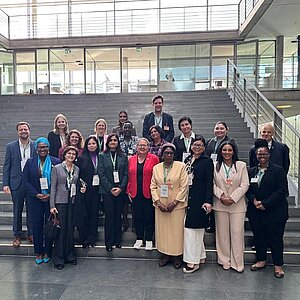
- Further sharpening of the thematic focus on the geopolitics of the energy transition, including through the annual hosting of the Future Forum Green Hydrogen at the Federal Foreign Office (March 2026) and the hosting of the Decarbonisation Dialogue in Madrid on the theme “Geopolitics meets Green Transition” (November 2025). Further dialogues in cooperation with diplomatic missions in Portugal (March 2026) and Turkey are currently being prepared: organisation of a high-level study tour (“Female Leaders of Energy Transition”, 09/2025) for female executives from the energy and climate sectors from nine partner countries to Berlin and Bonn, with meetings at the Bundestag, the Federal Foreign Office and the UN Climate Secretariat, amongst others.
- Advising the partner government on the development of national and sectoral decarbonisation strategies; Facilitation of an inter-ministerial H2 Council; organisation of the German-Angolan Hydrogen Symposia; cooperation agreement with the Ministry of the Environment on enhanced collaboration on climate issues and UNFCCC COP-related processes.
- Support for the Ministry of Energy in the development and implementation of the revised national H2 strategy through coordination and advisory services. Focus, among other things, on local use cases for green H2 (e.g. in refineries).
- Regional focus: Substantive and coordinating support for the Tajik Ministry of Energy in developing an H2 programme as the initial foundation for the country’s national H2 economy. H2-diplomacy orientation of the regional Decarbonisation Diplomacy Forum with representatives from Europe, Central Asia and the South Caucasus.
- Advice on the implementation of the Kenyan H2 strategy, e.g. through events on local use cases or private sector engagement; or through study tours and delegation participation (Africa Climate Summit 9/25; Global African Hydrogen Summit 9/25).
- Institutional support for the Kenyan Hydrogen Secretariat and advice to the Kenyan Ministry of Investment, Trade and Industry (MITI) on green H2 for Kenya’s industrialisation (from 9/2025).
- Implementation of regional activities through a grant agreement with the East African Centre of Excellence for Renewable Energy and Efficiency (EACREEE), including a comprehensive regional H2/PtX study.
- Organisation of events and seminars on capacity building, including: Online training on green hydrogen value chains in collaboration with the triangular cooperation on green hydrogen and geothermal energy (Colombia, Honduras and El Salvador).
- Capacity building in the field of environmentally friendly fertilisers for universities, the public sector and associations.
- Coordination of working groups on fertilisers with representatives from the public and private sectors to identify and remove barriers identified in the relevant study.
- Study on regulatory proposals currently being finalised; organisation of consultation workshops with relevant stakeholders (10 + 11/2025).
- Organisation of the first strategic dialogue on the decarbonisation of the maritime sector towards a green shipping corridor between Colombia, Panama and the EU (October 2025, Panama City).
- An inter-ministerial working group on the reduction of gas flaring was established under the coordination of H2-diplo. H2-diplo discussion paper analyses gaps in the implementation of existing laws banning flare gas and provides recommendations for action.
- The interministerial working group, established with H2-diplo’s support, presented the first national H2 strategy on 26–27 November 2025 in Abuja during the H2 symposium.
- Through a funding agreement with the local NGO “Girls and Women Technological Empowerment Organisation”, training for young girls in STEM and a ToT on H2 and PtX were carried out during the reporting period.
- Strengthening bilateral cooperation through the organisation and technical support of high-level events, including an H2-Global event at Oman Sustainability Week.
- Advising the Ministry of Energy and Minerals on strategic issues relating to the energy transition, including expert input on the design of the German electricity market.
- Providing expert input to the Technical Committee of key national energy transition forums (e.g. IEEE Energy Transition Conference; Green Hydrogen Summit Oman).
- Supporting high-level international delegations with German participation, e.g. led by Baden-Württemberg’s Environment Minister Thekla Walker (04/2025), with the aim of exploring areas of cooperation in the field of green hydrogen and sustainable logistics.
- Increased focus on expanding climate policy cooperation with partners, including through analyses and dialogues on UNFCCC and energy transition topics, e.g. the preparation of a study on the skills gap in the renewable energy sector (“Powering the Transition”) and a launch event attended by the German Ambassador (07/2025) and a webinar on the state of climate change mitigation following COP30 (12/2025).
- Support for partners in addressing strategic questions regarding the development of a national H2 economy. Future focus on technical support for analysing export potential and decarbonised value chains. Support for knowledge transfer and national exchange through dialogue formats (in cooperation with AHK) on the general potential of green hydrogen-based value chains.
- Technical support, e.g. through a study on the potential of green value chains in cooperation with the IKI project “Promoting Green Deal Readiness in the European Partnership Countries”.
- Promotion of an inclusive H2 discourse in Ukraine through cooperation and training programmes with and for women’s networks in the energy sector.
Latest Update:
10/2026
Project relations
Legend:
The link has been copied to the clipboard