
Operationalizing the NBSAP Accelerator Partnership
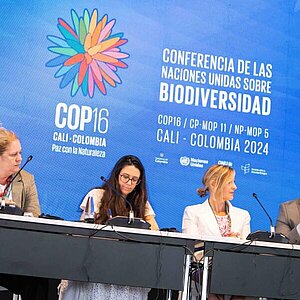
The project supports the design of the NBSAP Accelerator Partnership, which works to achieve the targets of the Kunming-Montreal Global Biodiversity Framework of the Convention on Biological Diversity. It provides technical, financial and policy support to member countries to accelerate and scale up the implementation of their National Biodiversity Strategies and Biodiversity Action Plans (NBSAPs). In doing so, the project always promotes whole-of-government and whole-of-society approaches in close coordination with the many other ongoing and emerging initiatives in this field. This includes matchmaking between the need and supply of funding for biodiversity conservation measures, as well as providing direct technical and financial support on the ground.
- Countries
- Armenia, Bolivia, Colombia, The Democratic Republic of Congo, Ecuador, Georgia, Kazakhstan, Kenya, Liberia, Madagascar, Mexico, Mozambique, Nigeria, Pakistan, Panama, Peru, Philippines, Sierra Leone, Somalia, South Africa, Sri Lanka, Uganda, Vanuatu
- IKI funding
- 30,000,000.00 €
- Duration
- 01/2023 till 12/2026
- Status
- open
- Implementing organisation
- United Nations Environment Programme (UN Environment)
- Political Partner
-
- Department of Environment and Natural Resources (DENR) - Philippines
- Department of Forestry, Fisheries and the Environment (DFFE) - South Africa
- Environment Protection Authority (EPA) - Liberia
- Federal Ministry of Environment - Nigeria
- Ministry of Climate Change - Pakistan
- Ministry of Development Planning - Bolivia
- Ministry of Ecology and natural resources of the Republic of Kazakhstan
- Ministry of Environment, Climate Change and Forestry (MECCF) - Kenya
- Ministry of Environment, Water and Ecological Transition (MAATE) – Ecuador
- Ministry of Environment (MINAM) - Peru
- Ministry of Environment - Panama
- Ministry of Environment - Sri Lanka
- Ministry of Environment and Climate Change - Sierra Leone
- Ministry of Environment and Climate Change - Somalia
- Ministry of Environment and Natural Resources (SEMARNAT) - Mexico
- Ministry of Environment and Sustainable Development (MinAmbiente) - Colombia
- Ministry of Environment and Sustainable Development - Madagascar
- Ministry of Environment and Sustainable Development - DR Congo
- Ministry of Environment of the Republic of Armenia
- Ministry of Environmental Protection and Agriculture (MoEPA) - Georgia; Ministry of Land and Environment - Mozambique; Ministry of Lands and Natural Resources, Environment and Conservation - Vanuatu; National Environment Management Authority (NEMA) - Uganda
- Implementing Partner
-
- Secretariat of the Convention on Biological Diversity (SCBD) - Canada
- United Nations Development Programme (UNDP)
State of implementation/results
- Membership expanded to 105 (60 countries, 13 institutions, 32 non-state actors) supporting GBF implementation.
- The Global Coordination Unit (GCU) strengthened capacity with new secondees and continues coordinating partnerships (e.g. HAC, BIOFIN, NDC Partnership, GIZ, IUCN).
- The first cohort of 12 facilitators is operational across multiple countries and regions, supporting policy coordination, stakeholder engagement, and implementation. Countries are assessing capacity needs (e.g. Kazakhstan) and engaging stakeholders to advance whole-of-government approaches.
- The recruitment of the second cohort of facilitators is near completion, with 10 additional facilitators onboarded to support Armenia, Bolivia, Liberia, Madagascar, Mexico, Pakistan, Peru, South Africa, Uganda and the Central American regional organisation CCAD.
- The Matchmaking Mechanism (MMM) has become a key operational tool, with 80 requests from 33 countries since COP16 (74% supported at varying levels). In 2025, demand increased significantly by 41% compared to 2024, reflecting growing trust and use.
- Knowledge sharing expanded through case studies, webinars (e.g. ABS and GBF Target 13), and contributions to regional dialogues supporting peer learning on implementation, monitoring, and biodiversity–climate integration. A Knowledge Management and Learning Strategy and internal framework were also developed to strengthen coordination and learning.
Latest Update:
10/2026
Further links
Project relations
Legend:
The link has been copied to the clipboard