

Why gender equality makes sustainable agriculture more resilient
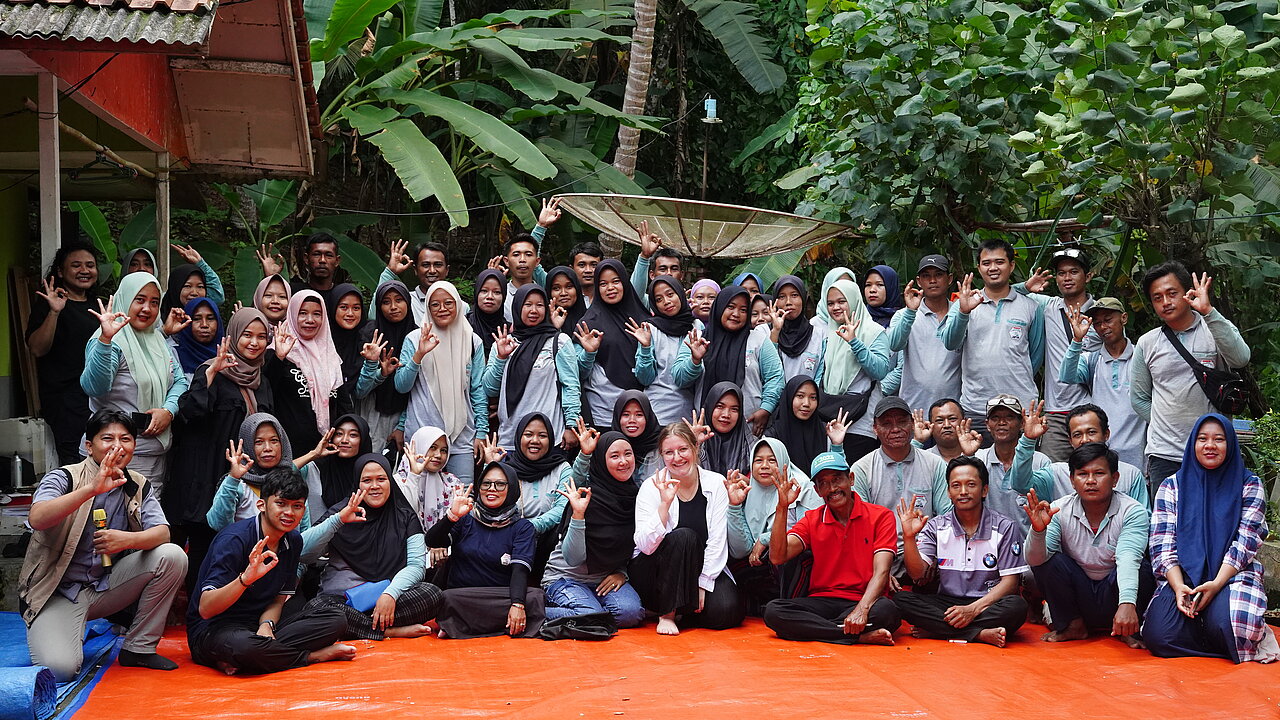
A master’s thesis has examined gender relations in agriculture within the context of an IKI Medium Grants project in Indonesia. Opportunities for women to participate in decision-making play a key role in this. The project is now benefiting from the recommendations for gender-equitable implementation that emerged from the research.
Sustainable agriculture aims to ensure food security, protect natural resources, and make rural communities more resilient to the impacts of climate change. Whether these goals are achieved, however, does not depend solely on cultivation methods or technical innovations. Equally crucial are who has access to knowledge and resources, who is involved in decision-making, and how paid and unpaid work are distributed.
This is where the master’s thesis by Cecilia Weissenhorn (Humboldt-Universität zu Berlin), supported by the Gender Team of the International Climate Initiative (IKI), came in. Using a gender analysis, Weissenhorn examined gender relations among the target groups of the IKI Medium Grants project "Rural Youth Climate Action Movement for Cool Farming in Indonesia (RYCAM)".
Master’s thesis analysing power dynamics between genders
Through the RYCAM project, Germany, via the IKI, supports young farmers in West and Central Java as well as in South Sulawesi. The Centre for Rural Development (SLE) at Humboldt University Berlin is implementing the project jointly with the Indonesian organisations Jaringan Masyarakat Tani Indonesia (Jamtani) and Motivator Pembangunan Masyarakat (MPM). Through further training, networking, and practical, sustainable innovations, the initiative aims to foster a youth movement for climate-resilient and low-emission agriculture.
As part of her master’s thesis, Weissenhorn, with the support of Jamtani, examined the gender and power relations in the day-to-day agricultural lives of the farmers participating in the project in West and Central Java. To do this, quantitative data were collected using the Project-level Women’s Empowerment in Agriculture Index (Pro-WEAI). In addition, she conducted informal interviews during her stay in Indonesia, focusing in particular on the organisation and distribution of agricultural activities as well as unpaid care work.
The analysis looked at access to resources, opportunities for decision-making and agency, social gender norms, and the division of tasks within households and farms. The aim was to make power dynamics between genders visible and to gain insights into existing challenges to gender equality.
Unequal workloads limit scope for action
The results show that gender power imbalances are not based solely on individual choices. Rather, social norms, institutional structures, religious beliefs, and economic conditions shape the relationship between men and women.
A key role is played by the social ideal of "Ibuism", which views women primarily as mothers and those chiefly responsible for the household and family. This role model also shapes societal expectations regarding the tasks women are supposed to take on. At the same time, women are increasingly expected to take up paid employment. These conflicting demands create a double burden for many women. As suitable support structures are often lacking, it is difficult to reconcile both responsibilities.
The study's findings reflect this reality. The women participating in the research spend roughly two and a half times as much time on unpaid care work as men. Meanwhile, for decades in Indonesia, only around half of all women have been in employment, compared to about 80 per cent of men holding paid jobs. The causes include a lack of childcare facilities, inflexible working conditions, and restricted opportunities for decision-making and agency. These conditions not only make it harder for women to take up paid work, but also hinder their participation in community decision-making processes.
At the same time, the study reveals that men are also under pressure due to societal expectations to act as the sole breadwinner for the family. This clearly demonstrates that traditional gender roles restrict the options available to everyone involved.
From participation to genuine co-determination
As the research further demonstrates, equality cannot be measured solely by how many women participate in project activities. What matters far more is whether they can actively contribute, influence decisions, and develop their own ideas. At the same time, men must also be included in discussions about care work, responsibility, and gender roles, and be given the opportunity to actively engage in them.
One of the thesis's recommendations is that RYCAM can support this development at the project level by scheduling meetings more flexibly, providing childcare options, and raising awareness among facilitators to ensure the inclusive participation of both women and men. Weissenhorn also recommends that new income-generating opportunities be developed jointly with women and tailored to their specific lived realities – for example, through the local processing and marketing of agricultural products. Furthermore, a central finding of the analysis is that unpaid care work must be more widely recognised and more fairly distributed.
Gender equality does not arise simply by giving women access to existing programmes. It arises when women and men jointly question social roles and distribute decision-making power, responsibility, and opportunities more fairly.
Gender equality is not an optional social add-on alongside climate and environmental protection. It is an essential prerequisite for sustainable agriculture to achieve its full impact and strengthen rural communities in the long term. To this end, it must be factored into climate and environmental protection projects right from the outset. After all, genuine resilience can only emerge when all those involved and affected can contribute and actively shape the associated developments.
The findings of the master’s thesis confirm the IKI’s approach of designing its funded projects to be gender-responsive or gender-transformative, thereby achieving better outcomes for climate change adaptation as well as climate and biodiversity protection.
Text: Cecilia Weissenhorn
The link has been copied to the clipboard
Contact
IKI Office
Zukunft – Umwelt – Gesellschaft (ZUG) gGmbH
Please submit written enquiries via the contact form.
About the IKI Medium Grants
With the IKI Medium Grants the German federal government supports projects for climate action and biodiversity conservation that particularly involve smaller civil society actors in developing and emerging countries. The IKI Medium Grants funding instruments is implemented by Zukunft – Umwelt – Gesellschaft (ZUG) gGmbH.
Together with the IKI Large Grants and IKI Small Grants, the IKI Medium Grants complete the competitive funding instrument form IKI Compete.
