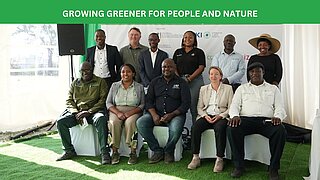

Growing greener: Restoration and sustainable use of agro-pastoralist systems in open arid landscapes across Southern Africa
The project locations are characterised by a vicious cycle of degrading resources driven by unsustainable agro-pastoral land uses to compensate for deteriorating incomes and livelihoods. The major transformation this project seeks to achieve is to catalyse nature-based land use and market supported systems that align socio-economic development with restoration of semi-arid landscapes and biodiversity thereby combatting desertification at community, national and regional level. It builds on proven good agro-pastoralist practices and traditional knoweldge systems to implement innovative, community-based conservation approaches that drive systemic behavioural change towards resilience and sustainable use of natural resources. Key to transformation is a phased rollout approach to embed learning and ensure effective scale up as it fosters cross-country learning.
- Countries
- Botswana, Madagascar, South Africa, Zambia
- IKI funding
- 20,000,000.00 €
- Duration
- 06/2022 till 09/2029
- Status
- open
- Implementing organisation
- Deutsche Gesellschaft für Internationale Zusammenarbeit (GIZ) GmbH
- Political Partner
-
- Department of Forestry, Fisheries and the Environment (DFFE) - South Africa
- Ministry of Green Economy and Environment - Zambia
- Ministry of Lands and Agriculture (MoLA) - Botswana
- Ministry of Livestock (MinEL) - Madagascar
- Southern African Development Community (SADC) - Botswana
- Implementing Partner
-
- Centre for Coordination of Agricultural Research and Development (CCARDESA)
- Conservation International (CI)
- Peace Parks Foundation
State of implementation/results
- To date, conservation agreements covering more than 570,000 ha of communal rangelands have been signed under the Herding for Health (H4H) model to support improved rangeland management. By the end of the project, nearly 1 million ha of communal land are expected to be managed under this approach.
- Since project start, more than 1,517 people (47% women) were trained in rangeland management and H4H.
- CCARDESA published over 10 news articles and 4 videos on project activities on its website and shared them via social media. The articles reached more than 1,500 readers, while 46 IKI Growing Greener Facebook posts generated 61,881 views, indicating strong regional visibility and stakeholder engagement.
- The project’s M&E data is published on the public project dashboard under the CCARDESA homepage: www.knowledgehub.ccardesa.org/…
- Madagascar:
- The project contributed to the development and validation of the Madagascar Livestock Master Plan which includes key actions for the improvement of pastures.
- South Africa:
- To date, 375 agropastoralists (33% women) from 13 villages have signed conservation agreements with Conservation International (CI) South Africa in Namakwaland.
- The project has begun deploying 43 GPS trackers on sheep and goats to monitor herd movement and grazing patterns over the next three years. The data will inform an adaptive management plan to support the resting and recovery of communal grazing lands.
- Through a partnership with Meat Naturally (Pty) Ltd, potential value chains were identified and its social enterprise model introduced to local farmer organisations to improve market access. One outcome is the use of low-quality wool as erosion-control material.
- Zambia:
- 70% of targeted villages have submitted a letter of agreement that they will actively participate in planning and designing of the project and are sensitised to the effects of child labour according to International Labor Organization (ILO) standards.
- 70% of target villages have adopted new and improved grazing plans.
- Local livestock owners earned ZMW 159,442 (EUR 7,592.47) through group sales of animals in the last quarter of 2025.
- The project trained 26 community members (58% women) in water harvesting measures in 2025.
- 154 community members (43% women) participated in a series of gender equity and equality exposure workshops.
- Zambia hosted a media training on rangeland management and the H4H model. The journalists came from the 16 Member States of Southern African Development Community (SADC). The training generated over 20 news articles published via the CCARDESA homepage and national media outlets in the SADC region.
- Botswana:
- Botswana spearheads the flagship initiative on rangelands and pastoralism under the UN Convention to Combat Desertification (UNCCD), which seeks to improve financing for projects centred on communal rangeland management. Botswana will be presenting the initiative at UNCCD COP 17 in Mongolia in 2026.
Latest Update:
10/2026
Further links
- Article "Gender Dynamics in Agriculture, Rangeland, and Conservation"
- Article "Herding for Health (H4H) Learning Exchange Strengthens Regional Collaboration in Rangeland Management"
- Article "We Are the Circle that Heals"
- Article "CCARDESA Highlights Knowledge Management and Communications as Drivers of Scaling Up IKI Growing Greener Initiatives"
- Article "People Need Nature to Thrive"
- Article "Stakeholders validate the Communication and Visibility Plan for the IKI-H4H Project"
- Article "The Capacity-Built Implementer"
- Article "The Young Woman Behind 300 Cattle"
- Article "Kasheshe Cooperative: Where Agriculture Keeps the Peace Between Villagers and Wildlife"
- Article "CCARDESA Trains Media on Rangeland Management and the Herding for Health Model"
Project relations
Legend:
The link has been copied to the clipboard