

Support from IKI projects for adaptive capabilities 2015–2023
At a glance
directly or indirectly supported by the project to adapt to climate change and/or to conserve ecosystems.
Based on the data reported for ‘Action People’ and ‘SI 3 - Adaptation’.
What is measured
Since 2022, the IKI has used the ‘Action People’ (AP) and ‘SI 3 - Adaptation’ indicators to track the number of people who have received support from IKI projects in adapting to the impacts of climate change or in conserving ecosystems.
‘Action People’ definition: ‘Number of people directly supported by projects to adapt to climate change or to conserve ecosystems.’
‘SI 3 - Adaptation’ definition: ‘Number of people directly or indirectly supported by projects to better adapt to the impacts of climate change.’
Ongoing IKI projects that submitted an interim report before 2022 and have not voluntarily switched to the new standard indicators (SI) still report on the old AP indicator. All newer IKI projects report on the indicator ‘SI 3 - Adaptation’. SI 3 measures people who have been reached by adaptation measures and not the qualitative changes in their individual resilience. It captures people who receive direct or indirect support to adapt to the impacts of climate change.
The concept of ‘directly’ supported individuals or households encompasses everyone having immediate contact with the project and receiving intensive support. Examples of direct support include the provision of crop insurance or structural support for houses that are made weatherproof by means of an IKI project. Examples of indirect support include people who receive weather information or live in a catchment area for which an IKI project has implemented structural flood protection measures.
The AP indicator is both narrower and broader in scope than ‘SI 3 - Adaptation’. While AP only tracks individuals receiving direct support, it covers not only adaptation but also support for the protection of ecosystems.
The details
Currently, 25 projects are reporting plausible actual values for SI 3. The majority of these projects operate within the funding areas of ‘Adaptation to the impacts of climate change’ and ‘Conservation of biological diversity’ Collectively, the projects have directly supported 156,058 individuals and indirectly benefited an additional 366,932 people in strengthening their adaptive capacity. Among those directly supported, approximately 47% are women. Compared to the previous year’s SI assessment, this represents an increase of over 86,000 directly supported individuals and nearly 200,000 indirectly supported beneficiaries.
Plausible current values for ‘SI 3 - Adaptation’ Directly supported persons
In total, six projects reported on persons directly supported in the data on ‘SI 3 - Adaptation’.
Plausible current values for ‘SI 3 - Adaptation’ Indirectly supported persons
In total, 19 projects reported on indirectly supported persons in the data for ‘SI 3 - Adaptation’.
Currently, 80 projects are reporting plausible actual values for the standard indicator AP. As in the previous year, projects within the funding area ‘Adaptation to the impacts of climate change‘ make the largest contributions. Through these projects, the IKI supported 1,161,028 people (50 percent of whom are women) in climate change adaptation or ecosystem conservation. Only 25 of the 80 projects report a share of 50 percent or more women. Compared to the previous year’s SI assessment, this indicator shows an increase of over 95,000 people.
Plausible current values for the Standard Indicator Action People
In total, 80 projects reported on the Standard Indicator Action People.
Project example: Integrated climate change management in community reserves in the Amazonian rainforest
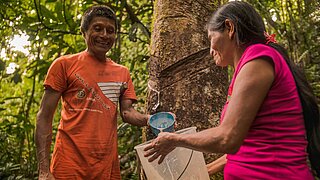
The project strengthened the resilience of the affected population in five community reserves against the negative impacts of climate change. This was achieved, for example, by integrating ecosystem-based adaptation (EbA) strategies into the sustainable management of communal protected areas. Aerial photography for identification of threats and progress made in reforestation helped to ensure the conservation of these valuable areas. The project also promoted the sustainable development of indigenous communities whose livelihoods depend on natural resources.
Through its activities, the project directly supported 6,910 people in enhancing their adaptive capacity – among other means, through micro-grants and additional assistance. Additionally, 34,816 people benefited indirectly from the project’s support.
The link has been copied to the clipboard