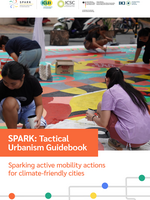

A transformative active mobility action in the Philippines
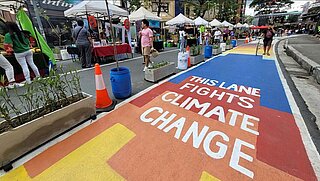
The IKI project SPARK demonstrates how small local activities can have a significant impact on sustainable and climate-friendly urban development.
Quezon and Pasig Cities in the Philippines are part of the larger dense urban agglomeration of Metro Manila that consists of 16 cities and one municipality. Once a compact harbour city with well-connected tramways and walkways, Metro Manila fell into a motorisation spiral during the post-war rebuilding efforts of the 1950s.
As the roads become saturated, the cost of congestion adds an economic burden. If this scenario continues, congestion in Metro Manila will cost the economy EUR 94.8 million per day by 2030. Both the national government and the local government units (LGUs) adopted a paradigm shift to rethink urban mobility and traffic demand management.
The International Climate Initiative supports active mobility in two pilot cities
The IKI-funded SPARK project (SPARKing active mobility actions for climate-friendly cities) responds to this shift and aims to promote active mobility strategies, policies, and practices that contribute to avoiding greenhouse gas emissions, improving safe connectivity in cities, and promoting climate-friendly mobility behaviour in the Philippines. Quezon and Pasig Cities were selected as pilot cities for this mobility transition.
SPARK is building on Quezon’s Enhanced Local Climate Change Action Plan (ELCCAP) and Pasig’s Green City Program, which supported the development of active mobility infrastructure, including cycling and walking, for example. It promoted community participation through tactical urbanism to facilitate the scaling of small-scale actions into a large-scale impact.
Tactical urbanism for active mobility
Tactical urbanism is an experimental method to redesign public spaces through temporary interventions and iterations of public participation in the redesign process. In the field of active mobility, this helps to test the reallocation of motorised street space to active transport modes, raise public awareness and promote behavioural change, and integrate the communities’ needs during the transitional phases to sustain long-term change.
Quezon City: a street becomes a social space
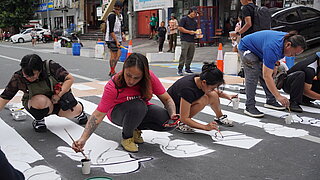
In Quezon City, SPARK launched a tactical urbanism intervention in Maginhawa Street, an active community hub and a local food and arts hotspot that faces challenges of mobility conflicts. At the end of 2024, a stretch of Maginhawa Street was temporarily transformed into a walkable, cyclable, and social space.
After several rounds of community conversations and envisioning workshops, an experimental reduction of vehicular traffic was implemented, leading to the creation of a protected bike lane and a widened pedestrian zone. More than 140 volunteers participated in this action, bringing community ownership to the space. The transformed stretch of the street witnessed many community events, such as bike training, yoga, dance-fitness, and mapping love stories of Maginhawa on Valentine’s Day.
Pasig City: giving way to pedestrians and cyclists
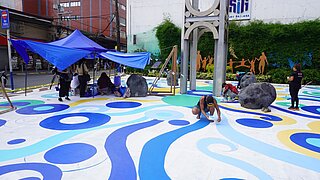
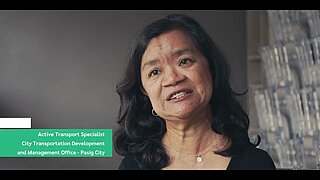
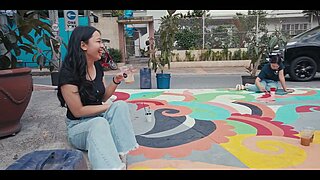
In Pasig City, a colourful outdoor park was painted in the historical Plaza Familia, and accessibility interventions for walking, cycling, and wheelchair users were implemented in the A. Mabini Street. Visitors to the old town of Pasig, the Immaculate Conception Cathedral of Pasig, or the many museums and cultural centres in the area had the opportunity to experience these venues on foot, by bike, and using barrier-free measures. These small, temporary interventions act as a testing opportunity to guide the city engineers and planners to envision other mobility options, outside the motorised norm. Local mobility experts are now studying this experience to assess long-term actions and policies for active mobility in the area.
A ripple effect – from the neighbourhood to the national level
The Department of Transport (DoT) mainstreamed the use of the SPARK Walkability and Cyclability Assessment methods to baseline active mobility in 20 Philippine cities as part of the national Active Transport Strategic Master Plan (ATSMP). Tactical urbanism was included in the nationwide plan as a community engagement practice and a tool for a cultural shift on mobility for the first time in the Philippines.
The IKI project demonstrates how small-scale, quick-to-deploy, community-driven actions can spark transformative changes across different scales - from neighbourhood to city, right up to national levels.
About IKI Medium Grants
With the IKI Medium Grants programme, which is implemented by Zukunft - Umwelt - Gesellschaft (ZUG) gGmbH, the German government funds projects for climate action and biodiversity conservation that specifically involve smaller civil society actors in developing and emerging countries.
The link has been copied to the clipboard
Contact
IKI Office
Zukunft – Umwelt – Gesellschaft (ZUG) gGmbH
Stresemannstraße 69-71
10963 Berlin
Funding priority
The IKI Strategy
The IKI aims to achieve maximum impact for the protection of the climate and biodiversity. To this end, it concentrates its funding activities on prioritised fields of action within the four funding areas. Another key element is close cooperation with selected partner countries, in particular with the IKI's priority countries.