

Beyond Compliance
How Environmental and Social Safeguards Shape Effective Climate Action: Interview with Mac Darrow, UN Office of the High Commissioner for Human Rights
In January 2023, the Safeguards Policy of the International Climate Initiative (IKI) entered into force. At that time, Mac Darrow had participated in the public consultation and provided very valuable feedback. In this interview, he explains why environmental and social (E&S) safeguards matter for climate and biodiversity projects and what distinguishes the IKI safeguards system internationally.
Why are environmental and social safeguards important for climate and biodiversity projects?
Environmental and social safeguards are guarantors of project quality. Even well-intentioned climate and biodiversity projects can harm ecosystems or local communities if risks are not properly identified and managed. Safeguards help maximise benefits while ensuring that environmental protection efforts do not cause unintended damage to people or nature.
Environmental safeguards reduce ecological harm through impact assessments, sustainable resource use and mitigation measures. Social safeguards protect human rights and livelihoods, especially of Indigenous Peoples, local communities and vulnerable groups, promote participation and gender equality, and reduce conflict-related risks.
Strong safeguards also enhance effectiveness and sustainability by building trust, strengthening local ownership and ensuring that adverse impacts are remedied, particularly in fragile and conflict-affected contexts.
How have environmental and social standards in development finance evolved?
Environmental and social issues have often been addressed in silos, with a stronger focus on environmental risks. This has changed. The latest safeguards of multilateral development banks introduce requirements on participation, non-discrimination, protection against reprisals, gender equality and gender-based violence, reflecting a more integrated risk management approach backed by accountability mechanisms.
Safeguard policies now cover a broader range of financing instruments, although the robustness of requirements remains debated. Recent updates by the Asian Development Bank and the European Bank for Reconstruction and Development also address privacy and other human rights risks linked to digitalisation, an area previously largely neglected.
Since 2020, greater attention has been paid to aligning safeguards with the UN Guiding Principles on Business and Human Rights (UNGPs). Stronger alignment supports genuine risk-based due diligence across value chains, clarifies responsibility for impacts, encourages use of leverage and strengthens approaches to remedy. The UNGPs also clarify that offsetting is not an appropriate response to human rights harms, a view increasingly reflected in critiques of carbon and biodiversity offsets.
Where do you see the main challenges for safeguards today?
Safeguards are still often seen as bureaucratic compliance tools rather than prerequisites for quality and sustainability. Within many development finance institutions, incentives prioritise lending volume and smooth client relations. Senior leadership plays a key role in aligning incentives and ensuring that E&S outcomes are core organisational objectives.
Even strong safeguard policies require effective implementation, including leadership, aligned incentives, adequate resources, accountability, transparency and clear governance. In climate and biodiversity finance, additional challenges include managing risks linked to complex financing mechanisms, ensuring Paris-aligned 1.5°C pathways, expanding protected areas while safeguarding rights, embedding human rights in a just transition, and ensuring free, prior and informed consent of Indigenous Peoples in practice (FPIC).
What makes the IKI Safeguards Policy distinctive?
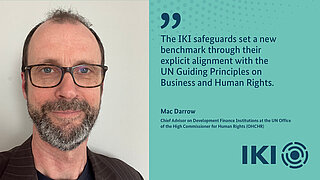
The IKI safeguards set a new benchmark through their explicit alignment with the UN Guiding Principles on Business and Human Rights. This has concrete implications for how risks are prioritised, addressed and remedied across entire value chains. The IKI Safeguards Policy also closes gaps where the IFC Performance Standards fall short of UNGP and OECD expectations.
Key features of the IKI Safeguards include a clear human rights commitment, a broad understanding of leverage, a requirement to prevent, mitigate and remedy adverse impacts, UNGP-compliant complaints mechanisms, and the application of whichever standard is higher – national law or international obligations. The IKI also recognises its own responsibility to contribute to remediation where it has been involved in causing or contributing to harm.
The safeguards further stand out in their treatment of advisory projects, serious incident reporting and responsible exit strategies, including recognition that severe human rights violations may justify project termination under defined conditions.
Where is there potential for further development of E&S safeguards?
Effective stakeholder engagement remains a major challenge, and the most common cause of complaints to development finance institution´s independent accountability mechanisms. Participation should go beyond consultation towards co-design and shared governance, supported by sufficient resources, capacity building and local decision-making power. Dedicated funding for local and Indigenous organisations and stronger protections against intimidation and reprisals would further strengthen implementation.
Another emerging area is digitalisation. Risks include privacy and data protection concerns, misuse of surveillance technologies, digital exclusion, environmental impacts of data infrastructure and ethical challenges related to AI, which have yet to be systematically addressed.
Finally, what message would you like to share with the IKI community?
In an increasingly volatile geopolitical environment, adherence to ethical principles and robust safeguards is more important than ever. Growing financing demands should not come at the expense of rigorous E&S due diligence, particularly in fragile and conflict-affected settings. OHCHR hopes that consistent application of the IKI safeguards will make a lasting contribution to climate and biodiversity goals while respecting human rights – and inspire others to follow this example.
The link has been copied to the clipboard
Contact
IKI Office
Zukunft – Umwelt – Gesellschaft (ZUG) gGmbH
Stresemannstraße 69-71
10963 Berlin
Short biography
Mac Darrow is a human rights expert and works as Chief Advisor on Development Finance Institutions at the UN Office of the High Commissioner for Human Rights (OHCHR) in Geneva.
He is a valuable resource person for the IKI Safeguards Team on how to mainstream UNGP in the IKI project cycle and other important considerations on how to improve our environmental and social safeguards management.