
Communities of Practice drives bottom-up energy transition in Nigeria

A community-driven rural electrification project in Nigeria has ended, strengthening implementation pathways for the bottom-up mini-grid deployment.
To achieve a climate-friendly energy supply through decentralised renewable energy, civil society must play a driving role. The International Climate Initiative (IKI) supported this approach through the project “Communities of Practice as drivers of a bottom-up energy transition in Nigeria” which was funded by the IKI Medium Grants.
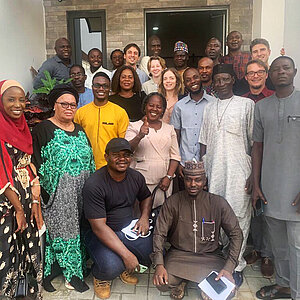
Concluded in 2024, the project, aimed at empowering rural communities to take an active role in the development of mini-grid electrification projects. The project set out to address existing gaps in energy access by supporting a shift from top-down to community-driven planning and implementation. During the project, five rural communities were selected to serve as “Communities of Practice”. Population sizes ranged from about 500 to 1,000 households. Most areas had no electricity access due to defunct or absent infrastructure, and limited power was provided through diesel generators or battery charging stations.
Quantitative surveys were carried out in each community to gain a clear understanding of socio-economic and cultural conditions and to estimate electricity demand. The project team surveyed households, enterprises, public institutions and health centres and conducted qualitative interviews with key stakeholders such as village chiefs and associations. A series of workshops was conducted to better capture their specific priorities, and local contexts.
Community Minigrid Toolbox guides community members
These consultations informed the design and customisation of the newly developed Community Minigrid Toolbox to ensure it reflected community realities. The toolbox guided community members through the initial planning process, including data collection, site assessment, preliminary technical design and financial analyses. Capacity-building workshops complemented these efforts by strengthening local knowledge and enabling informed engagement with project stakeholders.
After finalizing the community implementation plans, project developers and financiers were consulted to gauge their interest in supporting deployment. As a result, several communities have entered ongoing discussions with developers, setting the stage for implementation beyond the pilot phase.
Policy brief summarises project findings and recommendations
At the end of the project a policy brief was published, summarising its findings and recommendations. It highlights how national policy frameworks and funding mechanisms could better support community-led electrification. The findings were also shared in a dedicated webinar with stakeholders from government, finance, and development sectors.
By connecting communities with technical tools, capacity development, and policy dialogue, the project contributed to a more inclusive approach to rural electrification in Nigeria, paving the way for communities to take the lead in their own energy transitions.
The link has been copied to the clipboard
Contact
IKI Office
Zukunft – Umwelt – Gesellschaft (ZUG) gGmbH
Stresemannstraße 69-71
10963 Berlin
Further information
IKI Compete
With the IKI Medium Grants the German federal government supports projects for climate action and biodiversity conservation that particularly involve smaller civil society actors in developing and emerging countries. The IKI Medium Grants funding instruments is implemented by Zukunft – Umwelt – Gesellschaft (ZUG) gGmbH.