

Female Leaders of the Energy Transition: Fostering Leadership Where It Matters
Why female leadership is indispensable for a just transition.
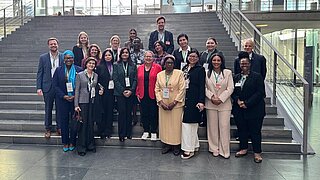
How does female leadership shape the global energy transition – and which political and economic factors shape its role? In September 2025, 15 female leaders from partner countries across Africa, Latin America, Asia and Europe gathered in Berlin and Bonn to explore these questions. The week-long study trip took place within the framework of the H2-diplo project, which is supported by the International Climate Initiative (IKI).
Geopolitics Meets Female Leadership
The program began in Berlin: meetings at the Federal Foreign Office and the German Bundestag enabled the delegates to exchange with German stakeholders on the political transformations accompanying the global energy transition. Participants shared the diverse contexts shaping their national energy strategies – ranging from security-related priorities, such as in Ukraine, to emerging economic opportunities in African markets.
During a discussion with members of the German parliament, including former Federal Minister for Economic Cooperation and Development Svenja Schulze, the delegates highlighted the importance of cross-border parliamentary networks for advancing fair and stable policy frameworks and developed initial ideas on how such cooperation could be strengthened.
A roundtable with academic experts explored how global rivalries over critical minerals, green technologies and energy flows are currently reshaping the international energy landscape.
The delegates also discussed a recently published H2-diplo study on Challenging Entrenched Power Structures in the Energy Sector. The analysis showed that structural barriers for women, as well as the unequal burden of energy poverty, remain strikingly similar worldwide. Contributions from the delegates underscored a powerful insight: the face of energy poverty is usually that of a woman.
This sends a clear signal that female leadership is not a “nice-to-have”, but a prerequisite for a socially accepted energy transition.
From Countering Disinformation to Scaling Industrial Innovation
A workshop with Deutsche Welle Akademie equipped delegates with strategies to respond to climate and energy disinformation – a growing risk for the public acceptance of energy projects. Women in leadership positions are particularly affected, as they often face targeted disinformation campaigns.
At the UN Climate Change Secretariat (UNFCCC) in Bonn, the group was welcomed by Deputy Executive Secretary Noura Hamladji, who stressed the importance of using all available platforms to expand coalitions for a just energy transition. Together with UN experts, the delegates explored the gender–climate–security nexus and emphasized that international energy goals can only be achieved through concrete action – not through political announcements alone.
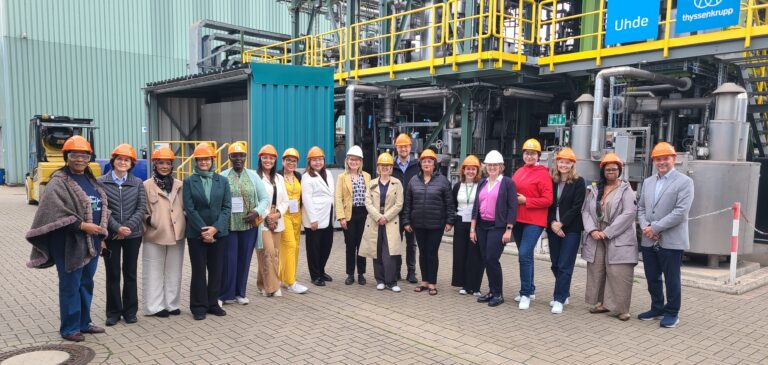
A visit to the Thyssenkrupp industrial park in Duisburg enabled direct exchange with large-scale industrial actors in the renewable energy sector. There, the delegates discussed how industrial innovation can be scaled and explored opportunities for technology development and international research partnerships.
Sustaining the Momentum and Looking Ahead
The study trip concluded at the headquarters of the Deutsche Gesellschaft für Internationale Zusammenarbeit (GIZ) GmbH in Bonn, delivering a clear message: the energy transition is not only a technological challenge, but also a matter of leadership, participation and societal transformation.
The study trip also marked the beginning of a growing network. Delegates have continued their exchanges virtually, and several have already reconnected at international conferences. Initial steps toward a self-organized international network are underway, highlighting the lasting connections created during the trip.
Overall, the study trip demonstrated that a just energy transition requires more than technology and investment – it also needs inclusive leadership and a diverse range of voices at the decision-making table.
About the Project: Embedding Gender in International Energy Cooperation
The IKI-funded H2-diplo project aims to systematically integrate gender perspectives into energy policy dialogue and cooperation. The goal is to support structural change in the energy sectors of partner countries.
Selected examples of the project’s work:
In Ukraine, H2-diplo works closely with the Women’s Energy Club of Ukraine (WECU) under the label “Innovation in Times of Crisis.” Together they organize public discussions and training programs on how a green recovery can be both just and inclusive.
In Kenya, the H2-diplo office collaborates with Women in Green Hydrogen (WIGH) and regularly organizes events that highlight female leadership in the hydrogen and energy sectors.
In Nigeria, a key achievement is the annual “African Women for the Energy Transition” event, which brings together women policymakers and energy professionals to strengthen their role in driving the transition. In addition, H2-diplo finances capacity-building trainings through a partnership with the Nigerian NGO Girls and Women Technological Empowerment Organization.
The link has been copied to the clipboard
Contact
IKI Office
Zukunft – Umwelt – Gesellschaft (ZUG) gGmbH
Stresemannstraße 69-71
10963 Berlin
Further information
WECU – Women’s Energy Club of Ukraine
GWTEO – Girls And Women Technological Empowerment Organisation
Gender in the IKI

Achieving gender justice is is a key factor for the IKI, because the potential of all those involved should be harnessed and contribute to improved climate action and biodiversity conservation.