
Germany and Luxembourg jointly promote the transformation of the international financial sector

The Greening Financial Systems Program, launched by the International Climate Initiative, will be transferred to a separate fund and expanded.
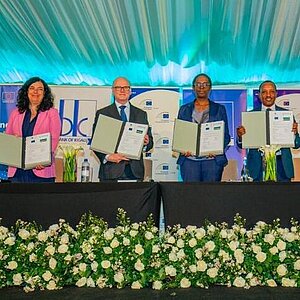
Financial markets play an important role in the transition to climate neutrality. The demand for advisory services on green finance products, regulation, and financing is steadily increasing. Within the framework of COP30, Germany is therefore launching a joint fund together with Luxembourg to enable central and commercial banks as well as financial supervisory authorities in developing and emerging countries to advance their climate transformation efforts.
With a total of EUR 32 million, a systemic contribution will be made to the stability and transformation of the financial sectors in partner countries in the Global South, such as Kenya or Armenia. The European Investment Bank’s (EIB) Greening the Financial System program, through close cooperation with central banks, also supports the objectives of the Network for Greening the Financial System (NGFS).
Jochen Flasbarth, State Secretary at the Federal Ministry for the Environment, Climate Action, Nature Conservation and Nuclear Safety (BMUKN):
“The financial sector is essential for a economically successful climate-neutral transformation of the economy. Currently, large sums worldwide are still flowing into GHG-intensive activities, such as oil platforms or new gas extraction systems. Investments that are not aligned with climate goals today pose future risks to the financial market and, consequently, risks to economic stability. Central banks and supervisory authorities play an important role in analysing and addressing these risks and supporting the economic transition within the scope of their mandate. With the German-Luxembourg cooperation, we are contributing to ensuring that central and commercial banks, as well as financial supervisory authorities, can fully leverage this potential.”
Ambroise Fayolle, Vice President of the EIB:
“This initiative strengthens the EU’s global green agenda. With the contributions from Germany and Luxembourg, we help developing and emerging countries advance green financing — for a faster transition to a sustainable future.”
Sabine Mauderer, Chair of the NGFS and Vice President of the Deutsche Bundesbank:
“Our global network of central banks, the NGFS, aims to understand and manage the financial risks of climate change. Central banks support each other in this effort and share their knowledge and experience through tailored trainings. The Bundesbank also offers such trainings. I welcome the German-Luxembourg initiative, which broadens and strengthens capacity-building efforts!”
Today’s agreement strengthens the financial base of the GFS program. Through this program, the EIB works with authorities and investors to address climate risks such as droughts, fires, and floods, and to steer investments into clean energy through regulatory measures.
The Greening the Financial Systems Program: Launched via the International Climate Initiative
The so-called Greening the Financial Systems program is implemented by the European Investment Bank (EIB) and was originally launched by Germany through the International Climate Initiative (IKI).
With Luxembourg’s entry with EUR 2 million, the program is now being transferred into its own fund and financially expanded. The new fund solution also opens the way for further donors to join. Luxembourg’s contribution underscores the success of the program.
Through the program, central banks, financial supervisory authorities, and commercial banks in developing and emerging countries are supported in better considering and managing climate risks, as well as in building climate-resilient financial systems. The program thus contributes not only to climate protection but also to enhanced climate adaptation. Central banks and supervisory authorities benefit from capacity-building and technical cooperation, for example in the areas of climate risk disclosure, calculation of climate risk scenarios, or conducting climate stress tests. Commercial banks are supported in better understanding the impact of climate change on their clients and products and in developing sustainable financing and advisory strategies to expand their green portfolios. Central and commercial banks act as catalysts in the financial sector due to their many connections with the real economy.
In addition to climate targets, CO₂ pricing, and other traditional climate policy instruments, the financial sector is a crucial enabler in developing a climate-resilient and future-oriented economy. Accordingly, the Paris Agreement sets a third long-term goal (Article 2.1c) to align financial flows with mitigation and adaptation objectives. Central banks also play an important role in achieving this goal within the scope of their respective mandates. Financial supervisory authorities increasingly take into account growing climate risks in their work, thereby contributing to the stability of the financial system.
The NGFS is a global forum of nearly 150 central banks and financial supervisory authorities, aimed at addressing and managing climate and environmental risks in the financial system. The EIB participates as an observer in the NGFS.
Go to the BMUKN press release (in German)
The link has been copied to the clipboard
Contact
IKI Office
Zukunft – Umwelt – Gesellschaft (ZUG) gGmbH
Stresemannstraße 69-71
10963 Berlin