
Restoring Sustainability in Brazil

The IKI project RESTORE+ generated science-based insights that would assist the new Lula administration to deliver its restored commitments.
Brazil’s contribution to meeting the Bonn Challenge and its commitments under the Paris Agreement require solid and long-term land use impact assessment to support informed policy making towards these goals. The IKI funded RESTORE+ project, aiming at strengthening restoration related land use planning capacity in Indonesia and Brazil, enhanced established land monitoring and modelling capabilities for Brazil. It does so by conducting land use impact assessment to provide quantified and spatially explicit insight for land use policies.
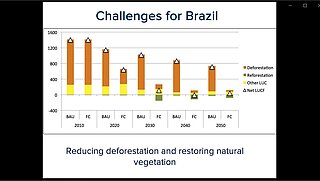
With the Paris Agreement, Brazil has committed to reduce 43% of carbon emissions by 2030 compared to 2005 levels. A key element in this commitment is to achieve zero illegal deforestation in the Amazon by 2030 using the Forest Code (FC) as a legal instrument.
Calculation of scenarios
For the project’s long-term land use impact assessment, scenarios of varying degrees of FC implementations were created by the RESTORE+ project partners from the Brazilian National Institute for Space Research (INPE), as a tool to get a glimpse of possible futures. A scenario of full-scale FC implementation was contrasted with a scenario depicting weakened implementation.
“Our findings revealed that, if rigorously enforced, the Forest Code could prevent a net loss of 53.4 Mha of forest and native vegetation, with 80% of these areas in the Amazon alone.” summarizes Fernando Ramos, senior researcher at INPE. While controlling illegal deforestation provides the largest environmental benefits, obligatory restoration of illegally deforested areas also creates 12.9 Mha of restored forest. Forest protection suffers greatly under weakened FC implementation, leading to a 28.8 Mha increase of accumulated deforestation. With all biomes considered, weakened FC implementation decreases the total area of native vegetation by 41.2 Mha.
New big data approach
Project partners in Brazil developed an innovative deep learning approach to classify unlabeled data to produce land use and land cover classification maps using satellite image time series.
“These results can greatly increase the efficiency of land cover monitoring as it is a transformation from the time-consuming manual visual interpretation to big-data informed automated interpretation”, says Gilberto Camara, senior researcher at INPE. This is also relevant to support land use and cover planning and public policies for forest restoration and sustainable food and energy crop production, as well as the estimation of greenhouse gas (GHG) emissions for the implementation of Brazil's NDCs (more information here).
New insights into targeted land use
The RESTORE+ Brazil team made a detailed assessment of the challenges for forest restoration in Brazilian Amazonia. After dealing with conflicts and overlaps between data from various official sources, they produced a new map of public and private land tenure in Amazonia. Combining this map with Brazil's official data on deforestation, they measured how much natural vegetation has been preserved in each public or private area and how much deforestation in Amazonia is illegal.
The new results from the Brazilian RESTORE+ researchers show that most of the deforestation inside rural properties is done by a few landowners, a finding that has important consequences for law enforcement. They also assess the challenges for forest restoration in detail. To do so, they considered how much forest needs to be rehabilitated for each private property according to Brazil's Forest Code. This analysis provides a comprehensive appraisal of the potential opportunity costs for forest restoration in the biome, considering farm size and land use. This analysis provides new insights into targeted land use policies that can meet Brazil’s forest restoration goals.
These findings were also presented at an IKI Brown Bag Lunch titled “What are the Options for Brazil’s Forest Policy and a Bio-Economy Appropriate for the Amazon?”. On January 26th, Prof Dr Gilberto Camara (IKI RESTORE+ project conducted by the International Institute for Applied Systems Analysis (IIASA) / National Institute for Space Research (INPE) in Brazil) and Rafael Feltran-Barbieri (World Resources Institute (WRI), Brazil) shared different options for Brazil’s forest policy and their possible implications.
The link has been copied to the clipboard
Contact
IKI Office
Zukunft – Umwelt – Gesellschaft (ZUG) gGmbH
Stresemannstraße 69-71
10963 Berlin
Further information
Scientific journal "Environmental Research Letters": A focus issue on "Tropical Landscape Restoration" contains the most important results from the project.
RESTORE+ website: all publications (peer-reviewed, reports and briefs)
Slides
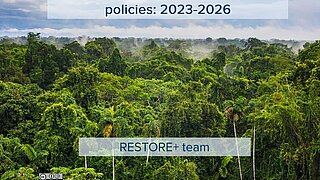
Powerpoint slides from Prof Dr Gilberto Camaras (National Institute for Space Research INPE, Brazil) presentation at the IKI Brown Bag Lunch (January 26, 2023)