

Sailing into the future: the SV Juren Ae as a model project
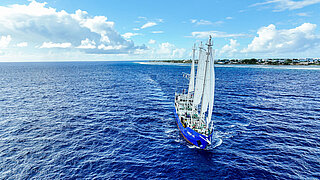
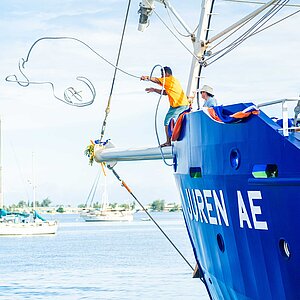
One year after its arrival in Majuro, the sailing freighter SV Juren Ae is a strong symbol of low-emission shipping, maritime training, and regional cooperation in the Federated States of Micronesia.
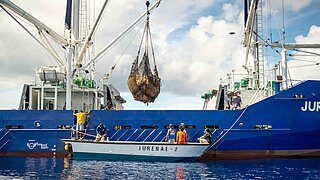
Since July 2024, the SV Juren Ae has been in test operation between the atolls. Here, real transport tasks were carried out under Pacific conditions The tests have made the project team confident: the performance models, which calculated potential emissions savings of up to 80 per cent compared to conventional ships of similar size, appear to be accurate in reality as well. This achievement is based on the combination of the Indosail sail system with solar and battery storage elements. Final adjustments are currently being made to the rigging system, which includes the masts and sails, and to the battery-powered system for further optimisation by the University of Emden-Leer, a long-standing project partner.
The ship is the centrepiece of the Low Carbon Sea Transport project, which is funded by the International Climate Initiative (IKI). The Juren Ae demonstrates an example of how decarbonisation, technological innovation, and maritime resilience interact in a Small Island Developing State (SIDS). The combination of low-emission technology, practical training, and political anchoring forms the basis for cross-sector climate action and regional scaling. The concurrent data collection also provides specific proof of potential savings and supports the development of future types of vessels.
Classroom under sails
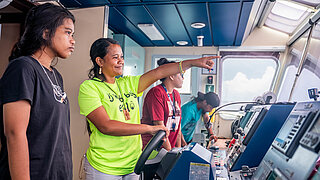
Alongside its operation, the SV Juren Ae serves as a practical training object at the Jela Meto Maritime Training Centre. This centre was established as part of the IKI project and is the key element of training programmes in climate-friendly shipping. Young people – increasingly also women – are being trained in the navigation, maintenance, and low-emission operation of ships. The centre unites modern technology with traditional knowledge. The result is locally anchored and future-oriented maritime training.
The project therefore contributes to a just transition in the Marshall Islands: local maintenance and training strengthen autonomy, while promoting economic independence by phasing out fossil fuels.
Regional appeal: sister ship planned for Pohnpei

The success of the Juren Ae reaches far beyond the Marshall Islands. During a demonstration run in February 2025 as part of the meeting of the Association of Pacific Island Legislatures (APIL), it convinced numerous delegations. A joint letter of intent with the state of Pohnpei (Federated States of Micronesia) for the building of a sister ship followed in May. A highlight was the visit by Arsenio Domínguez, Secretary-General of the International Maritime Organisation (IMO), who took a trip on the Juren AE as part of his official mission in the Pacific.
This development underlines the IKI approach of creating model projects with a signal effect for other SIDS. The political will to copy the project shows that it convinces both in terms of technology and development policy.
New alliances for maritime sovereignty
In parallel, a Memorandum of Understanding is in preparation for the establishment of a Micronesian ship registration system. The objective here is to close operational gaps between national and international registers. This would not only boost the visibility of climate-friendly ships such as the Juren Ae, but also increase their administrative security – contributing to global climate targets.
The initiative strengthens structural framework conditions for sustainable transport solutions and underlines the role of the IKI in the transition to climate-friendly mobility.
From vision to reality
Progress is based on targeted IKI-funding. Since 2017, it has been supporting the Low Carbon Sea Transport project – from technical developments and the training of skilled maritime personnel to the implementation of climate policy strategies.
One milestone was the “Sustainable Domestic Maritime Transport Roadmap”, which was adopted by the Marshallese government in 2023. With a project volume of over EUR 19 million, strong partners, and the target of total decarbonisation by 2050, the project is now viewed as a model for island states across the globe.
The strength of small island states
The SV Juren Ae stands for the potential of small island states to set global standards by means of alliances, innovation, and cultural strength. Thus, the wind in the Marshall Islands is driving more than merely a ship – it is navigating the Pacific region towards the future.
The link has been copied to the clipboard
Contact
IKI Office
Zukunft – Umwelt – Gesellschaft (ZUG) gGmbH
Stresemannstraße 69-71
10963 Berlin
Funding priority

The IKI Strategy
The IKI aims to achieve maximum impact for the protection of the climate and biodiversity. To this end, it concentrates its funding activities on prioritised fields of action within the four funding areas. Another key element is close cooperation with selected partner countries, in particular with the IKI's priority countries.


![[Translate to English:] Foto: thinkstock.com/RonaldPhilipBenjamin](/legacy/_processed_/b/2/csm_171114_Marshall310_a3f6f19711.jpg)