
Scaling Urban Transformation: IKI-supported TUC research informs policy dialogue in Mexican Senate
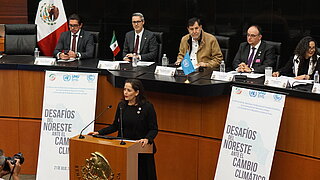
Insights from the Transformative Urban Coalitions (TUC) project, supported by the International Climate Initiative (IKI), were shared in the Mexican senate to support urban transformation across the region.
UN Climate Change, United Nations University - Institute for Environment and Human Security (UNU-EHS) and the Mexican Senator of Tamaulipas jointly organized a forum at the Mexican Senate to explore and discuss the “Challenges of the Northeast in the Face of Climate Change” (Desafíos del Noreste ante el Cambio Climático). Researchers involved in the TUC project participated in the forum, which served as a platform for knowledge exchange on the findings of the IKI project and how TUC methodologies and the project can be scaled up to support urban transformation in this region.
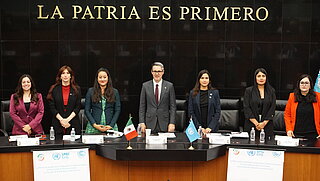
Held at the Mexican Senate, the forum opened with remarks from Senator José Ramón Gómez Leal of Tamaulipas and closed with a message from Gerardo Fernández Noroña, President of the Mexican Senate. The event featured three concurrent thematic tables:
Water and the Water Crisis

One thematic table focused on the impact of climate change on water availability, ecosystem degradation and pressure on shared watersheds. Legislators and local authorities from Tamaulipas, Coahuila and Nuevo León joined representatives from academia and public agencies to discuss water governance, soil conservation, pollution and the need for inter-institutional coordination. Representatives from the IKI project emphasized the importance of public participation and evidence-based knowledge to enhance climate resilience and ensure equitable access to water resources. Lessons from the TUC project and its implementation in Naucalpan and León were presented as inputs for strengthening water governance and implementing ecosystem-based approaches.
Urbanization, Deforestation and Health
The second thematic table focused on the effects of rapid urban growth and vegetation loss on public health and environmental sustainability in the Northeast. It included assessments of Nuevo León and Tamaulipas, institutional experiences in climate-focused urban planning at the regional level, and proposals for resilient urban planning policies. To address the convergence of these challenges, the project implementers presented three strategic mechanisms derived from the TUC project:
- Participatory urban governance to empower communities to shape their environments;
Resilient infrastructure through demonstrative actions that can be developed into scalable models of urban transformation;
Shared visions of the future to align local and regional policies with national and international sustainability and climate agendas.
These TUC-derived mechanisms reflect on the good practices captured by the project and reinforce the commitment to fostering inclusive, evidence-based policy making and promoting systemic change through collaboration.
International Cooperation and Institutional Capacities
The third thematic table explored the challenges and opportunities of international technical and financial cooperation to strengthen the institutional capacities of municipalities and state governments in the Northeast. Discussions focused on federal and international support mechanisms, common barriers to accessing climate finance, and lessons learned in building partnerships between local and global actors.
The dialogue was a concrete step toward transforming these complex and interrelated challenges into opportunities for sustainable urban transformations in northeastern Mexico. The contributions of the project implementing organizations not only stem from the ongoing work of the TUC project, which links research, capacity development and policy recommendations, but also highlight its potential for scaling up lessons learned and good practices. This effort consolidates the evidence to support scalable, inclusive climate action, building on the lessons from León and Naucalpan. The project's long-term vision emphasizes collaborative systems and lifelong learning to promote urban transformations that improve human well-being and protect the environment.
The link has been copied to the clipboard
Contact
IKI Office
Zukunft – Umwelt – Gesellschaft (ZUG) gGmbH
Stresemannstraße 69-71
10963 Berlin
10 years of sustainable urban development in the IKI
The topic has been an overarching priority at the IKI since 2015.