

Solar-powered e-bikes pave the way for sustainable mobility in Namibia
With support from Germany’s IKI Small Grants programme for local climate and biodiversity action, EBIKES4AFRICA is making biking accessible and affordable.
In Namibia's capital Windhoek, mobility is an everyday challenge – especially for the underprivileged in the city’s sprawling population. By manufacturing its own brand of solar-powered e-bike, introducing rental options, and partnering with social initiatives, the local enterprise is creating alternatives to traditional transport, specifically geared towards underserved communities.
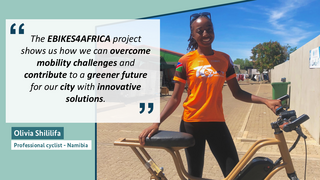
When Olivia Shililifa gets on her bike to ride out into the countryside around Namibia’s capital Windhoek, cycling is more than an exercise. To her, it’s about making a statement for sustainable mobility to her fellow Namibians. “Cycling is a way forward,” she says. “I don't ride for myself, I ride for a community, I ride for a nation.” Using her influence as a professional cyclist and athlete, Olivia is committed to putting biking on the map in Namibia. She is doing this together with the social enterprise EBIKES4AFRICA, which makes and provides solar-powered e-bikes – with funding and support from Germany’s IKI Small Grants programme.
From A to B: An everyday challenge
Cycling in Windhoek is rarely seen as a viable mode of transport. In recent years, the city has seen a major population influx from rural areas. The city’s borders have expanded, while infrastructure struggles to keep up. Buses are rare and unreliable, and the cost of driving or using taxis is unaffordable for many. Rugged terrain, steep hills, long distances, and scorching heat make traditional bicycles impractical.
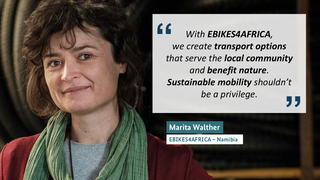
“Transport is a big struggle in Namibia,” explains Marita Walther, co-founder of EBIKES4AFRICA. “People spend up to a third of their income on transport alone. There's a great need to introduce a more cost-effective solution.” The e-bikes her company makes are designed to meet this need. “Riding traditional bikes is exhausting on the many hills of the city. While 10 or 20% of the population may be fit enough to cycle five kilometres to work, 80% are not, because they are too old or too young. We open up possibilities for people to use bicycles.”
Bikes “made in Namibia” for local needs and challenges
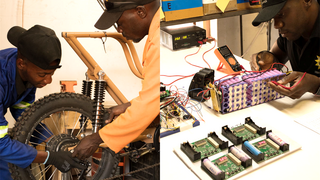
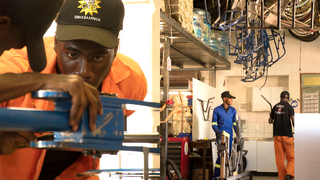
EBIKES4AFRICA designs and builds e-bikes tailored to Namibia’s local realities and demands. Like all-terrain jeeps on two wheels, the bikes can handle rough roads while remaining affordable to maintain. Built locally by trained Namibian technicians, they feature steel frames, puncture-proof tyres, and solar-powered charging systems. The bikes are built for a wide range of users — from students and commuters to street vendors and entrepreneurs, the enterprise’s main target groups.
Building an infrastructure for a mind shift
With funding and training from IKI Small Grants, EBIKES4AFRICA has established hubs for solar-powered e-bikes — or e-hubs — in peri-urban areas. These offer rental services and technical training, and form part of a wider vision to make biking both practical and aspirational. One such hub is run by Physically Active Youth (PAY), a community initiative that rents bikes to school children and students who would otherwise struggle to attend class. “Mobility shouldn’t be a privilege,” emphasizes Marita Walther.
The PAY space functions as a solar-powered manufacturing workshop, rental station, and battery charging point. EBIKES4AFRICA donated 25 e-bikes that are now available for rent at low rates, helping students and other commuters get where they need to go. The organisation also runs after-school and cycling activities, ensuring that youth from disadvantaged areas are included in the shift to sustainable mobility. As Walther adds, “Involving students empowers the younger generation to learn.”
Powering community through innovation and movement
As the name and credo suggest, EBIKES4AFRICA is more than just a product. It’s a community-led innovation. Beyond manufacturing and distribution, the enterprise creates local employment, training, and leadership opportunities — especially for women and youth. Thanks to funding and support from IKI Small Grants, 16 students from nearby educational institutions were trained to manufacture a total of 24 e-bikes and help establish hubs. With the support, EBIKES4AFRICA can spurn further growth and expand its vision.
One completed e-hub has since been handed over to the Namibian Women's Association (NAWA), now managed by two certified e-hub coordinators. In partnering with initiatives like NAWA and PAY, EBIKES4AFRICA provides real-world work experience, manufacturing and research opportunities for young trainees, students and volunteers.
Olivia was one of these trainees. After joining PAY as a teenager, she combined her passion for cycling with a mission to improve mobility in her city. She learnt how to assemble, repair, and service e-bikes — along with valuable business development skills. “I learnt so much from EBIKES4AFRICA’s bicycle building programme,” she shares. “Not only how to fix bikes but also how to communicate and how to be a leader.”
Looking ahead: future impact and future growth
With a current production capacity of 200 e-bikes per year, EBIKES4AFRICA is actively changing the transport landscape in Windhoek. “We selected EBIKES4AFRICA for its contribution to helping Namibia scale climate-smart, socially equal mobility solutions,” says David Fuchs, IKI Small Grants’ programme director. “This is not a one-off donation. It's part of a growing response and solution to achieve more transport equality, more climate resilience, and more energy independence.”
The project now serves as a blueprint for further e-hubs throughout Windhoek and northern Namibia. It’s a living example of how climate solutions can take root at the local level — driven by purpose, community, and opportunity. With more e-bike riders taking to the streets, figures like Olivia – once a trainee, now a national athlete – are championing safe, efficient, and sustainable transport alternatives in a country well suited for change. As she emphasizes, “Namibia is a cycling paradise.”
About IKI Small Grants
IKI Small Grants, implemented by the German federal enterprise Deutsche Gesellschaft für Internationale Zusammenarbeit (GIZ), funds local actors which are the driving force for change and essential for effective climate and biodiversity action worldwide. The programme is part of the International Climate Initiative (IKI), which is jointly commissioned by the German Federal Government. IKI Small Grants fosters bottom-up solutions while strengthening capacities of local actors.
The link has been copied to the clipboard
Contact
IKI Office
Zukunft – Umwelt – Gesellschaft (ZUG) gGmbH
Stresemannstraße 69-71
10963 Berlin
More about the organisation
Funding priority

The IKI Strategy
The IKI aims to achieve maximum impact for the protection of the climate and biodiversity. To this end, it concentrates its funding activities on prioritised fields of action within the four funding areas. Another key element is close cooperation with selected partner countries, in particular with the IKI's priority countries.