
Sustainable Energy Transition in Indonesia (SETI)
The desired outcome of SETI is an effective institutional, regulatory, and financial ecosystem that demonstrates the Indonesian embarkment towards a sustainable energy transition. To achieve this, SETI follows a multi-level and multi-stakeholder approach with a demand perspective: It demonstrates innovative technologies and business cases to encourage private sector actors to replicate successful renewable energy and energy efficiency approaches in industry. This is accompanied by improving readiness of financial instruments for sustainable energy investments. Through piloting integrated energy planning and its implementation on municipal level, SETI will bring the topic of decarbonisation also to sub-national level. Finally, SETI loops back results, lessons learnt and experiences to the national level for the design of a relevant and comprehensive policy framework.
- Countries
- Indonesia
- IKI funding
- 15,000,000.00 €
- Duration
- 10/2022 till 01/2030
- Status
- open
- Implementing organisation
- Deutsche Gesellschaft für Internationale Zusammenarbeit (GIZ) GmbH
- Political Partner
-
- Ministry of Energy and Mineral Resources (MEMR) - Indonesia
- Implementing Partner
-
- Fraunhofer Institute for Systems and Innovation Research ISI
- Institute for Economic and Social Research, University of Indonesia (LPEM UI)
- Institute for Essential Services Reform - (Indonesien
- World Resources Institute Foundation Indonesia
- Yayasan Indonesia Cerah
State of implementation/results
- The project supported the Ministry of Energy and Mineral Resources (MEMR) Regulation No. 8/2025 through national workshops for industry and buildings, engaging 250+ participants and increasing EBTKE Reporting (POME) from 367 to 440 companies within one month.
- In 2025, Focus Group Discussions on Carbon Trading Options and Strategies were conducted as an early step to inform MEMR’s upcoming roadmap for carbon trading in the energy sector. Conducted Focus Group Discussions on carbon trading options and strategies to inform MEMR’s upcoming energy sector carbon trading roadmap.
- At least 60 national and international funding sources in support of energy transition were identified and presented to the political partner.
- A second Workshop on Sustainable Energy Finance was held in collaboration with Indonesian Employers Association (APINDO) to explore the potential application of green finance and investment schemes for energy transition in the private sector.
- 72 participants from companies, government, and commercials associations learned about Industry Decarbonisation options.
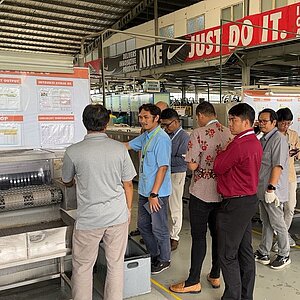
- Private Sector Engagement and Knowledge Exchange for Industry Stakeholders conducted. Including: site visits to TKG Taekwang in Cirebon, Indah Kiat Pulp & Paper in Tangerang, and two industrial parks in Surabaya and Batam; technical exchange sessions with CWC Industrial Estate; and participation in Asia Clean Energy Forum (ACEF) 2025.
- 14 Companies were selected as SETI Industry Lab Pilots Batch 1: Five energy audits across manufacturing sectors completed, identifying energy-efficiency measures with up to 21,706 tCO₂e annual emission reduction potential.
- Conducted an evidence-based rooftop solar PV study for Indonesia’s industrial sector, delivering technical, economic, and quota recommendations to support policymaking.
- Kick-off Events in Pilot Cities of Surabaya and Batam were held involving the city government, industry leaders, associations, renewable energy and efficiency experts, academia, and media.
- Communication Strategy developed with local media, academics, and CSOs in Surabaya and Batam to address the challenges and opportunities for sustainability in the built environment. Communication Strategy developed with local media, academics, and CSOs in Surabaya and Batam to advance sustainability in the built environment.
- Social Media Outreach and A/B testing conducted to assess effective outreach strategies in pilot cities and on national level.
- A Study on Options for Renewable Energy Generation in Buildings was disseminated in March 2025, completed Phase I of the Renewable Energy Alternatives in Buildings study and advanced Phase II, focusing on Building-Integrated Photovoltaics (BIPV and Air Source Heat Pumps (ASHP as priority solutions.
- Ten government officials and two private sector representatives participated in an Study Trip on District/Solar Cooling in May 2025.
- Delivered capacity building for decarbonisation and the built environment, training 484 participants, including a Study Trip on District/Solar Cooling with over 80% satisfaction.
- The collaboration with the Association of Indonesian Municipalities (APEKSI) was launched, supporting its Knowledge Management Forum, engaging with 22 cities, and generating policy recommendations for city-led energy transition initiatives.
- Developed green building and energy conservation financing guideline for local governments, based on a multi-ministerial Focus Group Discussion, to support implementation of national green building and energy conservation regulations.
- Completed the baseline energy consumption studies for Surabaya and Batam, delivering the basis for integrated urban energy planning.
- Conducted energy audits of two warehouses and three retail stores, identifying low-cost energy efficiency measures.
- Engaged with six potential patrons/hosts for the Sustainable Energy Network (SEN) and secured two Letters of Intent (LoI) from Disperindag Jabar and AGTI.
- SETI Industry Lab Batch 2 attracted 70+ registrants, with 29 of them progressing to technical and financial assessments and engaged with over ten industrial parks.
- Held Future Energy Demand Workshops in Surabaya and Batam with over 20 participants in each city to estimate future energy consumption and demand.
- Long-Term Energy Planning (LTEP) kick-offs conducted in Surabaya and Batam, each with 30+ local stakeholders, set the scene for development of LTEP.
- Promoted gender mainstreaming in industrial decarbonization through a podcast featuring women leaders, reaching 13,000 viewers and 3,308 article views.
Latest Update:
10/2026
Project relations
Legend:
The link has been copied to the clipboard