Restoring degraded coffee landscapes in Ethiopia
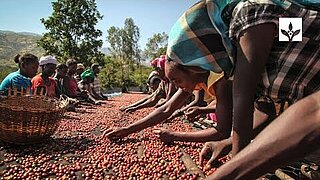
In the UNESCO biosphere reserve "Yayu Coffee Forest", the majority of the population depends on coffee as a source of income. Coffee grows naturally in the forests of Ethiopia, in partially forested systems or close to homes in "Garden Coffee" cultivation. Due to low crop yields, smallholder farmers are expanding cultivation into the protected area. Consequences are forest degradation and soil degradation. The project introduced a low-emission and climate-resilient coffee farming system. Implementation on coffee farms conserved biodiversity and reduced pressure on the forest. About 2,000 families were trained in sustainable coffee growing and processing methods. Eight farmer cooperatives and the regional coffee cooperative were supported with capacity-building activities. With the aim of scaling up, an investment-ready coffee business model and monitoring system for zero-deforestation coffee was developed with various public and private sector stakeholders.
- Countries
- Ethiopia
- IKI funding
- 1,473,153.40 €
- Duration
- 09/2018 till 06/2025
- Status
- completed
- Implementing organisation
- Hanns R. Neumann Stiftung
- Political Partner
-
- Environment, Forest and Climate Change Commission (EFCCC) - Ethiopia
- Ethiopian Coffee and Tea Authority (ECTA)
- Ministry of Agricultural Development (MoAD) - Ethiopia
- Implementing Partner
-
- Hanns R. Neumann Stiftung Ethiopia - Äthiopien
- Unique land use GmbH
State of implementation/results
- Project completed.
- The IKI-funded project demonstrated climate-friendly coffee production systems that strengthen livelihoods while reducing pressure on natural forests in the Yayu Coffee Forest Biosphere Reserve.
- A Garden Coffee system combining Good Agricultural Practices and agroforestry was piloted with evidence for future scaling, including 146,485 coffee seedlings planted on 60.4 ha of farmer owned land and 5.63 ha of degraded coffee plots rejuvenated.
- Local seed systems were strengthened through Farmer Field Schools and youth groups, supporting 71,000 seedlings for future planting seasons.
- Capacity building reached Farmer Field Schools, agricultural facilitators, model farmers, and cooperatives, improving technical skills, quality management, marketing, and governance.
- Gender and economic inclusion were advanced through household seminars, change agents, Village Savings and Loan Associations, and joint bank accounts, strengthening household financial resilience.
- Monitoring and verification showed declining forest degradation, improved biomass cover, and increased carbon sequestration potential in intervention areas.
- Improved coffee management enhanced productivity, quality awareness, and market participation, contributing to better household livelihoods.
- The project generated institutional learning through national and international knowledge-sharing platforms.
- Overall, the project delivered a scalable proof of concept showing that climate-friendly coffee production can jointly support forest conservation, climate action, and sustainable rural livelihoods, with strong potential for replication in Ethiopia’s coffee landscapes.
Latest Update:
11/2026
Project relations
Legend:
The link has been copied to the clipboard