
Scaling up Community based Adaptation for Livelihoods and Ecosystems in Southern Africa (CBA-SCALE Southern Africa+)
The project aims to achieve implementation of inclusive, gender-responsive & nature-sensitive Community based Adaptation actions in Southern Africa (and beyond) to increase resilience to climate change for people of all genders and social groups. The CBA approach will be implemented in more than 100 communities. Interlinkages between all levels of planning will be strengthened to ensure that community adaptation priorities are reflected in local development plans, and that they inform (sub-)national decisions, notably through NAP/NDC processes. During the preparation phase, the project will engage with the target groups, including both community beneficiaries and various policy-making stakeholders to gather insights and undertake a participatory project design. Research will be conducted to close information gaps and to deepen the collective understanding of the context. The outcomes of these efforts will be applied to collaboratively design the project framework.
- Countries
- Mozambique, Zambia, Zimbabwe
- IKI funding
- 19,830,553.00 €
- Duration
- 11/2021 till 08/2029
- Status
- open
- Political Partner
-
- National Disaster Management Institute - Mozambique
- Government of the Republic of Zambia/ Department: Ministry of Green Economy and Environment
- Ministry of Agriculture and Livestock - Sambia
- Ministry of Environment, Climate, Tourism and Hospitality Industry - Zimbabwe
- Ministry of Land and Environment - Mozambique
- Office of the President, Provincial Administration Southern Province/ Department: Permanent Secretary– Zambia
- Implementing Partner
-
- CARE
- CARE International in Mozambique
- CARE International in Zambia
- FANRPAN
- International Institute for Sustainable Development (IISD)
- International Union for Conservation of Nature and Natural Resources (IUCN) - Eastern and Southern Africa Regional Office
- International Union for Conservation of Nature and Natural Resources (IUCN) - USA
State of implementation/results
- In all three countries, community dialogues, climate risk assessments, and local adaptation planning were carried out, during which women, men, and youth worked together to identify risks and develop practical adaptation measures.
- In Mozambique, the focus was on building local capacity to understand climate risks and potential adaptation measures. Through training and awareness-raising activities, communities and local organizations were able to engage more effectively with national adaptation processes.
- In Zambia, the project strengthened collaboration between communities, technical experts, and government agencies. This improved the information flow between local and national levels and supported dialogue on climate resilience and priorities for adapting to climate change.
- In Zimbabwe, the project promoted dialogue between communities, civil society, and government institutions working on climate and agriculture. Local experiences and evidence were documented and shared with national authorities, contributing to ongoing adaptation planning. The project also promoted climate-resilient agricultural practices and improved coordination between local and national actors.
- At the regional level, the Food, Agriculture and Natural Resources Policy Analysis Network (FANRPAN), as part of the consortium, compiled findings from the project in Mozambique, Zambia, and Zimbabwe. These were shared through regional platforms, thereby promoting the exchange of experience and knowledge across Southern Africa.
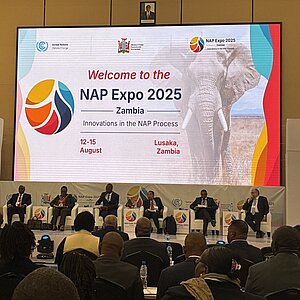
- The project also contributed to national climate planning processes such as NDCs and NAPs by ensuring that local priorities are given greater consideration.
- Initial results show increased awareness of climate risks, greater adoption of climate-resilient practices, improved collaboration between civil society and government, and better alignment between local action and national climate goals.
Latest Update:
10/2026
Project relations
Legend:
The link has been copied to the clipboard