

Ending deforestation and land use changes
Prioritised field of action in the IKI funding area "conserving and restoring of natural carbon sinks" (as of August 2026)
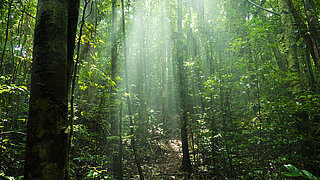
By protecting and conserving forests and peatlands, natural carbon sinks can be secured and negative climate impacts reduced. A large proportion of global deforestation is due to land clearance for agriculture. Consequently, in countries with vast forest resources, incentivising forest conservation and targeted action against the root causes can make an important contribution to climate protection.
In this field of action, the International Climate Initiative (IKI) supports, for example, the establishment of deforestation-free supply chains, the implementation of REDD+ measures, and the fight against environmental crime, as well as improvements in forest monitoring and social and environmental safeguards. Measures include, for instance, support for implementing national plans to prevent deforestation and land degradation, strengthening local networks and the incomes of indigenous, traditional, and smallholder communities, developing innovative financing instruments for sustainable land use and the bioeconomy, and generally raising ambition in the field of sustainable forest management.
Deforestation-free supply chains
The "EU Deforestation Regulation", or EUDR for short, adopted by the European Union (EU), aims to fight deforestation caused by the production of certain commodities – currently wood, cocoa, coffee, rubber, palm oil, soya, and cattle – and the products derived from them. Companies wishing to import or export products in these categories into or from the EU are required to ensure a deforestation-free supply chain.
Through various projects, the IKI supports capacity building for smallholders, cooperatives, and import and export companies to help them better meet the requirements for sustainable production and traceability in their supply chains. Innovative financing instruments aim to ensure the long-term viability of deforestation-free supply chains. In addition, national and local governments are supported in creating enabling environments for the implementation of the EUDR. Improving forest monitoring contributes to proving that forests remain intact in the areas surrounding the cultivation zones.
The REDD+ Framework
The REDD+ framework is an international climate protection concept developed by the UNFCCC, which offers developing countries financial incentives to protect and sustainably manage their forests. Verified emission mitigations are rewarded across three phases: In Phase 1, national REDD+ strategies are developed and a reference level for the current forest cover is established. In Phase 2, agreed measures and pilot projects to reduce deforestation are implemented, with their positive impact on emission reductions being financially rewarded retroactively. The payments are distributed to the participating stakeholders via benefit-sharing mechanisms. The Green Climate Fund (GCF), in particular, plays a key role in this financing.
The IKI has contributed to shaping the international REDD+ framework by supporting partner countries in developing and implementing innovative solutions for the execution of REDD+ strategies (Phase 2). This enabled the establishment of a results-based REDD+ system. Furthermore, demonstration projects were implemented, ranging from building technical know-how and institutional structures, policy advice, and providing technical expertise, to the effective use of investments in the forest sector and promoting the exchange of knowledge and experience. The IKI also specifically supports the development of environmental and social safeguards in REDD+ implementation, as well as ensuring co-benefits for the local population to secure the sustainable use of the REDD+ concept.
Fighting environmental crime
Increasing environmental crime, such as illegal deforestation, land grabbing, and illegal logging, exacerbates the negative impacts of climate change and the loss of biodiversity. Moreover, illegal deforestation is closely intertwined with other criminal activities, such as illegal mining, the trafficking of protected species, corruption, and money laundering. So-called "narco-deforestation", where profits from drug trafficking are laundered through land speculation, the agricultural sector, cattle ranching, and associated infrastructure, also poses a growing threat to Latin America's forests. Environmental crime destabilises both ecosystems and societies alike.
To fight illegal deforestation, various authorities – including those from law enforcement, the judiciary, and environmental protection – as well as civil society and affected communities must work closely together. Modern forest monitoring, advanced data analytic tools, and transparent, traceable supply chains are effective tool for protecting global forest stands.
Through a global project with INTERPOL and WWF Germany, the IKI supports capacity building for law enforcement agencies to improve operational measures and cross-border investigations into environmental crime in partner countries. At the same time, the project strengthens civil society organisations in Peru and Cameroon that assist in detecting environmental crime.
Selected projects
- Forest Landscape Restoration by means of sustainable wood energy value chains
- Forest Landscape Restoration with PPPs in Asia
- Implementing sustainable land use systems to contribute to forest conservation, climate protection (REDD+) and the peace-building process in Colombia
- EU Regulatory Compliance with Landscape Impact: Achieving climate resilience and nature conservation through EU compliant, sustainable agricultural value chains and landscape measures in South America
- Transforming Agricultural Supply Chains to Deforestation and Conversion-free in Latin America
- Coronavirus pandemic: financing deforestation-free supply chains in Africa
- Forest Landscape Restoration in Central America and the Caribbean and implementation of the Green Development Fund for Central America (REDD Landscape)
- Contribution for accelerating the implementation of REDD+ in Africa
Funding area

The link has been copied to the clipboard