

Adapting to climate change: why seedling quality matters
An IKI project in Viet Nam has gained valuable insights into how the success of tree plantings can be increased.
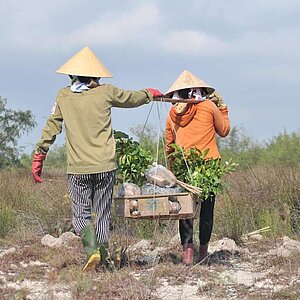
Along Viet Nam’s long shoreline, terrestrial coastal forests provide crucial ecosystem services, especially protecting the rural population and small-scale farmers from severe weather such as tropical storms, flooding or heat waves. Decades of overuse, harsh climatic conditions and sandy soils with high salinity and low nutrient content have left most coastal forests in severe states of degradation. Despite significant local research, only few efforts have been made to restore these biodiversity-rich forest ecosystems.
This is where the International Climate Initiative (IKI) comes in: Since 2018, the project "Ecosystem-based Adaptation on the Northern Central Coast of Viet Nam" has been demonstrating how coastal forests can be restored with native tree species adapted to the location. One of the most important lessons learnt from the project is: it's the seedlings that count!
Why high-quality seedlings?
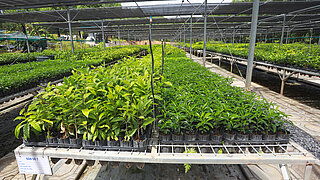
Globally, the success of tree-based restoration projects is often only measured by how many seedlings were planted, or the number of hectares covered. However, focusing on planting numbers overlooks the critical question of how many seedlings survive and grow well.
In the IKI-project, the team cooperated with Hué University to identify mother trees of more than 15 native tree species, collected the seeds and contracted local nurseries to raise the seedlings. More than 600,000 seedlings were produced, which looked healthy before and during planting. However, extreme storms, flooding and drought took a significant toll: although initial survival rates were above 80%, they declined with each extreme weather event.
Especially on difficult sites, successful establishment and long-term survival depend on species’ capability to cope with the stand conditions. Other crucial factors besides species suitability are strength and morphology of roots, and early-stage care. In most projects, however, seedlings are perceived as a non-priority cost factor. Accordingly, the quality of the planting material is often very low: seedlings are grown from uncertified seed sources, and show underdeveloped and deformed roots, unfavourable root-shoot ratios and deformed shoots.
Poor seedling quality translates into poor growth performance, high mortality rates, and a combination of higher costs and lower impacts – especially on sites with challenging soil and climatic conditions.
A new quality standard for native tree seedlings
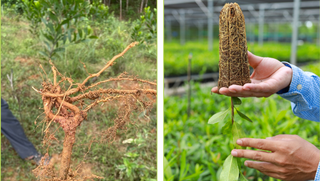
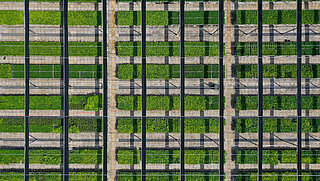
Triggered by the low seedling quality and corresponding high mortality rates of the first plantings, in 2020 the IKI-project decided to take the seedling production into its own hands. For this, the project entered into a partnership with a highly motivated and knowledgeable private nursery owner. Together they established a “best-practice nursery” in Cam Lo (Quang Tri Province). Designed for raising a variety of native tree species, the nursery focuses on producing and hardening seedlings with strong and robust root systems that are well-adapted to extreme climate conditions.
The most common forestry nurseries in Viet Nam typically use simple ground-level seedbeds or small polybags placed directly on the ground. They neither make use of specific substrate, nor provide enough space in the containers for the tap root. These practices often lead to root spiralling or root breakage during transplanting. Once planted and exposed to drought, the substrate turns into a brick.
Many examples describe how quality has been improved. The Cam Lo nursery was able to draw on the international experience of other nurseries for its aim:
- Seedlings are produced using cleaned, pre-treated seeds to prevent fungal infections.
- Germination occurs under shade nets, followed by transplanting into species-specific containers with customised substrates.
- Modern, reusable pots with air-pruning features help prevent root spiralling and promote healthy root development.
- Root pruning and gradual hardening further strengthen seedlings, which are then selected for planting based on height and key root traits such as root length, collar diameter, and root-to-shoot ratio.
- In addition, efforts are made to infect the roots with symbiotic and species-specific mycorrhiza.
- The team follows detailed protocols to guide each stage, including the use of bio-products for disease resistance, pruning guidelines, monitoring and pest control.
Looking ahead
Building on the promising results from the planted “best-practice” seedlings, the project is now exploring options for upscaling, which include a sustainable business strategy for the Cam Lo nursery, a seed bank, and mapping vigorous mother trees. Thus, the nursery will also serve as a training hub to share best-practice methods with other partners and local communities, including advice for setting up and running other nurseries.
This strategy will secure the project’s long-term impact and its commitment to seedling quality, laying the foundation for larger-scale efforts. In this way, the approach is helping to restore coastal forests to the richness and resilience they once had.
As this example demonstrates: even seemingly small things – in this case the quality of seedlings – can make a decisive contribution to adaptation to the impact of climate change.
The link has been copied to the clipboard
Contact
IKI Office
Zukunft – Umwelt – Gesellschaft (ZUG) gGmbH
Stresemannstraße 69-71
10963 Berlin
Funding priority

The IKI Strategy
The IKI aims to achieve maximum impact for the protection of the climate and biodiversity. To this end, it concentrates its funding activities on prioritised fields of action within the four funding areas. Another key element is close cooperation with selected partner countries, in particular with the IKI's priority countries.
Related Publications
-
 05/ 2024 | Educational material
Native Seedling Nursery Manual
English (PDF, 4 MB)
Vietnamese.pdf (PDF, 6 MB)