
Addressing Climate Risks in China: Risk Assessments and Early Warning Systems
The Sino-German Climate Partnership, supported by the International Climate Initiative (IKI), strengthens cooperation on a range of climate issues, including climate risk management.
In 2024, China experienced its warmest year on record, facing an alarming increase of extreme weather events such as heatwaves, heavy rainfall, and typhoons. As the impact of climate change accelerates globally, countries are under increasing pressure to strengthen their ability to anticipate, assess, and respond to climate-induced risks. Climate risk assessments and early warning systems are indispensable tools in this effort, enabling governments to protect vulnerable populations, reduce economic losses, and steer adaptation policies effectively.
Cooperation and Knowledge Exchange
China has made notable strides in building a comprehensive and science-based approach to climate risk assessment and early warning, supported by national research infrastructure and advanced meteorological technologies. Yet, as the scale and complexity of climate risks grow, international cooperation and knowledge exchange remain critical drivers of innovation and improvement. Exchanges among international experts and partners provide mutual learning opportunities, enhance technical capacities, enables an alignment of methodologies with global best practices, and fosters policy-relevant research that informs decision making processes.
Both China and Germany are working closely with developing countries to improve their adaptation capacity. During the last UN Climate Change Conference (COP29), Ding Xuexiang, China's vice premier and Chinese President Xi Jinping's special representative, launched “China’s Action Plan on Early Warning for Climate Change Adaptation (2025-2027)”, which aims to enhance early warning capacities in countries of the global south.
A Platform for Sino-German Exchange
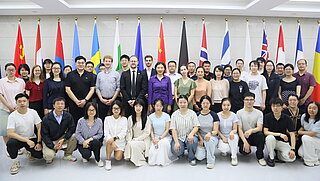
In July this year, the Climate Change Risk Assessment and Early Warning Training workshop was successfully held in Beijing, serving as a platform for advancing Sino-German cooperation to address climate risk management. Co-hosted by the Deutsche Gesellschaft für Internationale Zusammenarbeit (GIZ) and the Chinese Research Academy of Environmental Sciences (CRAES), the event brought together over 400 participants, including scientists, policymakers, and technical experts from both countries.
The workshop featured intensive training and collaborative dialogue on climate modeling, risk assessment, and early warning systems. Presentations reflected a blend of domestic expertise and international perspectives. Dr. Zhou Tianjun from the Chinese Academy of Sciences introduced the latest advancements in climate modeling, particularly the Coupled Model Intercomparison Project Phase 6 (CMIP6), and their applications for science-based policy. Professor Kai Kornhuber of the International Institute for Applied Systems Analysis (IIASA) presented a framework for climate risk assessment, using extreme heat events to illustrate the interaction of exposure, sensitivity, and adaptive capacity. By combining cutting-edge research with applied tools, the workshop strengthened technical capacity on both sides and reinforced the value of international exchange in building more resilient climate strategies.
Deputy Director Yin Yizhou of the China Meteorological Administration (CMA) shared innovations in early warning systems, highlighting the “climate + industry” model that integrates sector-specific forecasting into national preparedness efforts. China has reduced meteorological disaster-related deaths by approximately half to 573 death per year in 2023, down from 1000-2000 just a decade earlier, despite the trend of increasingly frequent and severe disasters.
From Models to Action: Bridging Science and Policy
China’s progress in climate risk assessment is reflected in the development of increasingly integrated early warning systems and advanced models. Institutions like the CRAES and the CMA are engaged in building advanced systems for risk modeling and early warning. Examples from China illustrate both the need for and benefits of this integrated approach. In 2023, heavy rainfall triggered a red-level rainfall alert in Beijing and nearby Hebei, prompting evacuation of some 840,000 people and deployment of seven flood storage zones – demonstrating both the intensity of extreme events and the system’s responsiveness. Similarly, during the peak flood season in 2024, China recorded 25 significant flood events while mobilizing over 5,000 reservoirs and diverting approximately 99 billion liters of floodwater, an operation coordinated by national meteorological and water resource agencies.
In July 2023, Beijing and neighboring Hebei experienced record-breaking heat and humidity. Zhejiang's provincial capital Hangzhou recorded a record temperature of 41.9 degrees on Aug. 3, 2024, after witnessing the hottest July in observed modern history. Early warning systems from the CMA issued a Red Alert for heat stress – the highest level in China’s four-tier weather warning system. It triggered city-wide emergency response and vulnerable populations were advised to stay indoors. Outdoor work was restricted or suspended by local governments and construction sites and cooling centers and hydration stations were opened.
These real-world stress tests underscore why advancements in risk assessments and early warning are crucial. To improve the responsiveness to heat stress, a new Sino-German joint study on extreme heat risks and its implications on the Beijing-Tianjin-Hebei region is ongoing. The study conducts a comprehensive assessment of extreme heat risks in one of China’s most densely populated and economically critical regions. It examines vulnerabilities, while linking scientific modeling with strategic policy recommendations. The study, conducted by CRAES and advised by an international expert, is support by the Climate Partnership project, a long-term IKI cooperation project to facilitate a political and technical dialogue on climate protection among Germany and China.
Advancing Risk Management Through Collaboration
China is steadily improving its climate risk management through advanced risk assessments and early warning systems, supported by scientific institutions and national commitment. These improvements enable more timely, targeted responses to extreme weather events, helping to protect vulnerable populations and guiding adaptation efforts.
International cooperation plays a vital role in accelerating this progress. The ongoing Sino-German Climate Partnership exemplifies how shared expertise, and joint research can enhance technical capacity and align strategies. Continued collaboration and knowledge exchange will be essential for China’s climate resilience and for supporting global adaptation, highlighting the importance of collective actions in facing the challenges of climate change.
The link has been copied to the clipboard
Contact
IKI Office
Zukunft – Umwelt – Gesellschaft (ZUG) gGmbH
Stresemannstraße 69-71
10963 Berlin