

Decentralised solar power supply on India’s roofs
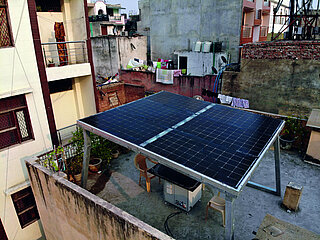
Photovoltaics installations on roofs are an essential aspect of a project supported by the IKI in India – the expansion of solar energy.
The Indian government has set itself an ambitious goal of 100 gigawatts of solar energy capacity by 2022. Decentralised photovoltaic installations, especially on roofs, have a particularly high potential in the solar electricity generation sector. This is why rooftop PV systems are to contribute to 40% of the country’s solar power supply. By comparison, 2019 saw around 42 gigawatts produced by solar installations in Germany, with more than 70% produced by roof systems. Despite ambitious targets, the development of renewable energies in India has so far fallen short of the government’s own expectations.
The IKI project Integration of Renewable Energies into the Indian Electricity System (I-RE) supports the Indian Ministry of New and Renewable Energy (MNRE) in its efforts to develop the electricity market in a climate-friendly way and increase the proportion of renewable energies. To this end, it links climate and energy policy stakeholders particularly in urban development, mainly focusing on distribution network operators in the transition to a low-emission energy sector.
To achieve these goals, the project first analyses the electricity market and the existing energy systems. Based on the results of the analysis, it then develops framework conditions for decentralised energy supply with photovoltaics (PV), using a prototype to demonstrate the feasibility of PV rooftop systems. The project also shows the economic and technical advantages of a rapid system expansion and develops support mechanisms for disseminating decentralised photovoltaics. Recommendations to support the expansion of PV rooftop installations are being developed and implemented together with pilot cities in the Indian Smart Cities Programme. Studies and further training events also strengthen the relevant expertise of the Ministry’s staff. In this way, the project effectively weakens prejudices against renewable energies that were previously considered too expensive, unreliable or small-scale, and supports India in achieving its national climate targets and nationally-determined contributions (NDCs).
India as an important climate partner
During the third German-Indian Environmental Forum in New Delhi, Minister Svenja Schulze, Ministry of Environment Nature Conservation and Nuclear Safety (BMU), and her Indian counterpart Harsh Vardhan stressed on the importance of cooperation between Germany and India saying, “We need India to solve the global environmental problems. In fighting climate change, combating the pollution of the oceans or protecting biodiversity, India is one of our most important partners”.
The link has been copied to the clipboard
Contact
IKI Office
Zukunft – Umwelt – Gesellschaft (ZUG) gGmbH
Stresemannstraße 69-71
10963 Berlin