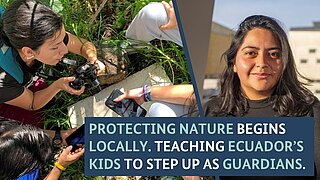

Inspiring Youth to Protect Biodiversity in Ecuador
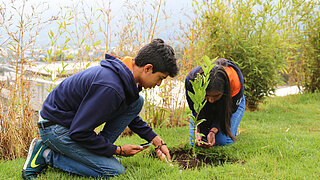
With support from the International Climate Initiative, Ecuador’s National Institute of Biodiversity (INABIO) worked with 13 pilot schools around the country to create hands-on biodiversity education rooted in local ecosystems.
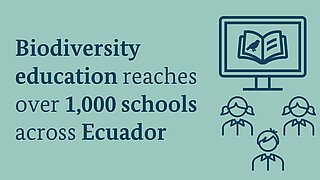
What began as a small-scale initiative has now reached over 1,000 schools nationwide through integration into Ecuador’s national curriculum. The project demonstrates how locally led, context-specific education – when trusted and funded – can start lasting systemic change nationwide.
A project rooted in the classroom
In one of the world’s biodiversity hotspots, a national shift in environmental education is underway. With support from IKI Small Grants, Ecuador’s Instituto Nacional de Biodiversidad (INABIO) helped pioneer a new approach to teaching biodiversity – one that now reaches schools across the country. It began with just thirteen schools. Through a pilot project, INABIO – supported by IKI Small Grants – set out to integrate biodiversity, climate change, and resource management into students’ everyday learning. But instead of arriving with a ready-made curriculum, they started with observation. “We didn’t arrive with a solution,” says Diego Inclán, Director of INABIO. “We arrived to the schools and learned from the community at the first stage. I mean the teachers, the kids, and the parents. We got the perception of what they feel, what they need – and then we developed tools together.”
Learning to see what was always there
The first step was reawakening perception. In many urban schools, biodiversity was something hidden or unfamiliar. INABIO’s team invited students to explore their surroundings, often for the first time. Equipped with smartphones and the iNaturalist app, which is part of a citizen science project for nature observation, children documented spiders, birds, or insects in schoolyards they’d never noticed before. “Some schools are not green at all,” Diego explains. “But we went outside to search for signs of biodiversity. And then they started to realise – there is biodiversity out there, even if it’s hiding.”
As part of the project's sustainability interventions, each school received an ecological garden and a composting system. Solar benches were set up to encourage the use of renewable energy for powering educational equipment. Additionally, rainwater harvesting systems were introduced to improve water availability in schools with limited access to potable water. In one school, a greenhouse was installed to support its ongoing project aimed at using greenhouse-grown produce to improve students’ nutrition.
Students focused on documenting biodiversity and asking scientific questions about their local ecosystems. “We wanted to connect the story,” Diego says. “You find a spider – what does it mean? What relationship does it have with other animals, with the environment?”
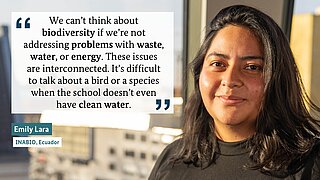
For Emily Lara, who oversaw the technical implementation of the project, integration was key: “We can’t think about biodiversity if we’re not addressing problems with waste, water, or energy. These issues are interconnected. It’s difficult to talk about a bird or a species when the school doesn’t even have clean water.”
Nationwide impact through the project
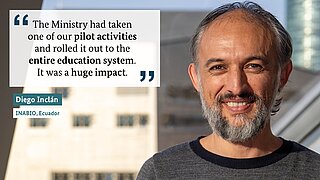
The pilot directly involved 13 schools, among them one inclusive school for children with disabilities, and over 8,000 students, teachers, and community members. But the project’s real breakthrough came unexpectedly – through a piece of homework. “One day I was at home,” Diego recalls. “And my daughter, who wasn’t in a pilot school, told me she’d been given homework to document biodiversity. I thought, ‘Wait, that’s our task!’ The Ministry of Education had taken one of our pilot activities and rolled it out to the entire education system.” That moment marked a major milestone. What started as a hands-on pilot had been adopted into Ecuador’s national curriculum. “It was a huge impact,” Diego says. “We didn’t know it was going to happen. But that’s the way to do it – get one activity into the curriculum, and then it repeats again and again.”
The power of supporting local institutions
The success of the project lies not only in the fruitful education initiative – it was also structural. For INABIO, this was the first time their work was formally brought into Ecuador’s education system. And that leap wouldn’t have been possible without the support – and trust – of IKI Small Grants. “If I go alone as INABIO with an idea, I probably won’t be heard,” Diego explains. “But when we said that this is part of an IKI Small Grants initiative, it made people listen.”
The Funding the Funders approach
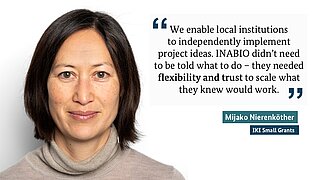
Mijako Nierenköther, in charge of the funding line for Funding Institutions of the IKI Small Grants programme, says that’s precisely the intention of the “Funding the Funders” model: “We enable local institutions to lead. INABIO didn’t need to be told what to do – they needed trust, flexibility, and legitimacy to scale what they knew would work. That’s what our model supports.”
Emily Lara saw that principle come alive in practice. “It wasn’t just about the funding,” she says. “We were trusted to do it in our own way – and that made all the difference.” IKI Small Grants also supported the institutional strengthening of INABIO through various capacity development measures. These included the design and preparation of a Call for Proposals, the improvement of financial management procedures, and the enhancement of technical skills such as photography and camera handling for nature monitoring purposes. INABIO staff also received training to strengthen overall project management, along with the use of project management software to support these processes. In addition, the members of the institute attended an IKI Small Grants networking workshop to exchange experiences and discuss lessons learned with other funding institutions supported by IKI Small Grants.
Lessons that travel beyond the schools
One of the project’s most powerful effects has been how it has reached homes and communities. “Kids go home really happy with what they learn,” Emily recalls. “They teach their parents and neighbours. We had one child come back and say, ‘My neighbour is composting now.’ That was really cool.” She was especially moved by the gendered impact. “Some girls didn’t even imagine they could be a biologist or a scientist. But after the workshops, one six-year-old said to me, ‘I will be a scientist once, and I will be like you.’ That was one of the objectives – seeing that change in them.”
A living curriculum, grounded in lived curiosity
For INABIO, the project is only in its first phase. Monitoring and follow-up will continue, but the foundation has been laid. As a public institution, INABIO plans to sustain the work beyond the life of the grant, directly alongside Ecuador’s Ministry of Education. “We believe that if you want to conserve something, you need to know what you want to conserve,” Diego says. “What we’re trying to do is help children recover that surprise – that emotion – when they see something like a spider. That curiosity is where the story begins.”
About IKI Small Grants
IKI Small Grants, implemented by the German federal enterprise Deutsche Gesellschaft für Internationale Zusammenarbeit (GIZ), funds local actors which are the driving force for change and essential for effective climate and biodiversity action worldwide. The programme is part of the International Climate Initiative (IKI), which is jointly commissioned by the German Federal Government. IKI Small Grants fosters bottom-up solutions while strengthening capacities of local actors.
You can find details about the Fund the Funders approach in this video:
Climate and Biodiversity Action: How Germany is ‘Funding the Funders’
The link has been copied to the clipboard
Contact
IKI Office
Zukunft – Umwelt – Gesellschaft (ZUG) gGmbH
Stresemannstraße 69-71
10963 Berlin