
Good Practice: Success Factors for Effective Urban Transformation
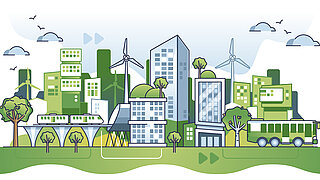
Eight tools from ten years of project work on sustainable urban development within the IKI
In 2025, we looked back on ten years of “sustainable urban development” within the International Climate Initiative (IKI). Since 2015, the topic has been a cross-cutting priority area across the four funding areas of the IKI. To date, more than 100 IKI projects worldwide have worked on sustainable urban development in over 50 countries.
Looking back on ten years of project experience in successful sustainable urban development within the IKI, the following eight tools in particular have emerged as good practice:
- Participatory approaches
- Demonstration projects
- Institutionalising knowledge and capacities
- Digital tools
- Financing and upscaling
- Leveraging synergies with other projects and city networks
- Multilevel governance as well as frameworks and standards
- Visibility and narratives
Tool 1: Participatory approaches
Citizen participation is the foundation for lasting climate action in cities. Formats such as “Urban Labs” bring together residents, businesses and planning professionals to develop and implement concrete climate action and adaptation measures. Bottom-up approaches generate multiplier effects and promote the transformation of neighbourhoods.
For example, the Urban Lab in Buenos Aires won third prize in the prestigious urban planning competition “Urban Life” (“Vida Urbana”) for its proposal on the climate-friendly redesign of a neighbourhood.
IKI project examples
- Transformative Urban Coalitions: Catalysing urban partnerships to drive systemic transformation towards sustainability
- Morgenstadt Global Smart Cities Initiative: Global approach - local solutions
- Ambitious City Promises: Commitments for low-carbon urban development in Southeast Asian large cities
- Gender into Urban Climate Change Initiative (GUCCI)
Tool 2: Demonstration projects
Small, testable initiatives demonstrate the feasibility of new concepts and facilitate their scaling. They strengthen cross-sectoral cooperation, for example between municipal administrations, universities and businesses, and support vertical integration across political levels.
For instance, 14 pilot projects were implemented in ten cities through the IKI project Urban Pathways—ranging from a pedestrian zone, a mobility start-up acceleration centre and energy-efficient housing in Nairobi (Kenya), to a 30 km/h zone and low-emission zones in Belo Horizonte (Brazil), and electric mobility systems in cities such as Kochi (India), Hanoi (Vietnam) and Quito (Ecuador).
IKI project examples
Tool 3: Institutionalising knowledge and capacities
Knowledge, skills and processes must be permanently embedded in local institutions (municipalities, ministries, research institutions and NGOs); otherwise, they are lost once projects end.
Institutionalised know-how creates an “institutional memory”, enables independent planning, implementation and evaluation, and improves access to public and private financing.
For example, nine African cities benefited from the deployment of urban climate advisers and were able to institutionally anchor climate mitigation and adaptation in urban planning.
IKI project examples
Tool 4: Digital tools
Open-source applications support data sovereignty, participation and knowledge exchange. They can be further developed after project completion and adapted to local needs, ensuring that knowledge and data remain available in the long term.
Examples include the online biodiversity platforms CitiesWithNature and RegionsWithNature, which were developed as part of IKI project work.
The free open-source tool Energy Performance and Carbon Assessment and Monitoring (ECAM) has established an internationally applicable standard to support municipal utilities in reducing emissions in the water sector through targeted efficiency measures, thereby contributing to climate action.
IKI project examples
Tool 5: Financing and upscaling
Stable, long-term financing models are essential to scale pilot projects to larger levels. Early match-making between projects and public or private funders increases success rates. Support mechanisms should begin early in the project cycle and form an “ecosystem” of development banks, city networks and technical partners.
A good example is the Water Funds established in over 20 cities in Latin America. They bring together municipalities, businesses and authorities to finance nature conservation measures in the long term through contributions and tariffs.
IKI project examples
Tool 6: Leveraging synergies with other projects and city networks
Exchange through networks such as C40, the Global Covenant of Mayors or specialised project partnerships enables the transfer of proven practices, saves resources and increases visibility.
Combining climate action with themes such as energy, circular economy or water results in integrated solution approaches.
For example, C40 provided its network of member cities, best practices and technical expertise. Through this partnership, comprehensive climate mitigation and adaptation plans were developed in nine pilot cities, more than 150 professionals were trained in sustainable mitigation strategies, and a regional knowledge and data hub was established.
IKI project examples
Tool 7: Multilevel governance as well as frameworks and standards
Coordinated collaboration across all levels of government—national, regional and local—links political guidance, local implementation and financing.
International frameworks and standards provide clear guidance and enhance the comparability of measures.
For example, the PIEVC (Public Infrastructure Engineering Vulnerability Committee) protocol of Engineers Canada can be used as a basis for climate risk assessments of public infrastructure. The methodology has been adapted in Costa Rica.
In Brazil, with support from the IKI, a sustainability agenda was developed that demonstrates how specific measures of the Ministry of Cities align with ongoing federal government initiatives on sustainability and climate change, as well as with international agreements and commitments.
IKI project examples
Tool 8: Visibility and narratives
Public-facing formats such as short films, illustrations and storytelling approaches make successes tangible and mobilise support.
Strong narratives convey complex content in an accessible way and create emotional connections, making replication in other cities easier.
Good IKI examples include the short film series A True Paradise, featuring renowned climate experts, and the illustrated Natural Asset Maps.
IKI project examples
From project to structure: how sustainable urban development succeeds
Ten years of IKI project experience clearly show that sustainable urban development is not a single instrument, but a combination of participation, knowledge, financing and political frameworks. The eight identified tools illustrate how lasting structures can emerge from local pilot projects—provided they are networked early, institutionally embedded and financially secured. In this way, climate action in cities becomes not only plannable, but scalable—and thus a key pillar of global transformation.
The link has been copied to the clipboard
Contact
IKI Office
Zukunft – Umwelt – Gesellschaft (ZUG) gGmbH
Stresemannstraße 69-71
10963 Berlin
Funding priority
Developing sustainable and climate-friendly urban and peri-urban areas