
Urban-Act: Integrated Urban Climate Action for low-carbon & resilient cities
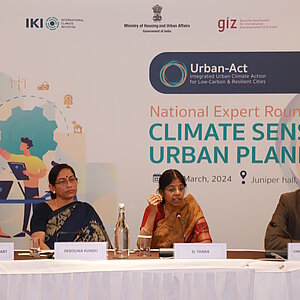
The Asia-Pacific region is rapidly urbanizing. The project supports a transformation towards low-carbon and resilient urban development. It assists its government partners to align policies, regulations, and services for urban development with climate and sustainability targets.Further, it invests in knowledge transfer to strengthen the capacities of institutions, decision makers and technical staff. At the local level, the project supports 14 pilot cities to integrate climate change into urban plans and budgets. Cities are enabled to identify targeted measures for greenhouse (GHG) emission reduction and resilience building related to urban mobility, urban environment, building or circular economy and leverage finance for the preparation and implementation of urban climate actions. At the Asia-Pacific level, the project supports advocacy through intergovernmental and city-to-city dialogue and facilitates knowledge sharing to enable scaling-up of projects results and good practices.
- Countries
- China, India, Indonesia, Philippines, Thailand
- IKI funding
- 22,625,000.00 €
- Included preparation phase
- 354,031.24 €
- Duration
- 04/2022 till 12/2027
- Status
- open
- Political Partner
-
- Department of Interior and Local Governments (DILG) - Philippines
- Department of Public Works and Town & Country Planning (DPT) - Thailand
- Ministry of Ecology and Environment - China
- Ministry of Housing and Urban Affairs (MoHUA) - India
- Ministry of Natural Resources - China
- Office of the Permanent Secretary for interior - Thailand
- State Ministry of National Development Planning (BAPPENAS) - Indonesia*
- Implementing Partner
-
- Chulalongkorn Universität - Thailand
- Clean Air Initiative for Asian Cities Center, Inc. (Clean Air Asia) - Philippinen
- Institute for Climate and Sustainable Cities (iCSC) - Philippines
- National Center for Climate Change Strategy and International Cooperation (NCSC) - China
- National Institute of Urban Affairs (NIUA) - India
- Shanghai Urban Planning Development & Research Institute (SUPDRI) - China
- Thai Meteorological Department (TMD) - Thailand
- Thammasat University - Thailand
- The Energy and Resources Institute (TERI) - India
- Tongji University (TJU) - China
- TU Dortmund University (TUD) - Deutschland
- United Cities and Local Governments Asia-Pacific(UCLG ASPAC)
- United Nations Economic and Social Commission for Asia and the Pacific (ESCAP) - Thailand
- Universität Stuttgart - Deutschland
- World Meteorological Organisation
State of implementation/results
- Asia-Pacific Region:
- Experiences on climate-sensitive urban development have informed the High-Level Communique for Sustainable Urban Development in Asia-Pacific (APUF-8) and two ESCAP resolutions to improve the enabling environment for urban climate action.
- City perspectives were embedded into three ASEAN Mayors Forum declarations (2023–2025).
- +135 practitioners from 20 cities enhanced their climate finance expertise, leading to 17 city proposals submitted to domestic and international climate funds.
- The “Climate Conscious Cities” webinar series surpassed 10,000 registrations; there are +3,000 registrations across the 6 webinars in 2026, scaling knowledge on nature-based solutions, sustainable transport and waste management.
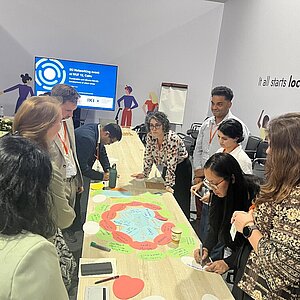
- City pairing and peer learning supports the transfer of practical climate solutions across the region. For instance, technical recommendations for Khon Kaen’s sponge city initiative were developed through a systematic peer exchange with 12 cities on nature-based solutions and flood management.
- Research results fed into the National Technical Guideline for Climate Change Impact and Risk Assessment (2025) and China's Progress Report on Climate Change Adaptation 2024.
- Evidence from the cities of Xi’an and Xiamen on climate risks, carbon accounting, biodiversity and resilient transport is shaping national spatial planning guidelines. – The city of Xiamen approved its first Special Plan for Low-Carbon and Green Transport, mobilising municipal funding to cut emissions.
- Chinese experts shared ecological planning and low-carbon transport approaches across the region.
- The Ministry of Housing and Urban Affairs (MoHUA) established a dedicated climate team and updated national building efficiency guidance. – The city of Shimla used the Urban-Act Climate Budget Tool to prepare its 2026–2027 budget, embedding resilience into public spending. – The city of Panaji secured EUR 6.3 million under a national urban-investment programme (CITIIS 2.0) for waste management with a focus on gender and inclusion.
- With project support, Coimbatore expanded green spaces, boosting biodiversity and climate resilience.
- The city of Padang integrated its Climate Action Plan into the 2025–2029 Development Plan with a focus on the inclusion of women, youth and persons with disabilities. – The city of Padang secured feasibility funding for its Integrated Resource Recovery Centre; The city of Medan advanced investment-ready waste concepts.
- Supported the Ministry of National Development Planning (BAPPENAS) in demonstrating the roll-out of the National Climate Resilience Development Policy at the local level.
- Strengthened the National Circular Economy Framework and Extended Producer Responsibility System, coordinating across 19 national agencies. – The cities of Bacolod and Tagbilaran integrated circular economy approaches into their land-use plans and submitted project concepts for early-stage funding.
- Facilitated 8 multi-stakeholder circular economy initiatives via the EU-Philippines Green Economy Programme, turning waste, shells, and water hyacinth into biogas and biomaterials.
- The cooperation between the Thai Meteorological Department (TMD) and the Department of Public Works and Town and Country Planning (DPT) is embedding climate services into spatial planning in three pilot cities; five more provinces requested this service.
- Using the Public Infrastructure Engineering Vulnerability Committee (PIEVC) approach, 50 practitioners are being trained on climate risk assessments in public infrastructure planning. – The city of Khon Kaen applied hydrological modelling to its new local development plan; Phuket prioritised underground water storage and a Climate Data Platform. – The cities of Chiang Mai, Khon Kaen and Wichit each secured USD 50,000 from the Youth Climate Action Fund.
Latest Update:
10/2026
Further links
- Video: Urban Act: Joint Action for climate friendly and resilient cities
- Urban-Act Webinar Series: Climate Conscious Cities
- Training Manual: Assessing national enabling framework conditions for urban climate finance: a tool and guide by CCFLA and Urban-Act
- Training Manual: Assessing subnational enabling framework conditions for urban climate finance: a tool and guide by CCFLA and Urban-Act
Project relations
Legend:
The link has been copied to the clipboard