


IKI Small Grants 8th Call for Proposals open
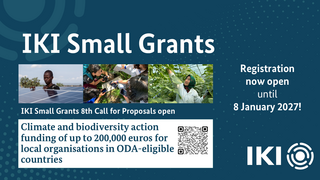
Local organisations can now apply for funding for local climate and biodiversity projects. Registration is open until 8 January 2027.
Our world is full of ingenious solutions. Somewhere, right now, at this very moment, the next initiative to protect the climate and biodiversity is taking shape. IKI Small Grants has set itself the task of discovering the people behind these ideas and helping them realise their full potential. So local initiatives can become effective solutions that drive changes and pave the way for a future worth living in for both people and nature.
Apply now
Are you working on site to support climate action and conserve biodiversity? Then IKI Small Grants could be the right funding for you!
The Call for Proposals is aimed at local organisations based in an ODA-eligible country (more information on the OECD website) with an average annual turnover of between 60,000 and 500,000 euros. You can apply for support for your local or regional climate and biodiversity projects. We are looking for committed organisations that wish to further develop and implement their initiatives with financial support. IKI Small Grants provides support for up to 200,000 euros per project.
IKI Small Grants is part of the International Climate Initiative (IKI) of the German Federal Ministry for the Environment, Climate Action, Nature Conservation and Nuclear Safety (BMUKN).
Thematic focus: Nature-based solutions
Nature-based solutions are the focus of this year’s Call for Proposals. We are looking for local and regional initiatives that harness the potential of natural ecosystems to simultaneously protect the climate and biodiversity and tackle specific societal challenges.
The focus is on projects that protect, and promote sustainability in managing natural or human-modified ecosystems, or restore them. This is not solely about conserving nature: the solutions developed should also improve people’s well-being, strengthen biological diversity and make an effective contribution to climate change adaptation. They should have a long-term impact and be adaptable to different local conditions.
Furthermore, the proposed projects must correspond to at least one of the four funding areas of the IKI: reduction of GHG emissions; climate change adaptation; preservation of natural carbon sinks, with a focus on reducing emissions from deforestation and forest degradation; and protection of biological diversity.
Support goes beyond financial funding
IKI Small Grants offers more than just financial support: the programme specifically strengthens the capacities and structures of local organisations so that they can develop their work in a long-term and sustainable manner. Through targeted organisational and capacity-building measures, the funded organisations receive, for example, training in fundraising or organisational development. In this way, they are supported in expanding their capabilities, forging new partnerships and sustainably strengthening their role as key stakeholders in international climate and biodiversity conservation – even beyond the funding period.
Throughout the funding period, the organisations receive technical and organisational support. This support is provided by the Deutsche Gesellschaft für Internationale Zusammenarbeit (GIZ) GmbH, which handles the implementation of the IKI Small Grants on behalf of the BMUKN.
Results that count: strengthening climate and biodiversity projects worldwide
Since the programme began in 2019, more than 200 local organisations have already been selected for support. Together, they are working worldwide to promote effective climate and biodiversity solutions. Through their project work, around 70,000 people have so far been supported in strengthening their resilience to the consequences of climate change – for example, through measures that help to better cope with the impacts of drought-related crop failures and flooding, or to prevent them in a targeted manner.
The contribution to biodiversity conservation is also significant: more than 100,000 hectares of terrestrial, marine and coastal ecosystems have so far been effectively protected or saved for the long term through sustainability. This corresponds to an area roughly twice the size of Lake Constance.
Further information including the funding information and application guidelines can be found at the IKI Small Grants Website:
The link has been copied to the clipboard
Contact
IKI Office
Zukunft – Umwelt – Gesellschaft (ZUG) gGmbH
Stresemannstraße 69-71
10963 Berlin
Please submit written enquiries via the contact form.