
IKI supports the development of a blue carbon policy roadmap
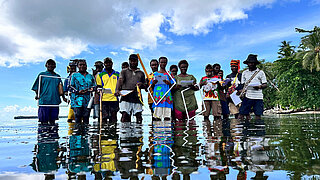
With IKI funding, Papua New Guinea is pioneering a national policy roadmap to protect mangroves and seagrass in the Pacific – enhancing climate action, biodiversity, and resilient coastal communities.
Papua New Guinea, with support from the International Climate Initiative (IKI), has reached a milestone by developing a national Blue Carbon Policy Roadmap. The country is taking a leading role in the region on climate resilience by formalising blue carbon conservation as a central climate solution.
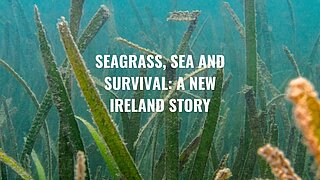
Blue carbon ecosystems like mangroves and seagrass areas can store up to ten times more carbon per hectare than terrestrial forests ("green carbon") and make a crucial contribution to climate mitigation. At the same time, they are indispensable for food security, cultural heritage, and livelihoods in Papua New Guinea, where around 90 per cent of the population depend on natural resources.
The Blue Carbon Policy aims to systematically embed the conservation of these mangrove and seagrass ecosystems – among the largest and most valuable in the region – into national strategies.
An inclusive approach to policy development
At the core of the initiative is a roadmap for 2025–2028, which links the conservation of blue carbon ecosystems with the strengthening of coastal communities and the achievement of global climate goals.
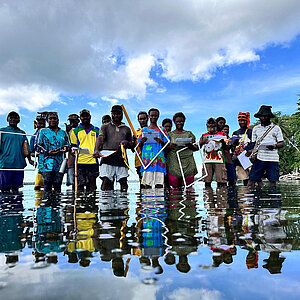
The roadmap was developed through a participatory process. National authorities, provincial administrations, research institutions, NGOs, and, importantly, coastal communities contributed their perspectives during consultations. The resulting policy is not stand-alone but aligns with existing national frameworks, including the Papua New Guinea Climate Compatible Development Management Policy, the Nationally Determined Contributions (NDCs), the Protected Areas Policy, and the Coastal Fisheries Management Framework. In doing so, the Blue Carbon Policy fills a previously existing gap while reinforcing existing strategies.
IKI project provides key support
The IKI-funded project implemented by the Deutsche Gesellschaft für Internationale Zusammenarbeit (GIZ) – “Strengthening coastal biodiversity conservation and management through protection and rehabilitation incentives for coastal carbon sinks in Pacific Island countries” – provided crucial support for the development and organisation of the roadmap. Targeted workshops and consultations brought together technical expertise, administrative experience, and local knowledge.
“The technical working group was able to deliberate and finalise the roadmap because of these engagements,” emphasises Phelameya Haiveta, GIZ’s Coastal Ecosystems Advisor in Papua New Guinea. She stresses that the long-term impact now depends on national ownership: “Once projects end, it’s the government, provincial authorities, and communities who must take this forward.”
Looking Ahead: Vision 2035
With the finalisation of the roadmap for 2025–2028, Papua New Guinea sends a clear signal: the protection of blue carbon ecosystems is a national priority. By 2035, the country aims to be recognised as a leader in the Pacific – with healthier ecosystems, more resilient communities, and sustainable revenues from blue carbon initiatives.
The link has been copied to the clipboard
Contact
IKI Office
Zukunft – Umwelt – Gesellschaft (ZUG) gGmbH
Stresemannstraße 69-71
10963 Berlin