
Sustainable Mobility Gains Ground in East Africa
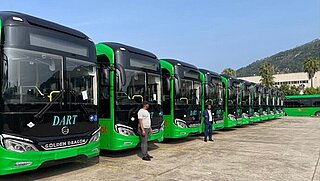
An IKI project shows how buses, cycle lanes and pedestrian-friendly streets can ease traffic congestion in East African cities. This reduces greenhouse gas emissions and improves people's quality of life.
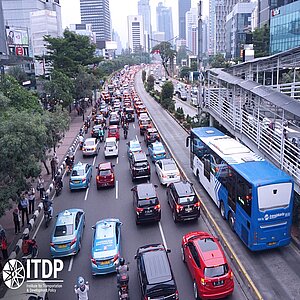
The rapid growth of cities across East Africa presents a significant challenge: how to move millions of urban residents safely, efficiently, and sustainably. Uncontrolled traffic congestion and urban sprawl have led to a surge in greenhouse gas emissions and air pollution, while also making it more difficult for many to access jobs and essential services.
The "Growing Smarter" Project
With support of the International Climate Initiative (IKI), the Institute for Transportation and Development Policy (ITDP)’s Africa team and partners at UN-Habitat embarked on the "Growing Smarter: Sustainable Mobility in East Africa" project in 2018 to transform the way people experience and move around urban areas with a focus on bus systems, walking, and cycling.
What began as ambition is now action – this new vision for urban mobility continues to gain ground in some of East Africa’s largest cities. Across Ethiopia, Kenya, Rwanda, Tanzania, and Uganda, the project has helped to foster deep collaboration with regional and global decision-makers and planners working to reduce traffic congestion and enhance public infrastructure.
Centering Bus Rapid Transit Systems (BRT) and Public Transport
Tanzania
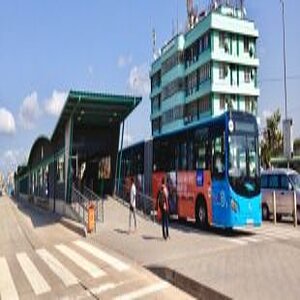
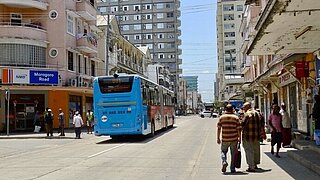
In Dar es Salaam, Tanzania, the project focused on extending the Dar Rapid Transit (DART) BRT as a reliable alternative to private cars and enhancing walking and cycling facilities. The IKI project assisted in design reviews and monitoring for the first three phases, which include 64.8 kms of bus lanes, and provided support for two additional phases totaling 56.1 kms. Initial operations reduced travel time from 2 hours to 45 minutes over the 21 kms of BRT Phase 1. Phase 2 is slated to launch in 2025, expanding the impact to more residents across the city. Once complete, the system could transport over three million passengers daily.
In a major win for the DART Agency, the long-anticipated adoption of the gross-cost contract model for BRT operations has finally been approved for Phase One operations, marking a pivotal step towards better urban mobility for Dar es Salaam. This shift away from the previously used net-cost contract model, where operators assumed revenue risks, promises to enhance service reliability and financial stability by ensuring operators are better compensated based on service delivery rather than fare collection.
Ethiopia
The IKI project also offered vital support to ITDP Africa’s efforts to ensure best-practice BRT designs for BRT B2 and B6 in Addis Ababa and to secure financing for the corridors.
Kenya
The IKI project supported the development of the service plan for BRT Line 2, emphasizing the need for a third-generation system that connects passengers directly to their destinations. The government has renewed its commitment to the project, with construction expected to resume in late 2025.
Uganda
In the capital, Kampala, the project´s technical assistance is ensuring that ongoing infrastructure improvements are aligned with the Capital City Authority’s roadmap for BRT design and implementation. While much of this planning work on new BRT systems is ongoing, it underpins a growing regional interest in high-quality, accessible public transport and a need for further investments into the future.
Championing Streets for Walking and Cycling
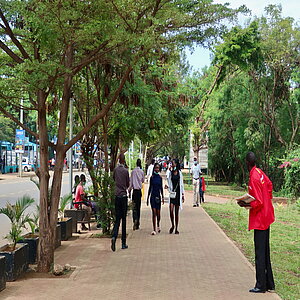
Sustainable mobility also means highlighting non-motorised and active modes. With IKI’s support, ITDP Africa and partners worked closely with national and city governments to assess and plan for the needs of pedestrians and cyclists in rapidly growing areas. The project has enabled several city governments across East Africa to develop new urban street design manuals that emphasize safety and accessibility.
Ethiopia
Addis Ababa’s Transport Bureau, supported by the project, is spearheading a four-year Non-Motorised Transport (NMT) Implementation Plan as part of a broader ten-year strategy to improve conditions for walking and cycling. Under the IKI project, a comprehensive cycle network plan has been developed, featuring 100 kms of walkways and cycle tracks, with another 76 kms in the design phase.
Kenya
In Kenya, cities like Kisumu, Mombasa, and Nairobi are further setting new benchmarks for non-motorised transport with protected cycle tracks, wider footpaths, and safer public spaces. In Kisumu, the Growing Smarter project worked on the development of the Sustainable Urban Mobility Plan in 2020 and helped prepare conceptual designs for Phases 2 and 3 of NMT improvements, including high-quality walkways and protected bike lanes. Implementation is planned by Kisumu County with funding from the World Bank.
Driving Policy and Planning
Sustainable mobility depends on reshaping policies and mobilizing key resources to move beyond car-centric development. The Growing Smarter project has played a pivotal role in supporting some of Africa’s fastest-growing cities by crafting regional strategies – from parking reform and cycling roadmaps, to integrated public transport planning. These high-level interventions help ensure that urban growth is guided toward sustainable, mixed-use communities built around walking, cycling, and transit.
Through regional conferences and knowledge-sharing events, the project has further cultivated a strong community of practice among planners and policymakers across the continent. By combining technical expertise with strategic partnerships and policy-driven change, this project has driven not only local mobility improvements, but also broader regional transformations in urban development and climate action.
The link has been copied to the clipboard
Contact
IKI Office
Zukunft – Umwelt – Gesellschaft (ZUG) gGmbH
Stresemannstraße 69-71
10963 Berlin
Funding priority
The IKI Strategy
The IKI aims to achieve maximum impact for the protection of the climate and biodiversity. To this end, it concentrates its funding activities on prioritised fields of action within the four funding areas. Another key element is close cooperation with selected partner countries, in particular with the IKI's priority countries.