
Training youth for freshwater conservation in Northeastern India
In our new series “Youth Empowerment and Action Highlight” – or IKI YEAH for short – we present successful initiatives from IKI projects that empower young people to engage in sustainable transformation. In this edition, we present a project from India.
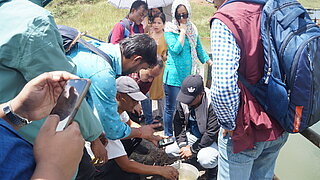
The project “Protecting Aquatic Ecosystems in India's Northeastern Himalaya Region”, funded by the International Climate Initiative (IKI), provided training to young people from Khliehshnong village, as well as to field officers from the Fisheries Departments and the Meghalaya State Biodiversity Board, in mapping aquatic habitats. The objective was to equip local youth with the necessary skills to carry out rapid habitat assessments of water bodies in preparation for future conservation interventions.
To support the effective management of the aqua park, youth also received training in nature interpretation, providing guided tours, aquarium maintenance, and understanding snakehead species — including their taxonomy, morphology, biology, and feeding habits.
Results
The activities led to three main outputs. First, a habitat assessment of the water body in Khliehshnong was conducted in order to generate recommendations for future implementation. Second, the capacity of frontline staff from the Fisheries Department and local youth was strengthened through targeted training. Lastly, a user manual was developed to guide similar exercises in the future. The assessment contributes to a better understanding of the overall health of the water body and indicates an absence of contaminants.
Lessons Learned
This activity aimed to integrate scientific expertise with locally grounded knowledge. The technical institute contributed the necessary scientific input and methodology for conducting a rapid habitat assessment. Local youth enriched the process with their understanding of local biodiversity, seasonal changes in aquatic life, and sources of pollution. The acitivity clearly demonstrated that valuable local expertise exists across all age groups.
Replication Potential
The involvement of field officers from the Department of Fisheries aimed to ensure that the knowledge gained would be institutionalised within the Department and applied in other regions of the state in the future. The demonstrated reciprocal strengthening of scientific and youth expertise offers a model that can be replicated in other sectors and regions — both within and beyond India.
The link has been copied to the clipboard
Contact
IKI Office
Zukunft – Umwelt – Gesellschaft (ZUG) gGmbH
Stresemannstraße 69-71
10963 Berlin
[Translate to English:] Jugendengagement in der IKI
[Translate to English:]
Erfahren Sie mehr, wie die IKI junge Menschen beim Klima- und Biodiversitätsschutz unterstützt.
Related Publications
-
 05/ 2025 | Educational material
Freshwater Fishes of Manipur, India: A Table Book on Fishes
English (PDF, 10 MB)