


Where crops and photovoltaic energy learn to coexist
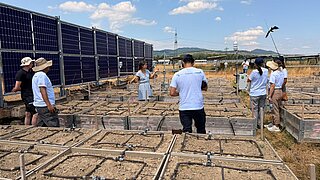
Solar panels above the crops: the IKI project JET-AgriSOL is testing in Colombia which agrivoltaic solutions actually work on site – and what this means for Colombian agriculture.
The question sounds simple: How can the same land produce food and solar energy without compromising farmers’ needs?
In Colombia, the answer is beginning to take shape through practical testing. By placing solar panels above crops, agrivoltaic systems could generate renewable electricity while keeping land in agricultural production.
But what works in one country may not work in another. Crops respond differently to shade, climates vary, and production systems have distinct energy, management and socioeconomic needs.
For Colombia, the task is therefore not simply to replicate solutions developed elsewhere. It is to learn what works locally. That is the purpose of the JET-AgriSOL project, which is funded by Germany’s International Climate Initiative (IKI).
The project is laying the foundations for an Agrivoltaics (APV) Laboratory at CIAT’s Palmira campus, complemented by a network of research pilots under real production conditions. Together, they will generate the evidence needed by farmers, communities and agribusinesses to decide whether and how agrivoltaics can become part of Colombia’s agricultural and energy future.
A solution for more than clean energy
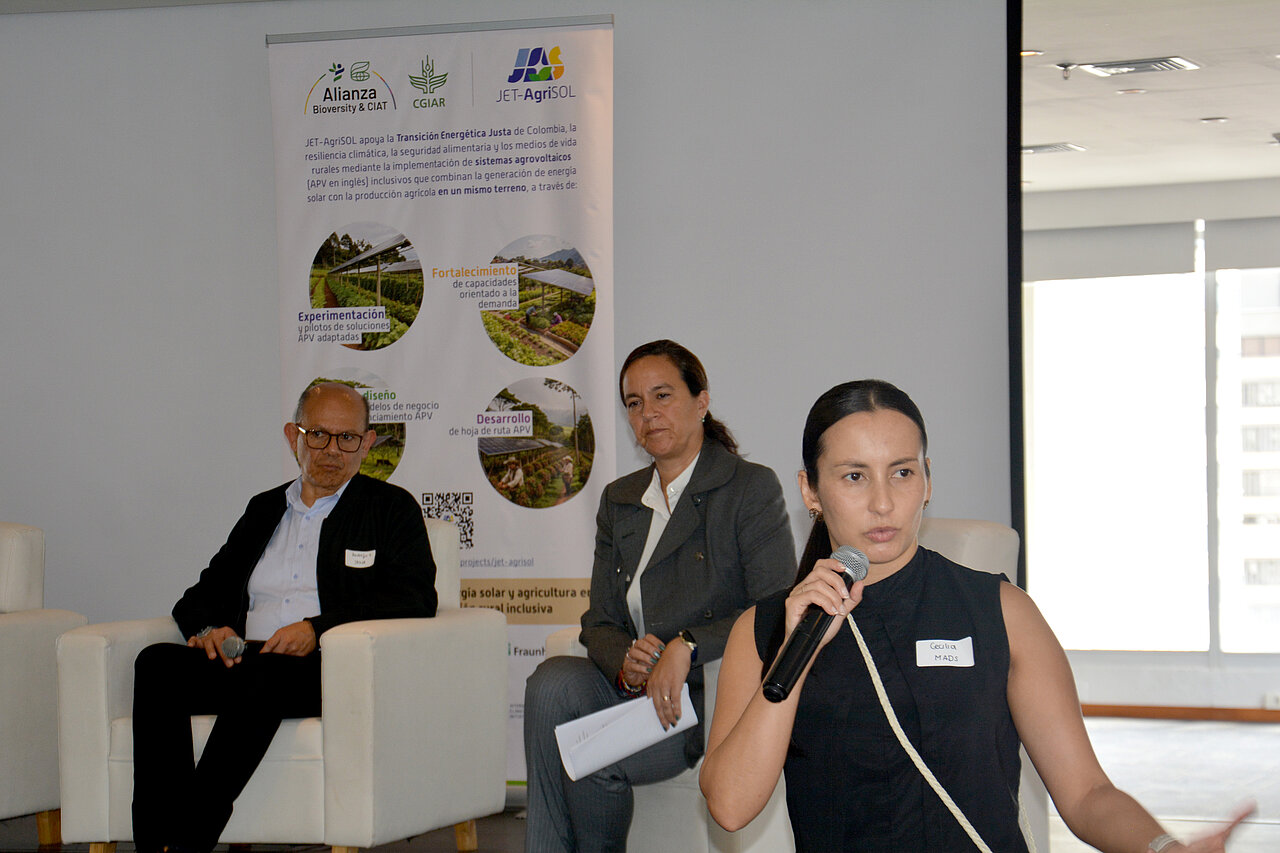
When Cecilia Medina looks at agrivoltaics, she sees more than solar panels standing alongside crops.
For the climate-change specialist at Colombia’s Ministry of Environment and Sustainable Development, the technology could help connect renewable energy, food production and rural development. At the project launch in Bogotá, she described agrivoltaics as an emerging “real solution” for Colombia’s Just Energy Transition.
How inspiring it is to see how agrivoltaics is beginning to establish itself as a real solution to drive a just energy transition and rural development in Colombia. From the Ministry of Environment, we accompany and support initiatives like JET-AgriSOL, which integrate agriculture, renewable energy, and climate resilience, especially in rural territories where electrical grid interconnection still represents a major challenge. These models not only contribute to decarbonisation and food security, but they also open up opportunities to strengthen energy communities, improve quality of life, and promote a more inclusive and sustainable development for the country's rural communities.”
Her vision points to the wider potential of the technology. In rural areas where connection to the electricity grid remains a major challenge, combining agricultural production with renewable energy could create new opportunities. But turning that potential into practical solutions requires more than optimism. It requires evidence.
Learning what works in Colombia
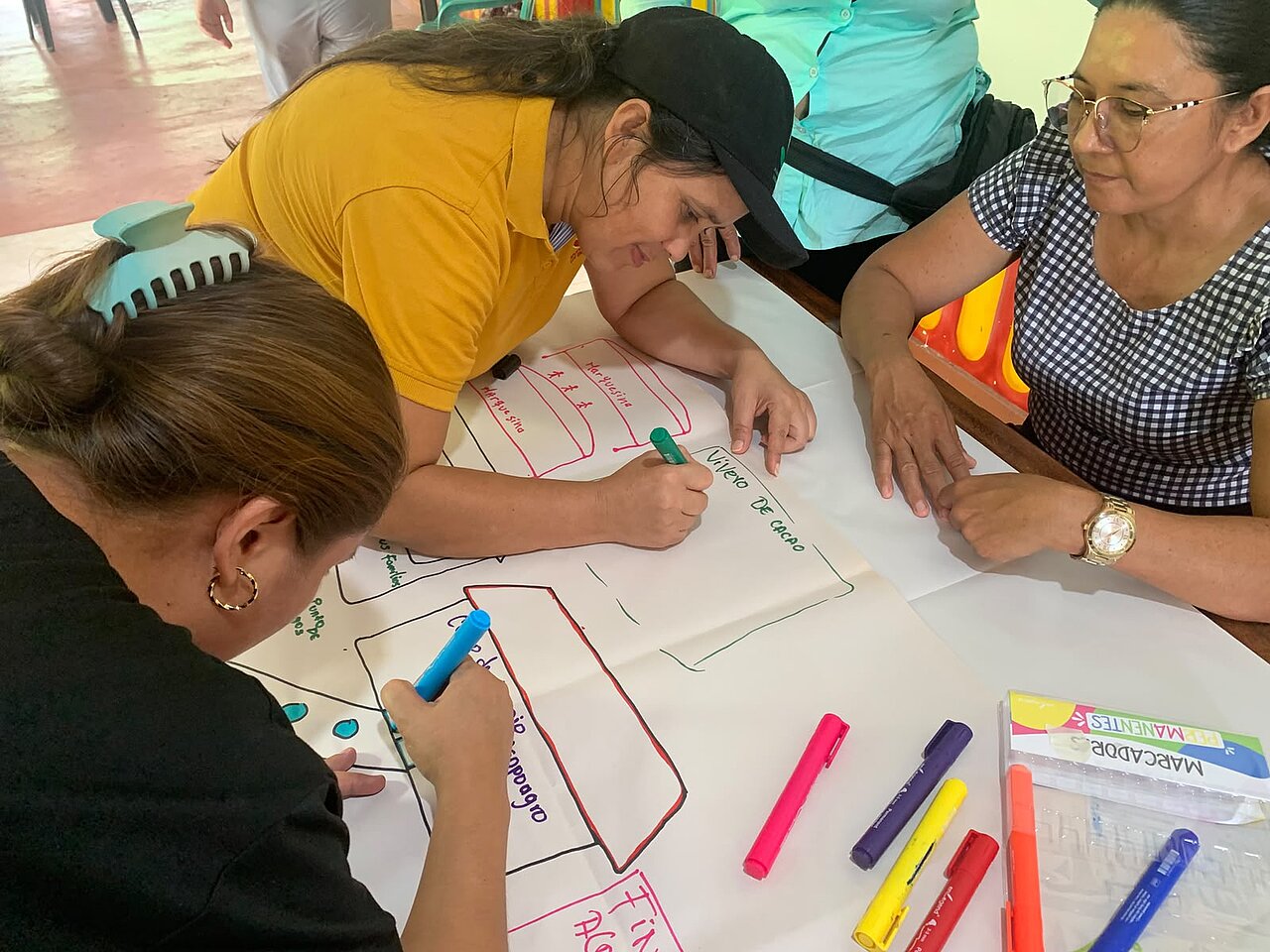
The IKI project is designed around a simple principle: test before scaling. The planned APV Lab is not intended simply to prove that agrivoltaics works. Its purpose is to find out where, how and for whom it can work in Colombia.
This approach began during the project’s preparation phase. JET-AgriSOL consulted smallholder communities and producer organizations and engaged institutions working across Colombia’s energy, agriculture, environment and planning sectors. These exchanges helped connect scientific questions with local priorities.
They also helped frame agrivoltaics as more than a clean-energy technology. The project is exploring its potential contribution to agricultural and rural development while ensuring that community perspectives and production realities inform the research.
The IKI project is designed around a simple principle: test before scaling.
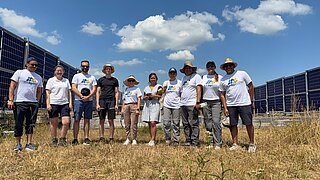
Members of the leadership and technical teams of JET-AgriSOL consortium partners (CIAT, Fraunhofer ISE and Colibrí Energy) also met in Freiburg, Germany to agree on an experimental approach adapted to Colombian conditions. Building on this joint work, the consortium is now designing a laboratory capable of rigorously comparing different agrivoltaic configurations and crops.
The approach combines international experience with knowledge of Colombian agriculture and renewable energy, creating a shared research framework for the country.
From evidence to decisions
The project is still at an early stage. Its impact cannot yet be measured in hectares covered, energy generated or farmers reached.
Its first achievement is instead the foundation for future decisions.
Controlled experiments at the APV Lab will systematically compare crops and agrivoltaic configurations. Research pilots with project partners will examine how the systems perform under different real-world conditions. By bringing these two settings together, JET-AgriSOL aims to connect scientific evidence with the practical choices that future users of agrivoltaics will have to make.
For pilot partners, early findings can already help refine their choices. As evidence accumulates, communities and agribusinesses will be better placed to assess which configurations fit their crops, energy needs, production systems and investment conditions.
This is where the project’s planned impact becomes tangible: knowledge generated in Colombia can reduce uncertainty for those considering agrivoltaics.
Rather than relying on assumptions or transferring solutions developed in other regions, future users can draw on evidence generated under Colombian conditions.
Putting communities and production at the centre
The APV Lab is designed to ensure that applied research reflects the realities of agricultural production and the needs of communities.
The evidence generated through the Lab and the research pilots is intended to be translated into practical guidance, community-scale applications and future agribusiness APV systems.
If the project identifies innovations that are technically effective, locally relevant and commercially viable, they could help communities strengthen production, create value and participate in emerging agribusiness models.
The potential benefits therefore extend beyond electricity generation. By bringing agriculture and renewable energy together, agrivoltaics could contribute to more resilient rural development while creating opportunities for communities and businesses.
Learning before scaling
Designing agrivoltaics for a tropical country is not a one-size-fits-all exercise. Different crops, climates and production systems mean that configurations need to be tested and adapted to their local context.
JET-AgriSOL is building the evidence pathway to do exactly that: test, compare, learn and adapt before scaling.
For Colombia’s communities, agribusinesses and public institutions, the planned APV Lab and research pilots can provide a stronger basis for deciding where agrivoltaics can deliver on its promise, and where further adaptation is needed.
Cecilia Medina’s vision of agrivoltaics as part of a more inclusive Just Energy Transition ultimately depends on this process of learning. Before the technology can be scaled, Colombia needs to know what works. Germany’s International Climate Initiative is helping create the conditions to find out.
The link has been copied to the clipboard
Contact
IKI Office
Zukunft – Umwelt – Gesellschaft (ZUG) gGmbH
Stresemannstraße 69-71
10963 Berlin