

CitiesAdapt: strengthening climate change adaptation in cities
Rapid urbanisation and the impacts of climate change are increasing the pressure to accelerate climate adaptation measures in fast-growing secondary cities in Mexico and South Africa. Adaptation efforts in both countries are affected by lacking capacities of cities and improvable urban development instruments. Against this background, the project worked with two cities to support their transformation towards a more climate-resilient and pro-poor urban development by building on capacity development, improved mainstreaming of climate adaptation into planning processes, and the implementation of small-scale, easily replicable adaptation measures in public spaces of disadvantaged neighbourhoods. The project enabled strong mechanisms of peer-to-peer learning and scaling-up between the project´s partner cities, mentor, and transfer cities as well as national ministries relevant for climate change adaptation and urban development.
- Countries
- Mexico, South Africa
- IKI funding
- 3,999,999.74 €
- Duration
- 03/2022 till 12/2025
- Status
- completed
- Implementing organisation
- Deutsche Gesellschaft für Internationale Zusammenarbeit (GIZ) GmbH
- Political Partner
-
- Department of Forestry, Fisheries and the Environment (DFFE) - South Africa
- Mexican Agency for International Development Cooperation (AMEXCID)
- Implementing Partner
-
- Ministry for Agricultural, Territorial and Urban Development (SEDATU) - Mexico
- Ministry of Cooperative Governance and Traditional Affairs - South Africa
- Ministry of Environment and Natural Resources (SEMARNAT) - Mexico
State of implementation/results
- Project completed.
- Stronger local adaptation planning: CitiesAdapt supported urban adaptation policies in partner cities Mérida (Mexico) and uMhlathuze (South Africa), as well as several transfer cities, e.g. development of neighbourhood adaptation strategies, municipal climate action plans, a green infrastructure plan, a buffer zone assessment. --*
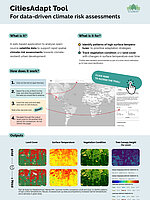
- New digital mapping tool for urban adaptation: The project developed a free remote sensing tool using open-source satellite data to identify and compare urban heat islands and land use changes over time. Partner cities use the tool for planning and climate action. --*
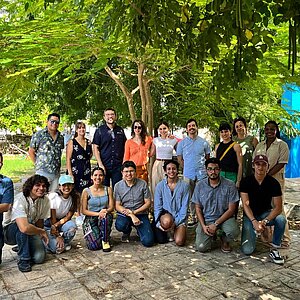
- Over 1.000 professionals trained: Topics included data for urban adaptation planning, climate-resilient design and urban climate finance. Trainings are now part of national training catalogues. CitiesAdapt also facilitated over ten peer-to-peer exchanges.
- Awareness raised among residents: Community members in both partner cities learned about local climate change impacts through interactive events such as awareness workshops, educational campaigns, a school competition, and a “nature and science” day. --*
- Concrete measures implemented in vulnerable neighbourhoods: Adaptation measures were developed in both partner cities through a participatory process involving local governments, academia, the private sector, civil society, and communities, ensuring the meaningful inclusion of Indigenous groups, women, youth, and older adults. In Plan de Ayala Sur, Mérida, measures have been implemented in a public space next to a medical clinic and primary school. Solutions included pollinator and community gardens, planting and maintenance of trees and rain gardens to improve water infiltration – helping residents better cope with waterlogging, dengue outbreaks and extreme heat. --*
- Scaling-up successful approaches: CitiesAdapt promoted its approach nationally and internationally, including the publication and presentation of the model “Future-Proofing our Neighbourhoods”, a practical method for local urban adaptation planning and implementation. Multi-level dialogues between local and national actors were organized in both countries. --*
- Replication: Many cities have shown interest in CitiesAdapt’s urban adaptation tools, instruments and measures. Building on a successful student competition for universities in Mexico that identified concrete adaptation actions in Plan de Ayala Sur, a new university competition has been launched through a private sector-science-government partnership. Measures will be implemented by the Urban Ministry, Yucatán state government, municipality of Mérida and private sector companies, supported by civil society organizations. Through a collaboration with the Mexican paint company COMEX, adaptation measures have already been replicated in transfer cities including San Mateo del Mar, Tepic, and Tulum.
Latest Update:
04/2026
Project relations
Legend:
The link has been copied to the clipboard

Related Publications
-
 05/ 2025 | Tool/Open source product
CitiesAdapt Tool
English (PDF, 1 MB)
Spanish (PDF, 1 MB)
Portuguese.pdf (PDF, 1 MB)
-
-
10/ 2024 | Tool/Open source product
GIZ CitiesAdapt's Toolbox and Resource Library
English (PDF, 276 KB)
Spanish (PDF, 357 KB)
-
10/ 2024 | Tool/Open source product
GIZ CitiesAdapt's Repository of Tools and Resources
English (ZIP, 3 MB)
Spanish (ZIP, 14 MB)
-
10/ 2024 | Tool/Open source product
Access to Finance for Adaptation Measures at the Hyper-local Level Guide
English (PDF, 654 KB)
Spanish (PDF, 981 KB)

![[Translate to English:] Cover Publikation "Access to Finance for Adaptation Measures"](/fileadmin/_processed_/2/8/csm_20241029_giz_Finance_Adaptation-Measures_CitiesAdapts_c365d63d79.jpg)