
CoralCarib: pioneering a new strategic approach for conserving and restoring Caribbean coral reef ecosystems that targets climate resilient refuges
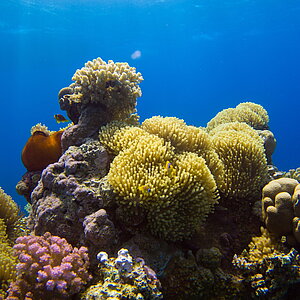
The future of the Caribbean is closely tied to the health of its coral reefs. Live coral cover – a key measure of coral health – in the Caribbean has declined by 60% over the past few decades due to a combination of global and local threats. Degradation of coral reef ecosystems threatens the region’s population, as local economies depend heavily on healthy reefs, which provide over €0.85 million per km2 in critical ecosystem goods and services (e.g., fisheries, coastal protection, tourism and recreation). This project will pioneer a new strategic approach focused on Coral Climate Refugia, with activities designed to protect, restore, and sustainably use coral reefs with high potential to survive future climate impacts. Major activities include effective management of marine areas, abatement of reef threats, coral restoration using advanced technologies, promotion of sustainable livelihoods, and a range of scaling activities to achieve region-wide impacts.
- Countries
- Belize, Cuba, Dominican Republic, Haiti, Jamaica
- IKI funding
- 6,500,000.00 €
- Included preparation phase
- 150,000.00 €
- Duration
- 11/2022 till 10/2028
- Status
- open
- Implementing organisation
- The Nature Conservancy (TNC) - International
- Political Partner
-
- Belize Fisheries Department - Belize
- Ministry of Housing, Urban Renewal, Environment and Climate Change (MHURECC ) - Jamaica
- Ministry of Science, Technology and the Environment (CITMA) - Cuba
- Ministry of the Environment - Haiti
- National Council for Climate Change and the Clean Development Mechanism - Dominican Republic
- Implementing Partner
-
- Alligator Head Foundation
- Dominican Foundation of Marine Studies
- Grupo Puntacana Foundation
- Haiti Ocean Project (HOP)
- Haiti’s Environment and Integrated Development Initiative (IEDIH)
- National Aquarium of CUBA
- University College London (UCL)
State of implementation/results
- FGPC and FUNDEMAR signed a data contribution agreement for the Caribbean region report on the status of coral reefs that will be published in 2025.
- Dec. 2024:
- CoralCarib team members attended the Reef Futures Global Symposium 2024 in Mexico and gave 10 presentations focused on Coral reef monitoring, impact of the 2023 bleaching event on coral restoration and strategies for adaptation, and value of in-situ coral nursery.
- Oct. 2024:
- During MarCuba 2024, a key international event for marine conservation in the Caribbean, the project brought together experts from across the region to exchange knowledge on reef restoration.
- In sessions hosted at the National Aquarium of Cuba and the Meliá Habana Hotel, CoralCarib representatives from Cuba, the Dominican Republic and the U.S. Virgin Islands discussed advances, challenges and lessons learned in coral restoration.
- A highlight was a session on Design and Development of Coral Reproductive Laboratories, where Jessica Ward (TNC), Rebecca Garcia (Fundación Grupo Punta Cana) and Sergio Guendulain (FUNDEMAR) presented their experiences in the construction of laboratories in the U.S. Virgin Islands, Punta Cana and Bayahibe, respectively. These laboratories have been crucial to implement reproduction and restoration strategies in the region and will serve as a model for the new laboratory planned in Punta Perdiz, in the Zapata Swamp, Cuba.
- Haiti:
- CoralCarib local partner, Haiti Ocean Project, established a coral nursery with ten coral trees, involving youth and fishers.
- Cuba:
- CoralCarib delivered equipment for the launch of a new coral restoration lab at the Acuario Nacional de Cuba in Havana. This facility will strengthen Cuba’s role in regional conservation efforts, fostering knowledge-sharing and innovative opportunities for local partners and communities while utilizing sexual reproduction techniques to restore coral populations.
- Dominican Republic:
- The Coral Innovation Hub is jointly hosted by Fundación Grupo Puntacana (FGPC) and Fundación Dominicana de Estudios Marinos (FUNDEMAR). Together, these organizations have produced over 3,122 coral fragments from six species in terrestrial nurseries and maintain 40 marine nursery structures focused on critically endangered staghorn coral. New facilities are under construction and will further enhance coral research and restoration capacity through methods such as AI-powered tools, including automated systems for planting coral and analyzing large amounts of field data to identify resilient corals to incorporate into restoration activities.
Latest Update:
04/2026
Project relations
Legend:
The link has been copied to the clipboard