

Coronavirus pandemic: financing deforestation-free supply chains in Africa
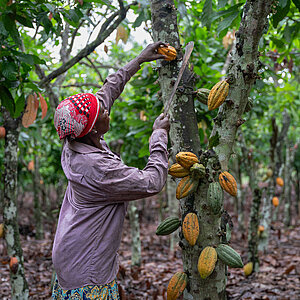
Communities in (sub-)tropical Africa dependent on forests for their livelihoods have been hard-hit financially by Covid-19. Investments in the value chains for speciality coffee and cocoa in western and eastern Africa can promote deforestation-free production while also supporting reforestation and economic growth. The Regeneration initiative supports the financing of sustainably produced coffee and cocoa in western and eastern Africa. The initiative is targeting distributors, who can purchase products from smallholders and agricultural cooperatives with the operating capital provided by IKI. The initiative brings together a network of distributors in many African countries that the two implementing organisations have set up in the course of various programmes conducted in recent years. The initiative’s model also has the potential to be expanded step by step to encompass other deforestation-free supply chains, countries and continents.
- Countries
- Ivory Coast, Ethiopia, Ghana, Kenya, Uganda
- IKI funding
- 10,000,000.00 €
- Duration
- 12/2020 till 07/2026
- Status
- open
- Implementing organisation
- The Palladium Group
- Political Partner
-
- Ministry of Agriculture, Animal Industry and Fisheries - Uganda
- Ministry of Agriculture, Livestock and Fisheries - Kenya
- Ministry of Agriculture and Natural Resources - Ethiopia
- Ministry of Food and Agriculture - Ghana
State of implementation/results
- The Rebuild Facility is a financing facility of Regeneration that supports sustainable cocoa and coffee businesses in East and West Africa. The project has a three-pronged mission: to conserve tropical forests, strengthen the private sector, and protect smallholder incomes. Jointly implemented by Palladium International and Systemiq under the Regeneration platform, the project works in Ghana and Côte d’Ivoire (for cocoa) and Ethiopia, Kenya and Uganda (for coffee).
- Rebuild Facility's financing is provided in the form of interest-free working capital to cooperatives, aggregators, off-takers, and buyers of sustainable, certified cocoa and coffee.
- Similarly, Technical Assistance is provided in three focus areas: traceability and data management support to meet new regulations like the European Union Deforestation Regulation; support toward accessing finance; and business strategy and governance support toward increasing revenues.
- Returnable grants and technical assistance offered through the Rebuild Facility ensure the continued purchase of sustainably produced commodities from communities and community-based enterprises. As the products are successfully sold to end-markets, the working capital financing is returned and reinvested to bolster and enlarge sustainable and fair value chains.
- The Rebuild Facility began implementation in December 2020 and has, so far, supported 38 different organisations, contributed to securing livelihoods of 62,408 cocoa and coffee farmers, unlocking 31.9 million EUR of finance for companies, and placing 123,299 hectares of land under sustainable land use.
Latest Update:
04/2026
Project relations
Legend:
The link has been copied to the clipboard
Related Videos

Related Publications
-

-
08/ 2023 | Educational material
Scaling deforestation-free robusta coffee production in Uganda
English (PDF, 11 MB)

