
Restoring Landscapes in South Africa (ReLISA): Nature-based solutions for climate, biodiversity and people
Large areas of the most important biomes in South Africa are severely degraded due to overexploitation and climate change. The project addresses this landscape-wide degradation and makes the economic case for restoration. By creating the conditions for a just transition of the land-use sector and mobilising investment at scale, the project seeks to restore degraded priority areas in key biomes (grasslands, savannas, thicket), while recognising the socio-cultural and economic context. On-the-ground implementation in close consultation with various stakeholders will contribute effectively to adapt to the impacts of climate change, address biodiversity loss, while improving livelihoods of rural communities and commercial farmers. Targeted capacity development and creating bankable investment opportunities for the private sector will support the upscaling of South Africa’s restoration efforts, climate objectives, green economy and other environmental targets under the Rio conventions and the UN Decade 2021-2030.
- Countries
- South Africa
- IKI funding
- 14,547,493.00 €
- Included preparation phase
- 441,867.00 €
- Duration
- 11/2024 till 10/2029
- Status
- open
- Implementing organisation
- United Nations Environment Programme (UN Environment) - Kenya
- Political Partner
-
- Department of Cooperative Governance and Traditional Affairs (COGTA)
- Department of Forestry, Fisheries and the Environment (DFFE) - South Africa
- Department of Planning, Monitoring and Evaluation (DPME)
- South African National Biodiversity Institute
- Implementing Partner
-
- Council for Scientific and Industrial Research (CSIR) - South Africa
- The Endangered Wildlife Trust (EWT)
- United Nations Development Programme (UNDP)
- United Nations Educational, Scientific and Cultural Organization (UNESCO)
- Online
State of implementation/results
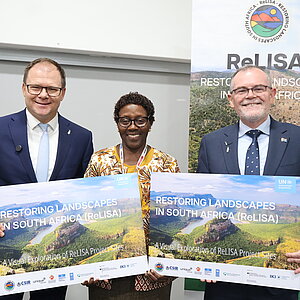
- ReLISA was officially launched on the margins of the 3rd G20 Environment and Climate Sustainability Working Group (ECSWG) meeting in Cape Town in October 2025.
- Project governance and coordination were strengthened through the first Project Steering Committee meeting in Pretoria in February 2026, with the Terms of Reference signed in March 2026 by the Department of Planning Monitoring and Evaluation (DPME) and the Department of Forestry, Fisheries and the Environment (DFFE).
- Restoration is advancing in priority landscapes:
- In the Northern Drakensberg, 42ha of invasive species have been cleared, while further clearing is underway in the Soutpansberg.
- In Amathole, the proposed 5,491ha Rising Ground Nature Reserve has entered the formal declaration process.
- In Kruger to Canyons, preparations are underway for restoration covering 1,000ha of invasive alien plant clearing, follow-up clearing on 150ha and improved rangeland management on 200ha.
- ReLISA is also supporting expansion of the existing uThukela Water Fund into areas of the proposed Northern Drakensberg Biosphere Reserve.
- Investment assessments have progressed across the biomes:
- The Northern Drakensberg grassland restoration opportunity has advanced from pre-feasibility to full feasibility, supported by field assessments and soil-carbon sampling.
- Pre-feasibility assessments for restoration opportunities in the Wild Coast and for biochar production in the Waterberg have also advanced.
- In the Waterberg, mapping and field verification identified degraded and bush-encroached areas and informed upcoming restoration planning. Engagements involved over 100 community representatives, with 50-60% women participating in discussions on restoration, ecosystem management and climate adaptation.
- The strengthening of South Africa’s Monitoring, Reporting and Verification system has progressed from framework design towards testing. Prototypes for the monitoring system, laboratory information system and field-data collection application are now being tested to improve the quality and integration of restoration data and support future national climate, biodiversity and land reporting.
- The scientific evidence base for restoration investment is being strengthened through partnerships with local universities and fieldwork. Data collection has been completed at multiple grassland sites in the Wild Coast and fence-line comparison sites in Northwest and Free State, examining restoration impacts including soil carbon, vegetation, biodiversity and ecosystem functioning.
- ReLISA participated in various high-level events including the National Agroecology Framework for South Africa Workshop (NAFSA, April 2026), the 3rd Land Degradation Neutrality National Working Group Meeting (LDN NWG, May 2026), the IUCN-led Carbon Markets Forum (May 2026), the National Ecosystem-based Adaptation COP (EbA COP, June 2026), the Southern African Regional Conference on Soil Health (June 2026), and the UN Convention to Combat Desertification COP17 (UNCCD COP, Aug 2026).
- The ReLISA website continues to be updated: www.relisa.org
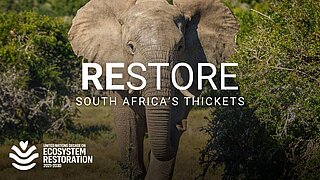
- In December 2025 “Thicket Restoration in South Africa”, a movement spearheaded by ReLISA, was recognized as a UN World Restoration Flagship: www.decadeonrestoration.org/…
Latest Update:
10/2026
Further links
- Article "UN recognition is latest boost to restoring spekboom across South Africa’s semidesert Karoo"
- Article "SA’s award-winning thicket project on track to create 100,000 jobs and revive 800,000 hectares"
- UN Decade Website "Thicket Restoration in South Africa"
- Photobook for ReLISA project
- Short slide show for ReLISA project
- Interactive map of ReLISA project sites
Project relations
Legend:
The link has been copied to the clipboard