
Growing smarter – sustainable mobility in East Africa
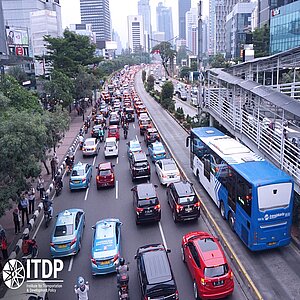
The rapid growth in African cities leads to traffic jams and uncontrolled urban sprawl – and the consequences are rising greenhouse gas emissions, air pollution, urban poverty and climate vulnerability. The project helped to avoid this and reduce greenhouse gas emissions in the transport sector at the same time by supporting public & non-motorized transport and urban planning in the target countries. It also supported the implementation of high-quality public transport systems in Addis Ababa, Nairobi, Kigali and Kampala and the expansion of the existing bus rapid transport system in Dar es Salaam. The integration of public transport with cycling and walking was improved and urban development along transport corridors was addressed. The project also promoted policy frameworks at urban and national levels, accelerating changes in the transport sector through quality standards, improved financing and other policy measures.
- Countries
- Ethiopia, Kenya, Rwanda, Tanzania, Uganda
- IKI funding
- 4,998,829.00 €
- Duration
- 09/2018 till 02/2026
- Status
- completed
- Implementing organisation
- Institute for Transportation & Development Policy (ITDP)
- Political Partner
-
- Ministry of Infrastructure Rwanda
- Ministry of Roads and Transport - Kenya
- Ministry of Transport and Logistics - Ethiopia
- Ministry of Works and Transport (MOWT), Uganda
- President’s Office, Regional Administration and Local Government - Tanzania
- Implementing Partner
-
- UN-HABITAT
- Online
State of implementation/results
- Ethiopia:
- In 2025 the Addis Ababa Transport Bureau, with support from the project, developed a four-year Non-Motorised Transport (NMT) Implementation Plan, the third Implementation Plan under the NMT Strategy, outlining a set of immediate actions that can be taken to improve the walking and cycling environment. The Implementation Plan accompanies the 10-year Addis Ababa Non-Motorized Transport Strategy, which identifies key goals, quantitative indicators, and implementation targets.
- The project supported the Ministry of Urban Infrastructure and the Ministry of Transport and Logistics in developing the Ethiopia Urban Street Design Manual.
- The project reviewed operational plans and infrastructure designs for various BRT projects, including the B2, B3, B4, and B6 corridors. In February 2026, construction of BRT B2 corridor commenced. The project supported the Ministry of Transport in establishing appropriate business models to fast-track implementation. It also supported plamnning for the BRT B6 corridor, providing technical feedback to ensure best-practice design standards and aligning BRT elements with recent NMT improvements. In December 2025, the construction of what will become Ethiopia's first electric BRT corridor was launched.
- Kenya:
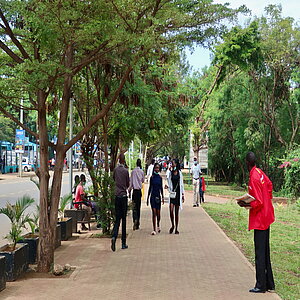
- The project supported Nairobi City County with the design of streets in the Nairobi central business district and Westlands district. The street design will result in equitable and inclusive streetscapes with wider footpaths, safe pedestrian crossings, street trees, and organised parking areas for public transport vehicles.
- From April 2024 to January 2025 the Project supported the preparation of the conceptual design for the Kisumu phase 2 NMT corridor. It is part of the Kisumu Sustainable Urban Mobility Plan supporting implementation of enhanced non-motorized transport in the City of Kisumu: improved streets will include wider footpaths, protected bike lanes, pedestrian crossings, and other street elements that will enhance the safety and comfort of pedestrians and cyclists.
- In partnership with the Nairobi Metropolitan Area Transport Authority, the project developed a travel demand model for public transport services in greater Nairobi as a basis for a public transport service plan.
- Rwanda:
- The project supported the city of Kigali in the implementation of a rapid bus system as well as in the development of master plans to align urban and transport planning based on the principles of transit-oriented development and to plan charging infrastructure for electric buses.
- In partnership with the City of Kigali, a Parking Management Strategy for Kigali was prepared. The strategy calls for increasing on-street parking fees to reflect market demand and improving enforcement mechanisms to prevent parking on footpaths.
- In early 2025 the project supported Rwanda in developing its first national urban street design guide to create safer, more inclusive, and sustainable streets nationwide.
- Tanzania:
- The project contributed through conceptual and planning inputs around walking and cycling integration and first and last-mile access improvements to planning for a new additional BRT phase, Phase 7, that will expand the Dar Rapid Transit (DART) BRT system to new parts of Dar es Salaam.
- DART, the Ministry of Lands, and municipal governments developed localised transit-oriented development (TOD) policies for Dar es Salaam with support from the project. The policies include corridor-wide regulations to guide elements such as zoning, parking requirements, and building facades.
- Through 2025, the project supported DART to present a Transit Oriented Development (TOD) based Local Area Plan (LAP) for the Gerezani Terminal, building on the Dar es Salaam corridor Development Strategy (CDS). The LAP proposes policy reforms to encourage appropriate densification, improve street design and connectivity, and support delivery of affordable housing.
- Uganda:
- The Ministry of Works and Transport, Kampala Capital City Authority (KCCA), and development partners developed a roadmap for BRT implementation in Kampala with technical assistance from the project. The project also supported the preparation of infrastructure designs for the planned BRT corridors.
- The project supported KCCA to review the design of key streets in the Central Business District. The review prioritized wider sidewalks, dedicated cycling lanes, tree planting, and improved pedestrian crossings to enhance comfort and safety for road users.
Latest Update:
10/2026
Further links
Project relations
Legend:
The link has been copied to the clipboard