
Securing crucial biodiversity, carbon and water stores in the Congo Basin Peatlands by enabling evidence based decision making and good governance.
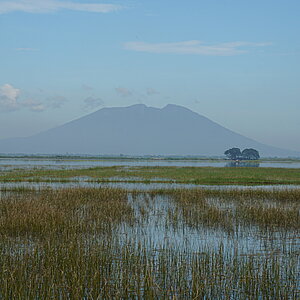
The Lac Télé/Lac Tumba landscape is a unique ecosystem shared between both Kongos. The landscape stores enormous amounts of carbon and harbors important populations of endemic species. The project supports the governments and stakeholders to mitigate climate and development impacts on biodiversity, water and carbon. The project contributes to a biodiversity-friendly development pathway through effective integrated land-use plans, improved sustainable livelihood approaches, methods, data and tools, addressing peatland and water monitoring, the National Investment Plans, and cross-sectoral coordination. This ultimately supports the conservation and sustainable management of the peatlands. Countries benefit of South-South cooperation to chart a new pathway to the sustainable management of their peatlands, for the benefit of people, and conserving its ecosystem services. The current undeveloped status of the region offers a critical opportunity to promote evidence based land use planning and improve natural resource management.
- Countries
- The Democratic Republic of Congo, Congo
- IKI funding
- 15,000,000.00 €
- Included preparation phase
- 159,772.21 €
- Duration
- 01/2022 till 12/2027
- Status
- open
- Implementing organisation
- United Nations Environment Programme (UN Environment) - Kenya
- Political Partner
-
- Ministry of Environment, Sustainable Development and the Congo Basin
- Ministry of Environment and Sustainable Development - DR Congo
- Implementing Partner
-
- Food and Agriculture Organization of the United Nations (FAO)
State of implementation/results
- Consultations to establish cross sectoral stakeholder platforms in the Republic of Congo (RoC) (Likouala department: Impfondo, Epena, Dongou, Enyele), were held in 03/2025 – 04/2025. Women and youth were actively represented across the various platforms. In the Democratic Republic of the Congo (DRC), these consultations were rescheduled in Mbandaka to 10/2025. During Q4 of 2025, cross-sectoral stakeholder platforms have been established and operationalized in DRC, specifically in Mbandaka, Bikoro, Bomongo, Makenza and Lukolela.
- Discussions with UNESCO in 2025 aimed to use UNESCO’s expertise and collaboration to catalyze a binational process (DRC and RoC) designating the Congo Basin peatlands as a trans boundary biosphere reserve. A UN-to-UN agreement is now at the finalization status to accelerate this process.
- In DRC, training on improved agricultural techniques, the use of camera traps, and biological inventories in the Triangle of Ngiri Nature Reserve is progressing.
- Forest concessions with potential for management plan development have been identified and officially registered with the appropriate land authorities to advance integrated land use planning.
- In RoC, the Lac Tele Reserve Management Plan developed by WCS now fully incorporates community consultation outcomes and the finalized draft has been submitted for approval to the reserve management team.
- The draft document of the Lac Tele Community Reserve (LTCR) Management Plan has been shared with local authorities for their feedback, and the systematic monitoring protocols to facilitate the understanding of the status of key wildlife species continues.
- The Hydrological Decision Support System (HDSS) and the institutional framework for the peatland monitoring system were presented in workshops held in Brazzaville and Kinshasa in 10/2025.
- The Data/ and Knowledge Working Group co-chaired by FAO, UNEP-DHI, and GRID-Geneva, is fully operational and oversees interoperability standards between the peatland monitoring system developed by FAO, the UNEP-DHI Hydrological Decision Support System (HDSS) developed by UNEP-DHI, and the MapX platform developed by GRID-Geneva.
- Communication efforts encompass a range of storytelling and knowledge-sharing initiatives, including blog posts that spotlight key innovations and story maps have been developed.
- Technical expertise to strengthen the integration of peatland biodiversity and sustainable wetland management into national reporting and policy processes was brought to DRC’s 7th National Biodiversity Report under the CBD.
- Local consultations were conducted to analyse livelihoods options around the Eala Reserve (Mbandaka), three localities around the Mabali Reserve (Bikoro Territory) and ten localities around the Ngiri Reserve (Bomongo Territory).
- Operationalized peatland fire and deforestation monitoring workflows on FAO’s SEPAL Google ClassroomSEPAL–MapX interoperability has been launched with the support of MEDDBC and CNIAF (RoC); MEDD-NEC and DIAF (DRC).
- Demonstration sites for ground data collection were identified in collaboration with WCS (RoC) and WWF (DRC), in preparation for field implementation in 2026.
- Project lessons and technical input were made to the global Peatland Breakthrough under the COP30 Action Agenda, strengthening international visibility and knowledge exchange.
Latest Update:
10/2026
Project relations
Legend:
The link has been copied to the clipboard