
India Sustainable Mobility Initiative
By 2030, an estimated 200 million new people will be living in cities in India. In order to provide them with efficient mobility and reduce the use of private vehicles and greenhouse gas (GHG) emissions, India needs to improve local transport, infrastructure and urban development. This is particularly important for pedestrians and cyclists. In cooperation with national, state and municipal actors, the initiative supports a shift to low-carbon modes of transport. To this end, the project develops transport policies and investments that prioritise low-carbon mobility. In response to the COVID-19 pandemic, it advises on investments in footpaths and cycle paths and the expansion of public transport fleets. The project is working at the national level to develop guidelines that accelerate subnational projects and strategies, and with states to institutionalise methods for transport planning.
- Countries
- India
- IKI funding
- 4,847,096.96 €
- Duration
- 09/2015 till 09/2028
- Status
- open
- Implementing organisation
- Institute for Transportation & Development Policy (ITDP)
- Political Partner
-
- Diverse climate change relevant institutions in the respective partner countries/Diverse klimarelevante Institutionen in den entsprechenden Partnerländern
- Ministry of Housing and Urban Affairs (MoHUA) - India
State of implementation/results
- ITDP supported Maharashtra in unlocking financing for bus expansion by presenting a proposal to the Deputy Chief Minister which led to the procurement of 1,000 buses in November 2025, backed by 50% funding from the Pune Metropolitan Region Development Authority and municipal corporations. Complementary media engagement triggered a commitment of 25,000 buses for Maharashtra State Road Transport Corporation (MSRTC), to be rolled out at 5,000 per year across 44 cities. Following a meeting with ITDP in February, the Asian Infrastructure Investment Bank (AIIB) expressed willingness to finance the Maha Bus Programme to scale the fleet statewide. A joint meeting with the Urban Development Secretary is being planned to advance this.
- Advancing Gender Inclusivity in Public Transport: On International Women’s Day 2025, ITDP supported ASRTU to capture the experiences of female staff to develop outreach content, contributing to policy recommendations on workplace infrastructure, job security, and commuter safety. In partnership with GIZ, ITDP’s published the study 'Gender Inclusivity in India’s Public Transport'. This study examines how public transport systems respond to the needs of women commuters and staff. The study drew insights from 78,000 women surveyed through the Transport4All Challenge and highlights gender-specific barriers including harassment and unwanted physical contact. It outlines recommendations to help cities with gender-specific planning and develop transport systems that respond to women need. 23% of respondents indicated an increase in public transport use with improved conditions; emphasizing an opportunity for increased ridership. Findings were shared at the Urban Mobility India Conference roundtable on November 7, 2025.
- Engaging Delhi, Andaman and Nicobar Islands Civil Service (DANICS) Officers in Parking Management: ITDP trained officers, the administrative backbone of India’s Union Territories, using a hands-on parking game to explore pricing, financial models, technology, private sector participation, and best practices using Chennai’s reforms as a case study.
- Chennai Parking Policy & Pedestrian Infrastructure: ITDP supported the Anna Nagar Area-Level Parking Plan, including area-based management, demand-based pricing, and smart enforcement, with inputs from residents, businesses, and vendors. A ₹200 crore budget (USD $24 million) was allocated for 170 km of footpaths.
- Municipal Transport Chennai e-bus launch: Chennai introduced 120 non-air conditioned and 55 air-conditioned e-buses, part of a phased rollout targeting 1,225 buses. By March 2026 over 500 additional e-buses were introduced, including 10 free 'pink' lines for women-only, including an all-women crew. ITDP provided technical assistance for procurement, training, and rollout strategies, aligning the fleet with Tamil Nadu’s EV Policy for decarbonisation and efficient public transport.
- Safe Routes to School (SRTS) in Chennai & Coimbatore: ITDP’s SRTS initiatives engaged 176 students in Chennai to guide 19.4 km of street transformations, with workshops and a design consultant. Child Friendly Street Design Guidelines are under review by CUMTA. In March 2026, work commenced on the first SRTS tactical urbanism project in Coimbatore, covering a stretch of 170 metres, including a junction and two schools.
- Strengthening City Capacity for Safer Streets in Tamil Nadu: ITDP trained engineers from five cities on Healthy Streets and Parking Management at TNUIS, Coimbatore, highlighting leadership, coordination, early street design integration, and monitoring. In Coimbatore, over 20 major junctions are being redesigned with ITDP’s guidance, combining compact designs, tactical trials, and a practical Junction Design Checklist.
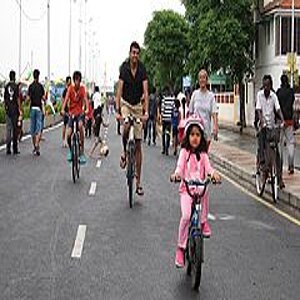
- In Pimpri Chinchwad, ITDP supported the city’s first Vehicle-Free Day, transforming 825 m of Pimpri Market, reducing pollution, increasing footfall. ITDP India also supported in conducting citizen engagement exercises that showed strong support for banning polluting vehicles.
- Nagpur Advances Safe Streets & School Zones: ITDP presented the Nagpur Urban Streets Analysis, prepared school zone designs, and launched the Urban Streets Assessment Report, identifying missing footpaths, unsafe crossings, and over-speeding. A capacity-building workshop brought city officials together, enabling adoption of a network-level Healthy Streets approach, innovative construction techniques, and dedicated budgets to sustain improvements.
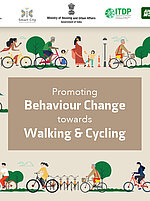
- In October 2024, ITDP India launched the publication Promoting Behaviour Change Towards Walking and Cycling, highlighting the need for infrastructure and behaviour change to go hand in hand. The report advocates for achievable walking and cycling habits alongside better footpaths, cycle lanes, and traffic calming measures. The publication also showcases the success of the Ministry of Housing and Urban Affairs (MoHUA’s) 2021 Freedom2WalkCycleRun campaign, which engaged citizens and officials across 30 cities, covering 30,000 km on foot, 80,000 km by cycle, and 17,000 km running in just two quarters.
- India’s public bus sector is rapidly transitioning to electrification, with 13,500 e-buses operational and 20,000+ under procurement as of March 2026. Recognising the opportunity for State Transport Undertakings (STUs), Special Purpose Vehicles (SPVs), and Urban Local Bodies (ULBs) to convert their emissions into revenue through carbon credits, ITDP developed India’s first Carbon Credits Guidebook to help public bus operators understand carbon financing. Launched by the Association of State Road Transport Undertakings (ASRTU) in Dehradun, in September 2024, the guidebook has become a key resource for transport officials nationwide, supporting the long-term sustainability of e-bus fleets.-- ITDP India, in partnership with ASRTU and Central Institute of Road Transport (CIRT), conducted a training workshop for STU officials, contributing to the training of 250+ officials across various states over the past year. The sessions focused on Electric Bus Service Planning and Branding, Marketing, and Communications to enhance the bus rider experience.
- In August 2024, ITDP collaborated with Pimpri Chinchwad Municipal Corporation (PCMC) to host a Parking Management Round Table Conference to enhance the city's parking system. The conference shared valuable strategies from cities like Mumbai, Chennai, Srinagar, and international examples, which will aid PCMC in formulating a comprehensive parking strategy and beginning implementation in key areas.
- ITDP supported the conceptualization of a city-wide behaviour change campaign 'Bus First' in Cennai. It was inaugurated by Tamil Nadu's Deputy Chief Minister in November 2025. The campaign aims to improve travel times, service reliability, and build public support for bus priority corridors. Additionally, the project supports a cohort of ten State Transport Undertakings to integrate communications and marketing into bus operations, improving passenger information and ridership confidence in the so-called National Bus Communications Initative.
- ITDP conducted a multi-city study called Cycling in Our Cities. The study assessed 152 km of cycle lanes and surveyed 605 cyclists and non-cyclists across Pune, Pimpri Chinchwad, and Nagpur examining barriers to everyday cycling. Findings highlighted obstructions like parked vehicles as the most common deterrent to bike lane use. Cyclists also mentioned traffic calming measures and continuous lanes as other important factors. Cycling in Our Cities emphasizes the need for stronger enforcement and maintenance of infrastructure and the importance of essential connected networks.
- The fist Pedestrian Priority Street was created in Chennai and inaugurated by Tamil Nadu's Chief Minister in February 2026.
- The project helped create Chennai's Comprehensive Mobility Plan (CMP) and Tamil Nadu’s Urban Mobility Priorities 2031. The former was developed over 30 months, the plan used data from 55,000 households across 5,904 sq. Km in 12 municipalities. The plan targets significant modal shift to public transport and active mobility by 2048. The latterdocument draws on insights from Tamil Nadu cities. ITDP helped shape the roadmap, which prioritises stronger public transport, clean mobility, safer walking infrastructure, and people-centred governance to guide statewide decisions through 2031.
Latest Update:
10/2026
Project relations
Legend:
The link has been copied to the clipboard
![[Translate to English:]](/legacy/_processed_/5/5/csm_Indien_EE_Solar_Frau_bfcf99c425.jpg)