
Brazil strengthens its ocean conservation efforts
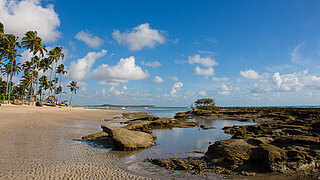
The International Climate Initiative supports the country in implementing its ocean-related climate goals – from the conservation and sustainable use of mangroves and coral reefs to the development of a climate adaptation plan for oceans and coastal zones.
The ocean absorbs 90% of the heat and 30% of the CO2 emissions produced by human activities. With over 8,500 km of coastline and a vast marine territory that corresponds to 67% of the country’s land area, Brazil shelters important coastal and marine ecosystems, including mangroves and the only coral reefs in the South Atlantic. As such, Brazil plays a central role in the global ocean agenda to ensure the protection of marine ecosystems and address climate change.
Ocean conservation included in Nationally Determined Contributions for the first time
For the first time, Brazil’s latest Nationally Determined Contributions (NDCs) acknowledge the vital role of the ocean in addressing climate change and include ocean-related climate commitments. As part of its NDC, Brazil has committed to developing Marine Spatial Planning (MSP), a Climate Adaptation Plan for the Ocean and Coastal Zone, a National Program for the Conservation and Sustainable Use of Mangroves (ProManguezal) and a National Strategy for the Conservation and Sustainable Use of Coral Reefs (ProCoral).
All of these initiatives are supported by the TerraMar II project of the International Climate Initiative (IKI), which is implemented by the Deutsche Gesellschaft für Internationale Zusammenarbeit (GIZ) GmbH.
Setting the course for sustainable marine use
Marine Spatial Planning is a public process of analysing and allocating human activities in marine areas to ensure that marine resources are used sustainably, balancing the needs of various sectors – from fisheries and tourism to renewable energy, shipping, and oil and gas exploration – in a way that respects the ecological limits of the ocean.
The IKI project is supporting this process by providing training to relevant stakeholders in Brazil. It also conducted a national MSP assessment in partnership with the UNESCO Intergovernmental Oceanographic Commission to inform national decision-making. In addition, it supported the Brazilian Ministry of Environment and Climate Change and the Interministerial Commission for Marine Resources to hold national workshops to develop objectives, principles and guidelines for MSP in Brazil, leading to its institutionalisation by federal decree.
Conservation and sustainable use of mangroves and coral reefs
Anchoring mangrove conservation in national policy
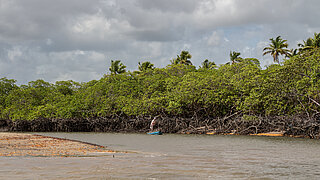
Brazil shelters the second largest area of mangroves in the world. Mangrove forests are vital carbon sinks that can sequester carbon at a rate up to ten times greater than tropical forests, and store up to five times more carbon per hectare than tropical forests. They also provide natural barriers against rising sea levels and storm surges.
TerraMar II actively supported the development of the National Program for the Conservation and Sustainable use of Mangroves (ProManguezal). In order to gather contributions and encourage participation, the project organised workshops in collaboration with the Ministry of Environment and Climate Change, bringing together over 120 representatives from the public sector, academia, civil society and traditional coastal communities.
Healthy coral reefs are beneficial for the climate and the local economy
Brazil is home to the only coral reefs of the South Atlantic. Coral reefs are important carbon sinks that are vital for supporting fisheries and coastal tourism, in addition to protecting coastlines from storm surges and erosion.
In 2024, Brazil faced the most severe coral bleaching event ever recorded due to rising water temperatures. In collaboration with the World Wildlife Fund (WWF) and the Boticario Group Foundation, TerraMar II supported the MMA and the Chico Mendes Institute for Biodiversity Conservation in conducting workshops to develop the National Strategy for the Conservation and Sustainable Use of Coral Reefs (ProCoral) and the National Action Plan (PAN Corais).
ProCoral was formally established by federal decree in June 2025 and presented at the UN Oceans Conference.
Climate Adaptation Plan for the Ocean and Coastal Zone
Climate change poses significant threats to coastal and marine ecosystems, including rising sea levels, ocean acidification and increased extreme weather events. To address these challenges, the IKI project supported the Ministry of Environment and Climate Change to develop the Climate Adaptation Plan for the Ocean and Coastal Zone.
In partnership with TerraMar II, Conservation International (CI), WWF and the Boticario Group Foundation, the Ministry organised workshops with key representatives from academia, government agencies and civil society organisations to collect expert contributions.
The Climate Adaptation Plan was open for public consultations in early 2025 and is expected to be approved by COP30.
The link has been copied to the clipboard
Contact
IKI Office
Zukunft – Umwelt – Gesellschaft (ZUG) gGmbH
Stresemannstraße 69-71
10963 Berlin