
Sino-German Climate Study Camps
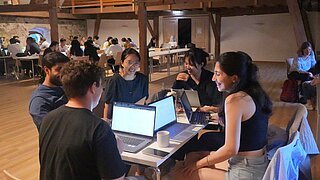
In our new series “Youth Empowerment and Action Highlight” – or IKI YEAH for short – we present successful initiatives from IKI projects that empower young people to engage in sustainable transformation. In this edition we take a look at a cross-border Climate Study Camp which was organised in partnership with universities.
From May 2024 to March 2026, the IKI project Sino-German Climate Cooperation implemented a series of youth engagement activities in China and Germany in cooperation with the Technical University of Munich and the Tsinghua University. It’s flagship format, the Sino-German Climate Study Camp, was held in Beijing (2024) and in Munich (2025).
Students participated in expert lectures, interactive workshops, climate simulations, field visits to renewable energy and climate adaptation sites, interdisciplinary group projects, and cultural exchange activities.

Mixed student teams developed joint policy briefs and presentations, supported by faculty members, international experts and staff from the Deutsche Gesellschaft für internationale Zusammenarbeit (GIZ). Living, learning and working together over two weeks created continuous opportunities for peer learning, intercultural dialogue and collaborative problem-solving beyond the classroom.
Results
The two Study Camps brought together over 80 master’s and doctoral students and around ten faculty members from the two universities.
Participants gained first-hand insights into climate policy, energy transition, sustainable technologies and governance in both countries while building lasting professional networks. The programme strengthened mutual understanding, improved participants' ability to communicate across disciplines and cultures, and generated joint policy recommendations on topics such as energy storage, climate adaptation, rooftop solar and sustainable healthcare. Several participants continued academic exchanges after the programme.
Lessons Learned
The strongest learning outcomes came from combining academic excellence with intensive peer-to-peer collaboration. The format encouraged trust, open discussion and creative problem-solving. Students consistently highlighted that informal exchanges were as valuable as formal lectures, providing perspectives and practical knowledge unavailable through textbooks alone.
Replication Potential
The youth engagement model developed through this project offers a replicable framework for fostering international climate collaboration among young people. Successful replication is already evident at some partner university. For example, in summer 2026, Tsinghua University organized a Climate Study Camp in collaboration with several European universities under the Global Alliance of Universities on Climate.
Key resources and conditions necessary for implementation of Study Camps include strong bilateral institutional partnerships with committed faculties, funding for the programme activities, international travel and logistics and a professional team to coordinate both sides for content design as well as logistics and participant management.
The link has been copied to the clipboard
Contact
IKI Office
Zukunft – Umwelt – Gesellschaft (ZUG) gGmbH
Stresemannstraße 69-71
10963 Berlin
[Translate to English:] Mehr Informationen zu den Studiencamps
[Translate to English:] Artikel über das Jahr 2024