

Double harvest
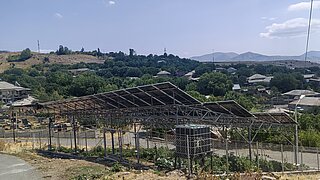
In an Armenian mountain village, solar panels combine clean energy with sustainable agriculture – showing how climate action and food security can be addressed together.
As dawn breaks over Gndevaz and the sun casts its golden rays across the rolling hills, Nunufar Frangulyan, a woman from the Armenian mountain village of Gndevaz, is harvesting the first crop of the plants she has carefully tended over the past few months.
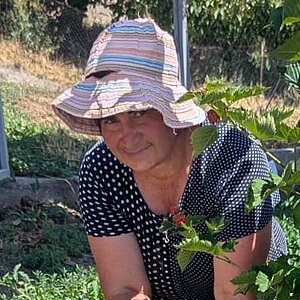
This first harvest is a lifeline that allows us to cover essential medical expenses, but more than that, it gives us hope.
Nunufar is collecting thornless blackberries flourishing beneath the protective shade of newly installed solar panels. The first harvest is more than an agricultural success: it demonstrates how locally adapted innovation can generate multiple benefits at once. By combining renewable energy generation with food production, the initiative helps strengthen local livelihoods while contributing to climate action.
This initiative is expected to prevent 13.4 tons of CO2 emissions each year - equivalent to a car journey that would take you round the world more than twice.
Nunufar and her husband Barsegh Harutyunyan are the heart of this transformative project in the serene highlands of Armenia. They manage the plot and put the innovative agrivoltaic approach in practice– farming beneath solar panels.
This approach was introduced by the non-profit foundation ‘Armenian Energy Agency’ (AEA) and supported by Germany’s International Climate Initiative (IKI) through the IKI Small Grants Programme.
Making scarce land work for climate action and local livelihoods
Armenia’s mountainous landscape presents a challenge: limited agricultural land and pressing need to reduce dependence on fossil fuels by developing renewable energy systems. This often leads to difficult choices over how land is used.
In response to this challenge, the project has implemented this approach as a way forward: solar panels and agriculture can share the same space - and create benefits for both climate action and local communities.
In 2024, the initiative installed a 25 kW solar power system connected to the electricity grid.
It generates approximately 40,000 kWh of clean energy each year—enough to power about 3,000 energy-efficient homes for a single day.
In addition, the facility illuminates a 1,250-metre-long community footpath, thereby also promoting tourism.
But that’s not all. The agrivoltaic approach also helps the blackberries thriving beneath the solar panels. Cultivating thornless blackberries was a joint decision between the Jermuk Municipality and the project’s agricultural expert. The plants thrive well under the panels, benefiting from reduced exposure to direct heat and minimized water loss through evaporation, thanks to a drip irrigation system installed to optimize water use in this water-scarce region.
Creating opportunities for women and persons with disabilities
For Nunufar and Barsegh the project is about far more than solar panels and blackberry cultivation. It represents an opportunity for income generation and a secure future.
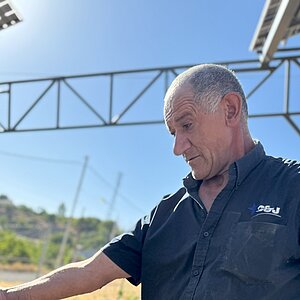
Working this plot allows us to earn our living with true dignity.
Barsegh, who has a disability, has been given the opportunity to farm the land through the project.
A cornerstone of the project is its commitment to social equity, particularly by creating opportunities for women and marginalized groups. In partnership with Jermuk Municipality, Nunufar’s family was selected to manage the agricultural plot. They received secure land-use rights and access to 100% of the harvest revenue for five years, providing critical stability and time to establish their operations and plan ahead.
The people who live with the challenges on the ground are also best placed to develop solutions that respond to local realities. They therefore have a strong interest in ensuring that the project’s results are sustained. The initiative’s long-term strength lies above all in the fact that the knowledge and responsibility remain with the local people.
Luiza Vardanyan, the General director of AEA, highlights the importance of local leadership that makes projects like this particularly effective: “This experience reinforces why community-led, inclusive projects like this are important for driving lasting change."
A local solution with wider potential
The positive impacts of the project extend beyond Nunufar’s and Barsegh’s individual stories. The project’s vision demonstrates a practical model for sustainable land use in Armenia and offers a scalable solution for other regions facing land scarcity.
It shows that climate action does not have to compete with other local priorities. On the contrary, many pertinent issues, such as renewable energy, food production, efficient water use, and economic opportunities, can be addressed together. With the right support, communities can turn local challenges into integrated solutions—thereby strengthening the foundations of their livelihoods while contributing to safeguard them.
In this way, the International Climate Initiative’s time-limited funding and technical support can bring about lasting change: not by creating a dependency on external actors, but by investing in the knowledge and capacities that enable communities to take ownership of solutions and carry them forward beyond the funding period.
As the sun sets over Gndevaz, the solar panels continue to produce clean energy while blackberry bushes thrive underneath. For Nunufar and Barsegh, the harvest represents more than a stable source of income. It is a beacon of hope and innovation, enabling communities to strengthen their livelihoods and take climate actions to protect the area they call home.
About IKI Small Grants
The project is funded by IKI Small Grants. This funding instrument is strengthening local solutions for effective climate and biodiversity action. It is part of the International Climate Initiative, commissioned by the Federal Ministry for the Environment, Climate Action, Nature Conservation and Nuclear Safety (BMUKN). IKI Small Grants fosters bottom-up solutions while strengthening capacities of local actors. It is run by Deutsche Gesellschaft für Internationale Zusammenarbeit (GIZ).
The link has been copied to the clipboard
Contact
IKI Office
Zukunft – Umwelt – Gesellschaft (ZUG) gGmbH
Stresemannstraße 69-71
10963 Berlin