

Driving Lesotho’s quiet green revolution
A pilot project demonstrates how electric mobility works in Lesotho, what challenges need to be overcome – and what this means for the country’s long-term transformation.
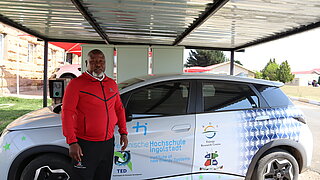
When T'sita Molapo turns the key in the MaZero electric vehicle each morning, there is no engine noise, just a quiet start to the day's drive. But the vehicle is doing more than getting him to work. As a Lecturer in the Department of Physics and Electronics at the National University of Lesotho (NUL), and the primary operator of what is currently only the third electric vehicle in Lesotho, Molapo is helping test what a transition to electric mobility could look like under real-world conditions.
What began as a routine assignment has become a practical demonstration of clean transport in Maseru, where conventional petrol and diesel engines remain the norm. At the same time, his everyday journeys are generating experience and data that can contribute to a much bigger transformation: the development of Lesotho's first national roadmap for electric mobility.
From a single vehicle to a national learning process
Lesotho faces a particular challenge when it comes to transport. The country relies heavily on imported fossil fuels, while its growing urban areas face increasing pressure from transport-related emissions. At the same time, Lesotho has significant potential for renewable energy, creating an opportunity to link cleaner mobility with locally generated solar power.
This is where Germany’s International Climate Initiative (IKI) comes in.
The IKI funded MaZero project introduced the electric vehicle to Maseru in July 2025. The aim is not simply to put an electric vehicle on the road. The pilot is designed to demonstrate how electric mobility can work in Lesotho, identify the challenges that need to be addressed and generate local knowledge that can support the country's longer-term transition.
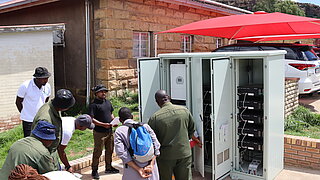
Rather than putting additional pressure on the local electricity grid, the project established two dedicated solar photovoltaic charging stations: a 11 kWp facility in Roma and a 16 kWp station in Maseru. Together, they demonstrate how electric mobility can be powered by renewable energy while providing the infrastructure needed to test the technology in everyday use.

Every journey teaches us more about what electric mobility needs in Lesotho. Our project is already showing that, with renewable energy, practical experience and local knowledge, we can help pave the way for cleaner mobility in the future.
Learning by driving
For Molapo, the transition to electric mobility has meant developing new routines. In a country without a widespread public charging network, every journey requires a little more planning.
Day-to-day charging is centred around the two solar charging stations. The car consumes around 16 kWh for every 100 km. When traveling further afield, Molapo plans his routes around the vehicle's battery range or makes arrangements in advance to plug in at his destination.
That conscious approach to energy management began on day one. When he collected the car at the South African border, the battery level was just 22 percent, with 72 kilometres of remaining range. His first journey therefore became an immediate real-world test of whether the vehicle could make it all the way to Roma.
One of his first experience was that driving for longer distances at speeds around 100 km/h on national highways like the N8 from Maseru to the BYD Service Centre in Bloemfontein, the range reduces quite substantially.
Hence, he got used to preserve the battery on such longer drives by maintaining the speed below 100 km/h. Apart from that, extreme weather proved to be one of the most important learning experiences: To preserve battery power on particularly cold or hot days, Molapo often opts for warmer clothes or opens the windows instead of running the air conditioning continuously.
Experiences like these may seem like small details of everyday driving. For a country at the beginning of its transition to electric mobility, however, they provide valuable insights into how electric vehicles perform under local climatic and infrastructure conditions.
Turning experience into evidence
This is where the impact of the MaZero pilot extends beyond the vehicle itself. Molapo travels around 80–90 km each day, and the car has now travelled around 16,500 km in total on the streets of Lesotho.
This equals around 2,82 t CO₂e savings since the start of the MaZero project – for a single car!
The data generated during Molapo's journeys feeds into research conducted by NUL. In this way, the project creates a link between demonstration, research and policymaking: technology is tested in everyday life, the experience generates data and knowledge, and those insights can contribute to national planning.
Input for the national e-mobility roadmap
The experience is particularly relevant as national ministries work on Lesotho's first official national e-mobility roadmap.
Recognizing this on-the-ground expertise, the MaZero project has been officially invited to contribute to the policy document. While an initial draft is expected by the end of October 2026 to kick off broader stakeholder engagement, the project has already laid vital groundwork: a series of MaZero stakeholder workshops has gathered valuable input from over 200 local participants, directly shaping the roadmap's development.
From pilot to scale
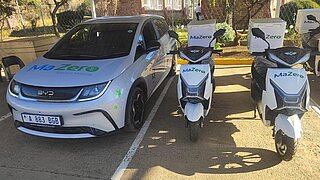
In the meantime, the project is already moving beyond a single vehicle. The arrival of six MaZero e-scooters in early 2026 is expanding the pilot's reach and creating additional opportunities to test electric mobility in different everyday applications. Simply registering the e-scooters in Lesotho has sparked a new regulatory process, presenting a steep learning curve for all involved.
The significance of these developments lies not in the number of electric vehicles currently on Lesotho's roads, but in what the pilot can enable next. Infrastructure, practical experience, research capacity and policy knowledge are all building blocks for a larger transition.
For Molapo, this transformation is visible in a very simple way: every morning, he gets into an electric vehicle and drives to work. For Lesotho, however, each journey represents something more – an awareness campaign and a chance to learn how clean mobility can work locally and what is needed to make it possible at a much larger scale. Molapo for example picks up colleagues along the route on rotational basis to gain first-hand experience and be exposed to the e-mobility concept.
Apart from that, over 1250 community members already had the chance to experience the e-vehicle first hand at national trade fairs.
The project’s experience shows that the transition to low-carbon transport does not have to begin with a nationwide fleet or a fully developed charging network. It can begin with a pilot, renewable-energy infrastructure and people willing to test a new technology under real-world conditions.
One vehicle is not a transport transition. But it can be the starting point for building the knowledge, evidence and policies needed to make one possible.
About the IKI Medium Grants
The MaZero project is funded by the IKI Medium Grants. With this funding instrument, the German federal government supports projects for climate action and biodiversity conservation that particularly involve smaller civil society actors in developing and emerging countries. The IKI Medium Grants are implemented by Zukunft – Umwelt – Gesellschaft (ZUG) gGmbH.
Together with the IKI Large Grants and IKI Small Grants, the IKI Medium Grants complete the competitive funding instrument form IKI Compete.
Click here for all IMG details
The MaZero project is coordinated by Technische Hochschule Ingolstadt together with the National University of Lesotho and the NGO Technologies for Development.
The link has been copied to the clipboard
Contact
IKI Office
Zukunft – Umwelt – Gesellschaft (ZUG) gGmbH
Stresemannstraße 69-71
10963 Berlin