
First Steps in Costa Rica to measure greenness of tax expenditure

The government of Costa Rica is working on the development of a methodology to classify tax expenditures according to their environmental impact.
Aligning fiscal policy with climate goals is a key challenge to achieve the goals set in the Paris Agreement. Between 2020 and 2021, the government of Costa Rican with support from the IKI project Green Economy Transformation (GET) has developed a methodology for classifying tax expenditure by its environmental impact. The methodology generates the necessary information for decision-making to align the country’s fiscal policy with its environmental goals.
The Climate Change Directorate within the Ministry of Environment and Energy underlines the importance of such a tool for the pursuit of the countries climate targets: For a country with clear targets to meet its commitments under the Paris Agreement, it is crucial to understand whether public finances promote a decarbonised economy and whether public finances are in line with environmental policies.
The new classification of tax expenditures provides a methodological basis for analysing both current tax expenditures and those that might be proposed in future draft legislation.
An analysis of the current tax expenditure has revealed that only 1.6% of the tax expenditure has a positive impact, 26.7% has no impact, and 71.6% has a negative impact on environmental goals.
The largest share of tax expenditure creating environmentally harmful incentives is accounted on tax exemptions for aviation and marine fuel, as well as exemptions and reduced tax rates for pesticides and machinery used in agriculture.
A working group of technical experts from the Ministries of Environment, Finance and Planning with the support of an international expert developed the new methodology. In a next step, it will be integrated into the Ministry of Finance’s institutional framework, delivering relevant information used for decision-making based on evidence and transparency.
In the process, a new understanding has been established between the fiscal and environmental authorities of the government of Costa Rican fostering inter-institutional cooperation.
For the Fiscal Policy Division of the Ministry of Finance, this is just a starting point: This work built a bridge between the Ministries of Finance and Environment. It is a milestone for the country in addressing how to comply with the National Decarbonisation Plan in a technical and dedicated way.”
The methodology enables the identification of tax expenditure line items based on the disaggregated analysis of the current framework, the application of internationally recognized standards, and their incidence on six strategic environmental public policy areas. For each expenditure line item, incidence factors are assigned per each public policy area, ultimately resulting in an overall incidence factor estimation that facilitates their qualification, i.e., positive, neutral, or negative.
Based on the analysis, the involved parties have outlined a roadmap for the implementation of the methodology. This roadmap includes setting up an inter-institutional working group to monitor and analyse new tax expenditure proposals and ensuring access to information for different public entities, as well as the private sector and the civil society actors.
This shall help a diverse set of actors to understand the scope of the data and utilize them for the country’s international environmental goals and national policies.
The implementation will make it easier to use the findings to support environmentally friendly tax expenditures and reduce expenditures that have a negative impact on the environment.
Additionally, the continuation of the methodology includes complementing the environmental impact analysis with a comprehensive economic and social assessment. The aim is to understand the impacts (intended and unintended) of the transitional measures and to develop the necessary compensatory measures if social well-being is affected.
The link has been copied to the clipboard
Contact
IKI Office
Zukunft – Umwelt – Gesellschaft (ZUG) gGmbH
Stresemannstraße 69-71
10963 Berlin
Further information
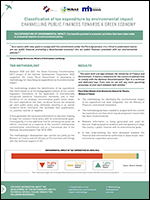
Classification of tax expenditure by environmental impact (Factsheet)