


Green skills, real impact: Zambia’s biogas entrepreneur[
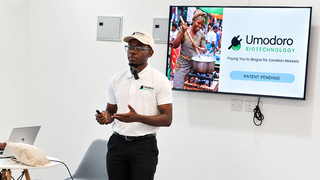
A young entrepreneur makes biogas from market waste. Discover how the IKI supports green skills and sustainable business.
Every morning, vendors in Zambia’s markets sweep vegetable peelings, spoiled tomatoes and leftover food into bins. For Mphatso Simbao, founder of Umodoro Biotech, this waste is not rubbish – it is a resource. His biogas units turn organic market waste into biogas for cooking fuel and nutrient-rich slurry that can be used as agricultural fertiliser.
But turning this idea into a viable business required more than technical expertise to bring a climate solution to life.
From experimentation to market-driven innovation
Mphatso grew up on a farm without waste collection, where burning waste was routine. “We always just burnt everything,” he recalls. Curious about better ways to manage waste, he began experimenting with fertilisers. His project earned him a place at the Google Science Fair in 2016, where a scholarship visit to Google’s headquarters introduced him to biofuel technology.
After returning home, he spent a whole year teaching himself how to build biodigesters before installing a working system at his parents’ home. Yet turning a technical achievement into a sustainable business remained a challenge.
As Zambia works towards its national climate targets, young innovators like Mphatso can help turn promising ideas into practical solutions. But technology alone is not enough.
Climate innovation also requires market knowledge, business development and an understanding of customers’ needs.
This is the focus of the Facility for Action for Climate Empowerment to Achieve Nationally Determined Contributions (FACE-NDC) Innovation Challenge, supported by Germany’s International Climate Initiative (IKI).
Selected as one of Zambia’s Top 12 finalists, Mphatso joined a five-week training programme to develop climate solutions that contribute to the country’s Nationally Determined Contributions.
Listening before building
Initially, Mphatso planned to convert plastic waste into crude oil. During the training, he realised that his concept did not address a sufficiently clear market need. He began speaking directly to potential customers instead.
“I interviewed around 30 businesses across seven major market zones,” he says.
The conversations revealed two interconnected challenges: growing volumes of food waste and a constant demand for affordable cooking fuel. Mphatso set aside his original concept and refocused Umodoro on biogas.
The experience taught him to validate ideas, engage users and design solutions around real needs – rather than build first and look for customers later.
A business model that creates local value

Umodoro’s model combines three key components: a 1,000-litre biodigester that converts food waste into gas, gas storage bags and smart meters that allow customers to pay only for the gas they use. This approach removes the need for vendors to cover the full cost of a system upfront. The process also produces a by-product that can be used as organic fertiliser.
To further reduce costs, Mphatso plans to manufacture storage bags locally. While imported bags cost around USD150 per 1,000 litres, local production is expected to reduce the cost to USD 40–50. This could accelerate the business’s path to financial viability while creating local green jobs.
Food vendors, many of them women, are among Umodoro’s main customers.
With this system, the food waste produced from the vending business is used to produce cooking fuel for the business.
The solution demonstrates how locally adapted climate innovation can reduce waste, provide an alternative cooking fuel and create economic opportunities.
From training to investment readiness
At Pitch Day in May 2026, Umodoro was one of three teams chosen for a further five-week programme of mentoring and prize funding through the FACE-NDC project.
Mphatso developed skills in customer acquisition, financing and growth planning. He learned how to secure licences for local council markets, measure impact through waste diverted and charcoal displaced, and ensure women vendors benefit. Mentors and fellow innovators also helped him improve products based on user feedback, communicate environmental benefits to funders and plan for responsible growth.
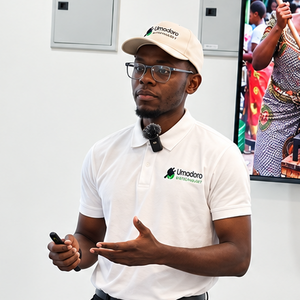
On 3 July 2026, he presented an investment-ready business plan at Demo Day, facilitated by Bongo Hive with support from the FACE-NDC project. The programme also connected him with potential investors and green-entrepreneurship organisations. He subsequently pitched to investors through the Zambia Business Angels Network and joined a three-year start-up incubation programme at the National Technology Business Centre.
Turning potential into impact
Today, Mphatso has two customers lined up and a new partnership to produce compressed biogas cylinders.
Over the next two years, he aims to operate systems in at least 15 local council markets, reducing waste while providing affordable cooking fuel.
His journey shows that climate innovation takes more than a promising technology. It requires the skills to understand markets, respond to users’ needs, build partnerships and develop a sustainable business model.
Through the FACE-NDC Innovation Challenge, supported by Germany’s International Climate Initiative, Mphatso gained the knowledge and entrepreneurial capabilities to move from experimentation to business development – demonstrating how green entrepreneurship can turn climate ideas into practical, economically viable solutions.
“If we can be fully sustainable and independent,” he says, “I feel like we can go far.”
The link has been copied to the clipboard
Contact
IKI Office
Zukunft – Umwelt – Gesellschaft (ZUG) gGmbH
Stresemannstraße 69-71
10963 Berlin
