
How climate risk insurance protects people and nature
An innovative insurance approach in the Philippines shows how people and nature can become more resilient to the impacts of climate change.
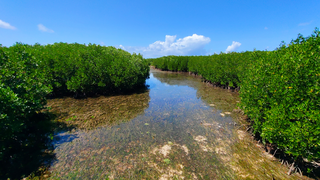
For the people of Saint Bernard and the islands of the protected Biri-LaRoSa Landscape and Seascape, typhoons are a part of everyday life. But in recent years, these storms have grown increasingly intense. When towering waves crash onto the coast, it is not only homes and livelihoods that are at risk. Mangrove forests, the first natural line of defence against storm surges, are often severely damaged as well.
Yet mangroves do far more than protect coastlines. They serve as vital nurseries for fish, store significant amounts of carbon, and provide livelihoods for many families. When they are destroyed, both people and nature bear the consequences.
This is precisely where Germany’s International Climate Initiative (IKI) comes in: Together with its partners, an IKI project demonstrates an innovative approach how financial protection mechanisms can complement ecosystem-based adaptation (EbA) and support the resilience of vulnerable coastal communities. In doing so, the protective value of coastal ecosystems such as mangrove forests is explicitly recognized.
Mangroves as protective shields – backed by insurance
A key initiative currently under development is a mangrove parametric insurance product to be piloted in Saint Bernard, Southern Leyte, and the Biri-LaRoSa Protected Landscape and Seascape in Northern Samar.
The product aims to provide insurance payouts to policyholders, such as local government units or local environment offices, when the mangrove ecosystem is severely damaged by a typhoon event. It uses climate-related parameters, such as wind speed and storm surge, to trigger predetermined insurance payouts once pre-agreed thresholds are met.
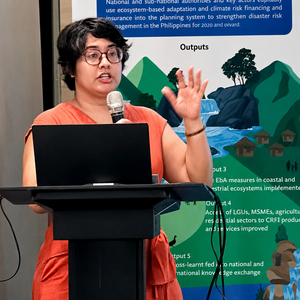
Rapid financing means rapid restoration. Faster ecosystem recovery strengthens long-term resilience for both people and nature.
What makes it special: The mangrove ecosystem is the asset covered by the insurance. The product is designed to provide rapid financing for ecosystem damage assessment, clean-up, and restoration following typhoons and associated storm surges, helping accelerate the recovery of mangrove ecosystems and the coastal protection services they provide.
Insurance payouts will augment the budgets of local government units or local environment offices for mangrove restoration and protection, including seedling production, replanting, and conservation enforcement. People living along the coasts can be trained to conduct damage assessments and hired for clean-up activities, providing cash-for-work opportunities after typhoons.
By enabling faster recovery of mangrove ecosystems, the approach seeks to strengthen the long-term resilience of both coastal communities and natural habitats.
The approval of the insurance product is on the horizon
The Philippine Crop Insurance Corporation (PCIC), a state-owned insurer, is jointly developing the product with Deutsche Gesellschaft für Internationale Zusammenarbeit (GIZ), which is implementing the IKI project. The product will be offered by PCIC in the two project sites in Northern Samar and Southern Leyte.
For the long-term sustainability of the product, local government units or local environment offices are expected to pay the insurance premiums, while the project supports PCIC by conducting feasibility studies, providing technical assistance in product development, conducting capacity-building activities, creating awareness, and exploring public funding pathways for insurance premiums.
Product development is ongoing, alongside awareness-raising and capacity-building activities for PCIC and local government units. The target timeline is PCIC product approval by the end of the year 2026, followed by a product simulation in the first quarter of 2027.
New framework conditions for climate risk management
Beyond product development, the project contributes to creating an enabling environment for innovative climate risk insurance in the Philippines. This includes support for product approval of climate risk insurance, integration of insurance considerations into development planning, and collaboration with public institutions, the insurance sector, and local stakeholders.
The mangrove insurance being developed is the first in the country, paving the way for insurance for nature as another product offered by both the state and private insurance providers in the future.
A model for climate-resilient coasts
As climate risks continue to intensify, the experience from the Philippines demonstrates how climate risk insurance can complement ecosystem-based adaptation and strengthen resilience in vulnerable coastal communities.
As work continues toward piloting and refining these solutions, the lessons generated can help inform similar approaches in other climate-vulnerable regions.
The link has been copied to the clipboard
Contact
IKI Office
Zukunft – Umwelt – Gesellschaft (ZUG) gGmbH
Stresemannstraße 69-71
10963 Berlin
Further information
The IKI project is recognised as an Impact Story in the Global Shield Vision 2025 Final Report.