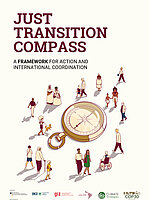


Just Transition Compass: A Framework for Action and Coordination

The Just Transition (JT) Compass aims to navigate our approach to equitable climate transition strategies by mapping the current JT landscape and exploring implementation pathways.
How can we turn high-level climate commitments into justice-focused, scalable strategies for implementation? Guiding international actors in aligning policy, finance, and practice, the Just Transition Compass, which was just launched at the UN Climate Change Conference in Belém, accelerates the translation of Just Transition principles into practical implementation across diverse contexts.
The Compass summarizes lessons from comprehensive stakeholder engagement conducted with policymakers, UNFCCC negotiators, community representatives, and civil society throughout 2025. It addresses stakeholders’ questions and offers actionable insights to foster Just Transition implementation nationally and internationally.
The Just Transition Compass responds to the lack of a coherent vision on how international actors can support Just Transition implementation, and address stakeholders’ priorities, needs and questions while offering actionable insights.
The Just Transition Concept
As the world races to respond to the accelerating climate crisis, the question is no longer whether we transition to cleaner economies, but how we do so fairly. The shift toward low-carbon development carries immense social and economic challenges as well as opportunities. Ensuring that no one is left behind requires a “just transition”.
The concept has become a cornerstone of global climate policy, emphasizing that the path to a sustainable future must also be equitable. As economies phase out fossil fuels and industries adapt, the fair distribution of both benefits and burdens is crucial. Without deliberate attention to fairness, transitions risk deepening inequality. Since its recognition in the Paris Agreement’s preamble (2015) and through initiatives such as the Just Transition Work Programme (JTWP) under the United Nations Framework Convention on Climate Change (UNFCCC), the idea of a Just Transition has evolved from an abstract principle into a guiding framework for climate action.
Yet translating these commitments into practice remains complex. Many discussions stay confined to high-level negotiations, often disconnected from national contexts and local priorities. Effective implementation requires more than commitments on paper: it calls for shared understanding, practical guidance, and coordination across diverse contexts.
How the Just Transition Compass was Developed
To address this lack of support for implementation, the Just Transitions in Motion Project conducted a series of global workshops. Between May and September 2025, the workshop series brought together more than 200 participants in Panama, Bonn, Addis Ababa, and Brasília.
The events served as inclusive spaces for policymakers, grassroots movements, and experts to share experiences, explore broad international and cross-sectoral consensus on common elements of a Just Transition, identify main barriers to Just Transition implementation, and draw conclusions on how international actors can help advance Just Transition implementation, both nationally and as part of a global effort.


The Organisations Behind the Compass
The Just Transition Compass presents the results of the Just Transitions in Motion Project - a partnership between Climate Strategies and LACLIMA, in cooperation with the COP30 Presidency and in collaboration with the Brazilian Ministry of the Environment and Climate Change (MMA).
It is funded by the International Climate Initiative (IKI) and implemented by Deutsche Gesellschaft für Internationale Zusammenarbeit (GIZ) GmbH through the Climate Diplomacy Action Programme (CDAP), on behalf of the German Federal Ministry for the Environment, Climate Action, Nature Conservation, and Nuclear Safety (BMUKN).
The link has been copied to the clipboard
Contact
IKI Office
Zukunft – Umwelt – Gesellschaft (ZUG) gGmbH
Stresemannstraße 69-71
10963 Berlin