
The energy transition starts in the kitchen
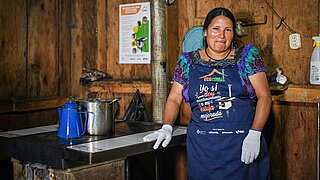
Less smoke, less firewood, a better quality of life: Doña Flory López from Guatemala can now cook more healthily and sustainably thanks to an improved cookstove.
Every day, Doña Flory López prepares breakfast, lunch and dinner for fifteen people in her home in San Mateo, Guatemala. Until recently, that meant constantly feeding a wood-burning cookstove that filled her kitchen with smoke. Today, she still prepares the same tortillas and meals – but uses less than half the firewood she needed before.
Less smoke, less firewood
Like millions of households in Guatemala, Doña Flory has long relied on firewood for cooking. Her previous cookstove had no effective way to vent the smoke. For ten years, it accumulated in her kitchen, blackening the stove and exposing her family to harmful air pollution.
Five months ago, Doña Flory replaced her old stove with an improved cookstove supported through the programme “Efficient Use of Firewood and Alternative Fuels in Rural and Indigenous Communities in Guatemala” (Guatemale – Cookstoves).
The programme promotes more efficient, low-carbon cooking solutions while working with local manufacturers to ensure that families can purchase, maintain and repair the technologies locally.
For Doña Flory, the difference is tangible. She estimates that she previously used around one tarea, approximately one cubic metre, of firewood each month. Today, she uses less than half that amount. A chimney directs smoke outside instead of allowing it to accumulate in her kitchen.
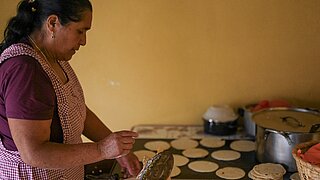
Improved cookstoves are especially important for the health of our children and for us women, since we’re the ones who spend the most time at home cooking.
The programme works with 15 improved cookstove (ICS) manufacturers that offer a range of tested models to households. All stoves include a plancha, which families use to cook tortillas and other foods, as well as a chimney that vents smoke outside the kitchen. They also feature an efficient combustion chamber designed to reduce firewood consumption.
From one kitchen to measurable climate impact
Doña Flory’s experience reflects a change taking place in thousands of households. By July 2026, more than 26,688 people had directly benefited from cleaner cooking conditions through the programme.
It reports cumulative greenhouse gas emission reductions of more than 134,000 tCO₂ e, primarily through reduced firewood consumption.
The programme is designed not only to distribute technologies, but to establish a functioning market for cleaner cooking. Local manufacturers receive support to improve the quality, production, sale and maintenance of improved cookstoves.
Families such as Doña Flory’s make their own purchasing decisions, while trained women in Indigenous communities are increasingly providing maintenance and repair services locally. In three Maya K’iche’ communities, 63 women have been trained to maintain and repair improved cookstoves and are now supporting 200 stoves in their communities.
This local expertise helps ensure that the benefits continue after installation.
Testing the next step: electric cooking
Improved cookstoves are already reducing firewood consumption and smoke at scale. At the same time, the programme is supporting 1,250 families in adopting electric cooking technologies.
Participating households can receive a USD 50 voucher towards the purchase of induction cooktops, alongside training and advice. Microfinance is also available for induction cooktops, electric pressure cookers and electric planchas, while household electrical installations are improved where necessary to enable their safe use.
Early monitoring indicates that electric cooking is already changing how some households use traditional cooking fuels. Among 65 households monitored between May and July 2026, 62 reported that they no longer used firewood for daily meal preparation, although some continued to use it for specific dishes or larger quantities. Households also reported that LPG cylinders lasted 15 to 30 days longer after adopting electric cooking technologies.
These initial findings show how financing, training and technical support can help households shift part of their cooking towards electricity. The pilot is generating valuable experience on how electric cooking can complement improved cookstoves as part of a broader transition towards cleaner, lower-carbon cooking.
For Doña Flory, the transition has already begun with a practical change in her own kitchen. She still cooks the food that has long brought her family together, but with much less firewood and without a room full of smoke. Experiences like hers – combined with the programme’s emerging evidence on electric cooking – show how families across Guatemala can cook with less pollution, lower emissions and greater comfort.
Background to the project work
57% of Guatemala’s total energy consumption comes from the use of fuelwood, mainly for cooking. About 2.1 million households, located mostly in the poorest and most vulnerable municipalities of the country, use firewood. 70% of Guatemalan households, mostly children and women, are at high risk of cardiac and respiratory diseases.
IKI support to the Mitigation Action Facility
The Guatemala – Cookstoves project is funded by the Mitigation Action Facility. The Mitigation Action Facility – a multi-donor programme – provides technical assistance and funding to help implement ambitious mitigation actions. It drives decarbonisation in the three priority sectors energy, transport, and industry. One of its key funding partners is the German Federal Government, which channels support via the International Climate Initiative (IKI).
Further projects in the energy sector
The link has been copied to the clipboard
Contact
IKI Office
Zukunft – Umwelt – Gesellschaft (ZUG) gGmbH
Stresemannstraße 69-71
10963 Berlin