

The International Climate Initiative at the Open Day
On the weekend of 20 and 21 June, the German government’s buildings in Berlin will be open to the public. The International Climate Initiative (IKI) will be there too!
Once again this year, the IKI will be present at the German Government’s Open Day. We look forward to welcoming you in person at our IKI stand at the Federal Ministry for the Environment, Climate Action, Nature Conservation and Nuclear Safety (BMUKN), or to chatting with members of the IKI Office at the ‘Foreign Climate Policy / Climate & Security’ stand at the Federal Foreign Office (AA).
Here you can find out more about four IKI projects that you may already have come across at our stand:
Climate Adaptation: Why the Quality of Seedlings Matters

Along Vietnam’s coastline, coastal forests play a vital role in protecting rural communities and smallholder farmers from extreme weather events. An IKI project demonstrates how coastal forests can be restored using native tree species.
One of the key lessons from the IKI project is clear: the quality of seedlings matters. In 2020, the project supported the establishment of a “best-practice nursery”. The nursery specialises in cultivating native tree species and producing seedlings with strong, robust root systems that are well adapted to extreme climatic conditions. Since autumn 2023, more than 130,000 climate-resilient seedlings from the nursery have already been planted.
The next phase will include developing a sustainable business strategy for the nursery and establishing a seed bank. In addition, the nursery will offer training courses to share best-practice methods with partners and local communities, as well as provide advice on setting up and operating their own nurseries.
Conclusion: Even seemingly small factors — such as the quality of seedlings — can make an important contribution to adapting to the impacts of climate change.
Innovative Financing for Deforestation-Free Supply Chains in Africa
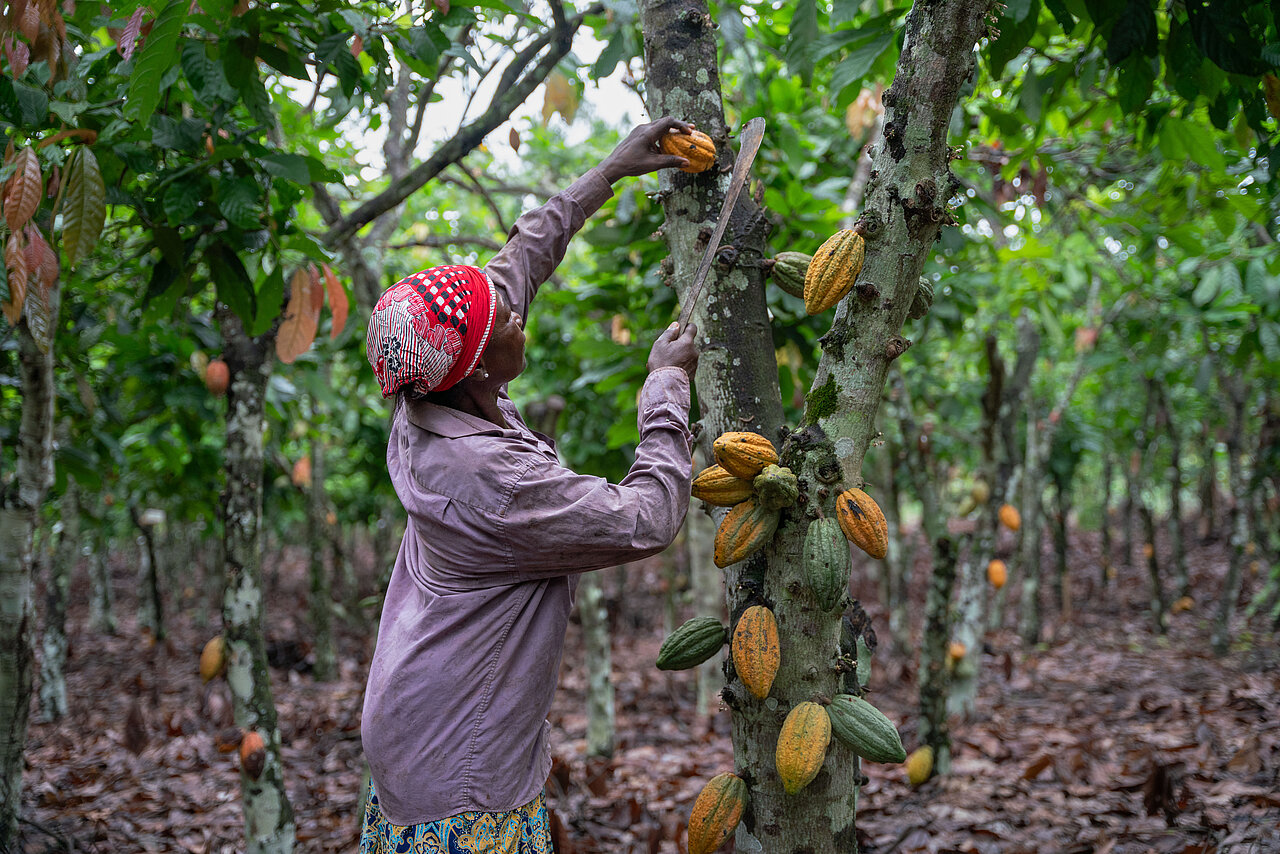
Deforestation-free supply chains are becoming a reality in Africa’s cocoa and coffee sectors through financing that links investment to sustainability results. Supported by Germany’s IKI, the Rebuild Facility has supported over 83,250 farmers, improved more than 143,371 hectares of land and unlocked €36 million for sustainable businesses across five countries since 2020.
By tying finance to clear conditions – such as deforestation-free sourcing and livelihood benefits – the approach enables local businesses to grow while maintaining sustainable land use practices, including protecting forests. Businesses receive working capital to buy crops and repay only after sales, reducing pressure to expand into forest areas. Moreover, Rebuild provides support to help local businesses improve their governance systems, map their supply chains and meet global standards.
This model shows that when finance rewards sustainability and reflects local realities, it can transform supply chains – protecting forests while improving livelihoods at scale.
Save the Blue Five: Working Together to Protect the Pacific

The South-East Pacific is home to some of the world’s most important marine ecosystems and migratory routes for the “Blue Five”: whales, sharks, sea turtles, dolphins and manta rays. Protecting their habitats requires action that goes beyond national borders and single protected areas.
With this goal in mind, the South-East Pacific Marine and Coastal Protected Areas Network (RAMPAS) was established with support from the IKI. The network strengthens ecological connectivity and joint management across more than 100 marine protected areas in Chile, Colombia, Costa Rica, Ecuador, Panama and Peru. RAMPAS is currently advancing the implementation of its 2025–2035 strategic plan. This includes strengthening regional expertise in marine conservation and promoting new approaches to the long-term financing of marine protected areas.
The initiative demonstrates how cross-border cooperation can reinforce the protection of marine biodiversity — while laying an important foundation for more resilient and sustainable marine ecosystems in the South-East Pacific.
Cooling That Works: Climate-Friendly Solutions Proven in Practice

Extreme heat, rapid urban growth and rising energy demand are placing increasing pressure on the cooling sector in the Middle East and North Africa. In Jordan, the IKI is demonstrating that climate-friendly alternatives work — and are ready for the market.
At the Jordanian Customs Authority in Amman, the country’s first walk-in CO₂ cold rooms have been installed. The system reliably supplies cooling across different temperature zones and maintains stable efficiency despite high outdoor temperatures. The natural refrigerant CO₂ replaces climate-damaging solutions and is expected to save around 85 tonnes of CO₂ equivalent over the system’s lifetime. At the same time, the installation improves food safety and provides reliable operational data for banks, logistics companies and retailers.
A second demonstration project at the Aqaba Marine Reserve uses a propane-based air-conditioning system that operates efficiently even at temperatures above 46°C. Replacing an outdated unit reduces direct emissions by up to 22 tonnes of CO₂ equivalent over the system’s lifetime while also serving as a training and demonstration site for technical professionals.
The pilot installations are also influencing policy and markets: insights gained from the projects informed Jordan’s first National Cooling Action Plan, developed in cooperation with the IKI project. In this way, IKI combines technical demonstration, capacity building and policy development — laying the foundation for a scalable transition towards climate-friendly cooling.
(Kopie 84)
The link has been copied to the clipboard
Contact
IKI Office
Zukunft – Umwelt – Gesellschaft (ZUG) gGmbH
Stresemannstraße 69-71
10963 Berlin
